
CUET Economics Syllabus Explained: Micro & Macro Made Easy
A complete, easy-to-understand guide to the CUET Economics syllabus, covering all Microeconomics and Macroeconomics topics as per NCERT Class 12. Learn key concepts, important chapters, and smart preparation tips to score high in the CUET Economics domain.
CUET
12/15/20253 min read
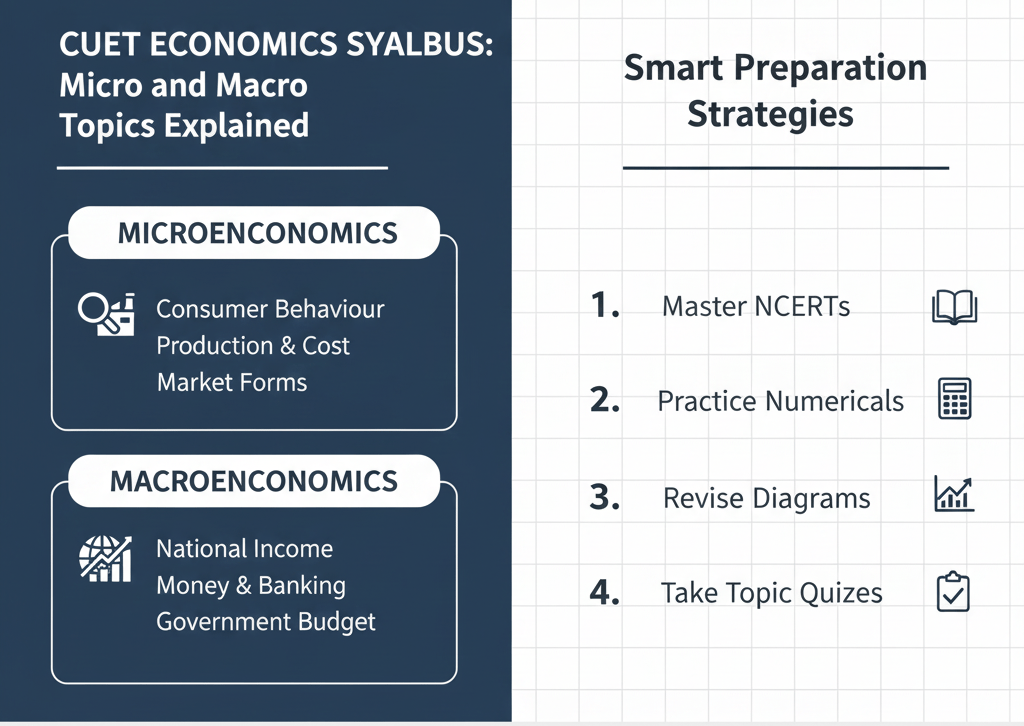
CUET Economics Syllabus: Micro and Macro Topics Explained
Economics is one of the most scoring and concept-oriented domains in the CUET exam. Whether you are from Humanities, Commerce, or Science, understanding the CUET Economics syllabus helps you build strong fundamentals and score high in Section II. The subject is divided into two major branches – Microeconomics and Macroeconomics. Each branch studies the economy at different levels but together forms a complete picture of how markets and economies function.
This blog breaks down all the key topics from both branches in a simple, exam-friendly way to help CUET aspirants prepare smartly and confidently.
Understanding the CUET Economics Domain
The CUET Economics syllabus is based on the NCERT Class 12 curriculum. The exam tests your clarity of concepts, analytical thinking, and ability to apply theories to real-world situations. Questions are usually straightforward, focusing on definitions, diagrams, formula-based numericals, and conceptual understanding.
To prepare effectively, you must understand which topics fall under Microeconomics and which belong to Macroeconomics.
Microeconomics: Understanding Individual Units
Microeconomics studies how individual consumers, firms, and markets operate. It focuses on decision-making at a smaller level and examines how prices are determined in specific markets.
Below are the major CUET Microeconomics topics:
1. Introduction to Microeconomics
This unit helps you understand the basics of economic problems, scarcity, opportunity cost, and the central problems of an economy. Students learn how resources are limited and how choices must be made efficiently.
2. Consumer Behaviour and Demand
This is one of the most important chapters for CUET. You will study how consumers make choices, how demand is formed, and what factors influence buying decisions. Key subtopics include:
Utility concepts: Total Utility, Marginal Utility
Law of Diminishing Marginal Utility
Law of Demand
Demand Schedule and Demand Curve
Price, Income, and Cross Elasticity of Demand
Elasticity-based questions are very common in CUET, so practice numerical problems thoroughly.
3. Production and Cost
This unit explains how firms convert inputs into outputs and how costs are calculated. Important areas include:
Short-run and long-run production
Law of Variable Proportions
Returns to Scale
Total, Average, and Marginal Cost
Cost curves and their shapes
Understanding diagrams is essential as questions often test the logic behind cost and production relationships.
4. Forms of Market and Price Determination
This topic is crucial for conceptual questions. It explains how prices are set in different types of markets:
Perfect Competition
Monopoly
Monopolistic Competition
Oligopoly
Students must also understand equilibrium price, the effect of shifts in demand and supply, and the role of government interventions like taxes or subsidies.
Macroeconomics: Understanding the Economy as a Whole
Macroeconomics studies the overall functioning of an economy. Instead of individual units, it looks at national income, inflation, government policies, and global economic indicators.
Here are the major CUET Macroeconomics topics:
1. Introduction to Macroeconomics
This unit sets the foundation for understanding large-scale economic indicators. It includes:
Difference between micro and macro
Circular flow of income
Types of economic agents
It’s important to understand how households, firms, government, and foreign sectors interact.
2. National Income Accounting
One of the most scoring yet challenging units, it deals with measuring the economic performance of a country. Key subtopics include:
GDP, GNP, NDP, NNP
Factor cost vs. market price
Real vs. nominal GDP
Methods of calculating national income:
Income method
Expenditure method
Product method
Practicing numerical questions is essential to score full marks in this section.
3. Money and Banking
This is an easy and highly scoring unit. Students learn about:
Functions of money
Demand for money
Role of commercial banks
RBI’s tools of credit control: CRR, SLR, Repo Rate, Reverse Repo Rate
Understanding how banks create credit helps in interpreting real-world financial news as well.
4. Government Budget and the Economy
This unit explains how the government manages finances. Important concepts include:
Revenue and capital receipts
Revenue and capital expenditures
Fiscal deficit, primary deficit, revenue deficit
Budget objectives and economic stability
Many CUET questions test conceptual definitions and basic applications.
5. Balance of Payments
This topic deals with international trade and foreign exchange flows. Key areas include:
Current account and capital account
Foreign exchange rate systems
Causes of surplus or deficit in BOP
The BOP chapter also links with global economics, making it helpful for GK and current affairs.
How to Study Economics Effectively for CUET
Study NCERT Class 12 thoroughly—the CUET paper is directly based on it.
Make short notes of definitions and formulas.
Practice all numerical questions from national income, elasticity, and costs.
Revise diagrams regularly since many questions depend on graphical understanding.
Take topic-wise quizzes to strengthen accuracy.
Final Thoughts
The CUET Economics syllabus is rich, balanced, and extremely scoring when prepared strategically. Understanding both micro and macro topics gives you a complete view of how markets operate and how the entire economy moves. With consistent practice and concept clarity, you can easily achieve a high score in the CUET Economics domain.
If you want, I can now convert this into a perfectly formatted Word file (.docx) with exact fonts, sizes, and alignment so you can download it without losing formatting.
🌐 Visit: www.resultprep.com
📞 Call: 8970007497
Prepare for the best results!
Achieve your goals with expert coaching and support from ResultPrep.
Contact us:
© 2025. All rights reserved.
Address:
GSS Complex, 2nd Floor,
16th Cross Rd, HMT Layout, Vidyaranyapura, Bengaluru, Karnataka- 560097