
Market Structures Explained: Pricing in Perfect Competition, Monopoly & Oligopoly
A clear and exam-focused guide to market structures in economics, explaining perfect competition, monopoly, monopolistic competition, and oligopoly. Learn how pricing works in different markets with simple explanations—ideal for CUET, CLAT, CA Foundation, and Class 12 Economics preparation.
CA FOUNDATION
12/15/20253 min read
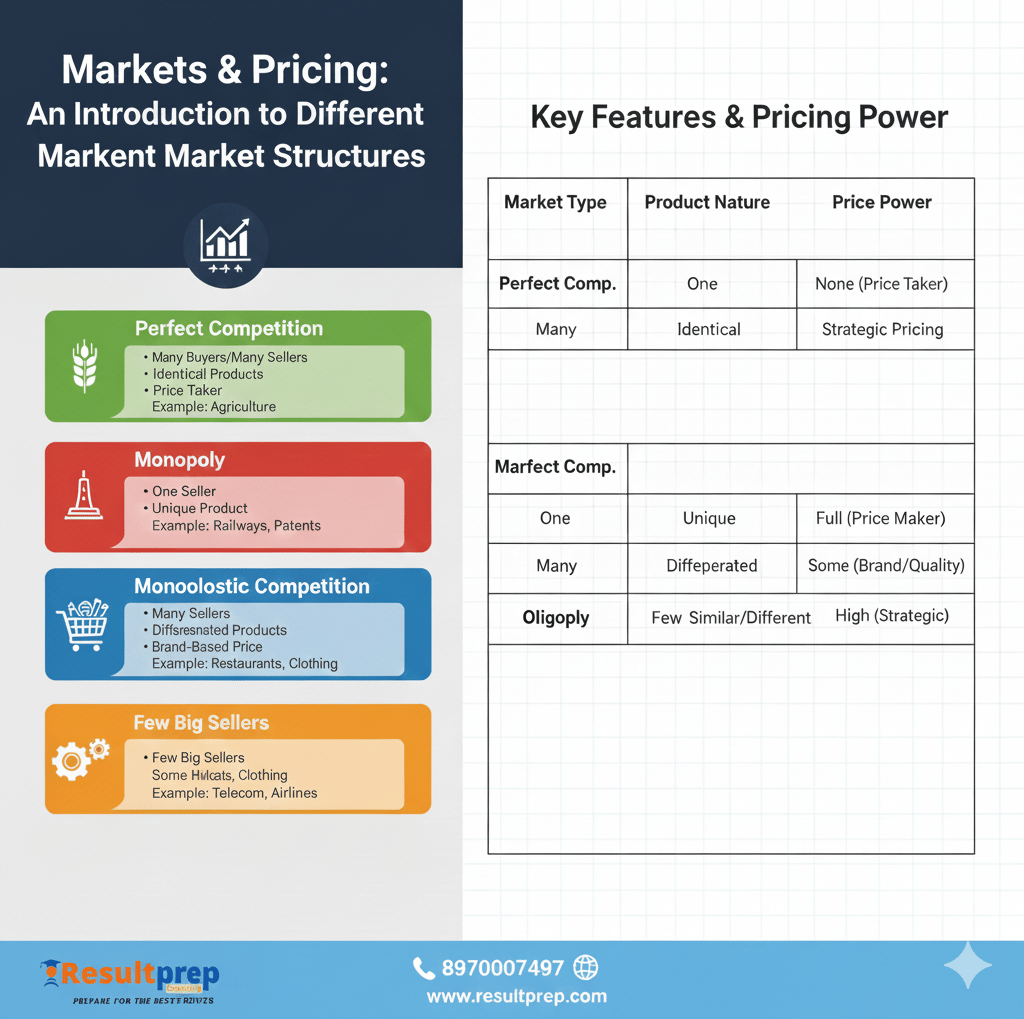
Markets and Pricing – An Introduction to Different Market Structures
Markets form the backbone of any economy. Whether you buy groceries, pay for a cab, or subscribe to an online service, you are participating in a market. To understand how prices are set, how firms compete, and why some products are cheaper or more expensive than others, it is essential to study market structures. These structures explain how buyers and sellers behave, how much control firms have over prices, and how efficient a market is. For students preparing for CUET, CLAT, CA Foundation, and Class 12 board exams, understanding market structures is an important part of Microeconomics.
This blog provides a simple and clear introduction to the major types of market structures and how pricing works in each of them.
What Are Market Structures?
A market structure refers to the characteristics of a market, including the number of sellers, the nature of the product, entry and exit conditions, and the level of competition. Different structures create different pricing outcomes. Some markets allow firms to freely set prices, while others force firms to accept the market price.
The main market structures include:
Perfect Competition
Monopoly
Monopolistic Competition
Oligopoly
Let’s explore each one in detail.
Perfect Competition: Many Buyers, Many Sellers
Perfect competition is the most ideal and efficient form of a market. Although it rarely exists in real life, it helps economists understand how prices should behave in a highly competitive environment.
Key features:
A very large number of buyers and sellers
Identical or homogeneous products
Free entry and exit of firms
No single firm can influence the price
Buyers have complete information about the market
Since no firm has control over pricing, the market determines the price, and firms simply accept it. Producers earn normal profits in the long run because new firms enter easily if profits increase, bringing the price back to equilibrium.
Examples: agricultural products like wheat, rice, sugarcane.
Pricing in perfect competition:
Price is decided by the forces of demand and supply. Firms simply produce the quantity where their cost equals the market price.
Monopoly: One Seller, High Market Power
A monopoly refers to a market with a single seller who controls the entire supply of a product or service. Because there are no close substitutes and entry is difficult, the monopolist acts as a price maker.
Key features:
Only one firm controls the market
Unique product with no close substitutes
High entry barriers such as government licences or heavy costs
Firm has full price-setting power
Examples include: Indian Railways, electricity distribution companies, patent-based medicines.
Pricing in a monopoly:
The monopolist sets prices based on demand. If demand is high, prices can be raised; if demand falls, prices may be reduced. However, the monopolist must consider that extremely high prices may lower demand too much.
Monopolies often lead to higher prices and lower output compared to competitive markets.
Monopolistic Competition: Many Sellers, Differentiated Products
This is the most realistic form of market and exists everywhere around us. Monopolistic competition features many sellers offering products that are similar but not identical. Because of product differences, each firm gets some control over pricing.
Key features:
Many firms selling differentiated products
Consumers choose based on style, branding, features, advertisements
Free entry and exit of firms
Some control over price
Examples: clothing brands, restaurants, toothpaste, cosmetics, mobile companies.
Pricing in monopolistic competition:
Since each product is slightly different, firms decide their own prices based on:
quality
packaging
branding
customer loyalty
In the long run, firms earn normal profit because new competitors enter if existing firms earn too much.
Oligopoly: Few Sellers, Strong Influence
An oligopoly is a market where a small number of firms dominate. Each firm is large enough to affect market prices, and competition becomes strategic. Firms often watch each other closely before making decisions on pricing or advertising.
Key features:
Few big firms control most of the market
High competition and interdependence
Products may be similar or different
Barriers to entry exist
Price rigidity is common
Examples: telecom companies, airlines, cement industry, chocolates, and automobiles.
Pricing in oligopoly:
Firms may avoid frequent price changes to prevent losing customers. Sometimes firms form agreements (called cartels), though these are illegal in many countries.
The famous kinked demand curve explains why prices often remain stable even when costs change.
Why Understanding Market Structures Matters for Students
For exams like CUET or CLAT, questions often test conceptual clarity. Knowing how each market structure functions helps in:
understanding pricing decisions
analyzing consumer and producer behavior
interpreting real-world business strategies
answering application-based MCQs
Students also learn why some goods are cheap while others remain premium, and why competition affects prices.
Conclusion
Market structures influence everything we buy, from mobile phones to groceries. Perfect competition shows how markets would work in an ideal world; monopoly and oligopoly reveal how power affects pricing; and monopolistic competition displays the importance of branding and variety. For students preparing for competitive exams, understanding these market structures builds strong economic reasoning.
If you want this blog in a Word file with fixed Times New Roman formatting, I can generate it next—just say “Yes, create the Word file”.
Prepare for the best results!
Achieve your goals with expert coaching and support from ResultPrep.
Contact us:
© 2025. All rights reserved.
Address:
GSS Complex, 2nd Floor,
16th Cross Rd, HMT Layout, Vidyaranyapura, Bengaluru, Karnataka- 560097