
Master the Sale of Goods Act, 1930 – Key Provisions & Cases
Learn the essentials of the Sale of Goods Act, 1930 with ResultPrep! 🚀 From definitions to key sections, landmark case studies, and practical tips, this guide simplifies commercial law for CLAT, CA, and law exams.
CA FOUNDATION
9/29/20253 min read
LAW: THE SALE OF GOODS ACT, 1930 – KEY PROVISIONS AND CASE STUDIES
Introduction
The Sale of Goods Act, 1930 is a foundational law governing the sale and purchase of goods in India. For law students, CA aspirants, and competitive exams like CLAT, understanding its key provisions, definitions, and landmark case studies is essential. This Act establishes the rights and duties of buyers and sellers, ensuring fairness in commercial transactions.
Definition and Scope
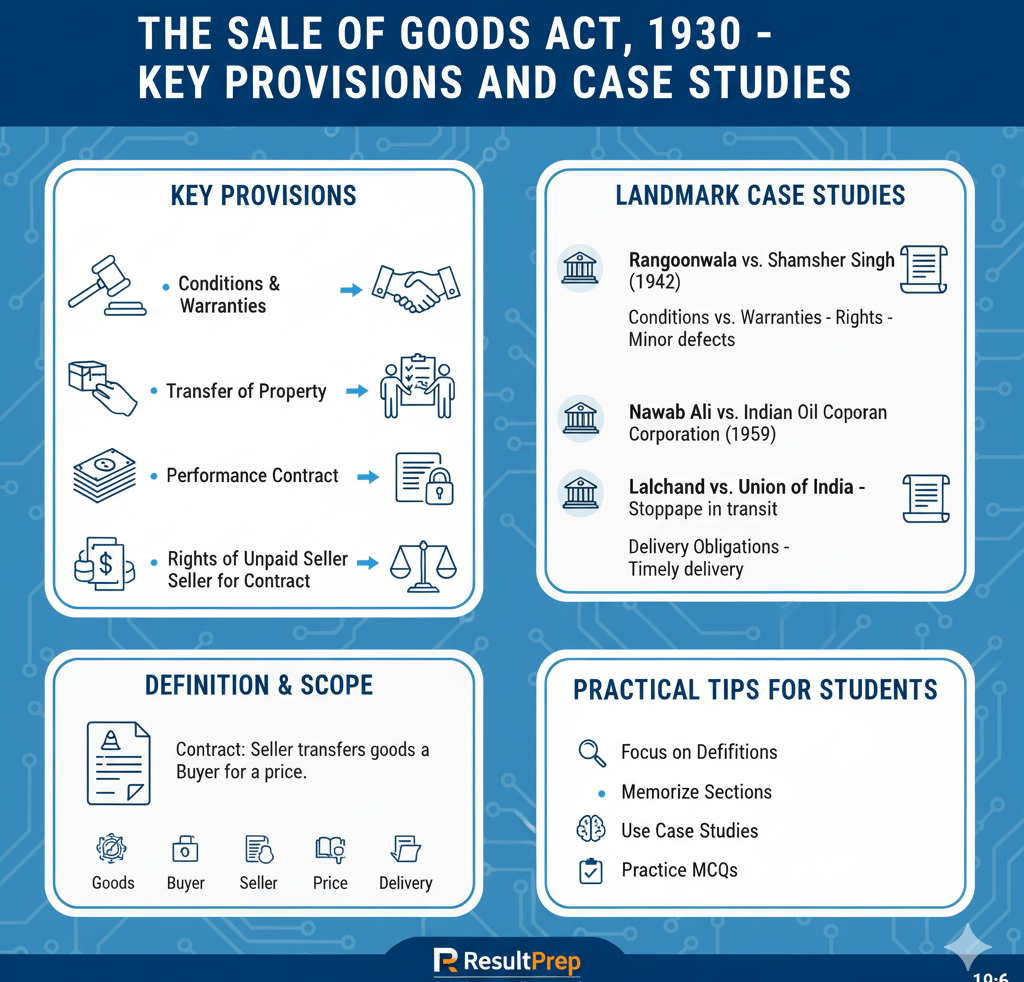
The Act defines a sale of goods as a contract where the seller transfers or agrees to transfer the property in goods to the buyer for a price. The law applies to all types of goods, whether tangible or intangible, movable or immovable, unless otherwise excluded. Understanding the definitions of goods, buyer, seller, price, and delivery is crucial.
Key Provisions
1. Conditions and Warranties
The Act distinguishes between conditions (essential terms) and warranties (non-essential terms). Breach of conditions allows the buyer to reject goods, whereas breach of warranties permits claiming damages. For example, Section 12 defines conditions as implied by law, such as the right to sell and goods being free from encumbrances.
2. Transfer of Property
Sections 18–25 cover the transfer of ownership. Property in goods passes to the buyer according to the terms of the contract and delivery. The rules regarding unascertained goods, future goods, and goods sent on approval help determine when ownership and risk transfer.
3. Performance of Contract
Sections 31–34 outline the duties of the seller and buyer. The seller must deliver goods as per contract terms, while the buyer must pay the price and accept delivery. Partial delivery, wrong delivery, or delayed payment are considered breaches under these sections.
4. Rights of Unpaid Seller
Sections 45–54 define an unpaid seller’s rights, including the right to lien, stoppage in transit, and resale of goods. These provisions protect sellers in case of buyer default and ensure commercial security.
5. Remedies for Breach of Contract
The Act provides remedies for both parties in case of breach. Buyers may reject goods or claim damages, while sellers can sue for price, damages, or specific performance. Understanding the legal recourse is vital for exams and practical applications.
Landmark Case Studies
1. Rangoonwala vs. Shamsher Singh (1942)
This case clarified the distinction between conditions and warranties. The court ruled that minor defects in goods did not justify rejecting the contract, emphasizing the legal difference between essential and non-essential terms.
2. Nawab Ali vs. Indian Oil Corporation (1959)
This case highlighted the rights of the unpaid seller. The seller exercised the right to stop goods in transit due to non-payment, affirming Section 50 of the Act.
3. Lalchand vs. Union of India (1965)
This case dealt with delivery obligations. The court held that timely delivery is a critical aspect of performance and delay could amount to a breach, reinforcing the buyer’s right to claim damages.
Practical Tips for Students
Focus on Definitions: Clear understanding of key terms like conditions, warranties, and property is crucial.
Memorize Sections: Important sections (12, 18–25, 31–34, 45–54) often appear in CLAT and law exams.
Use Case Studies: Relating sections to landmark judgments improves retention and application skills.
Practice MCQs: Solving previous years’ multiple-choice questions helps in quick recall.
Create Charts: Visual charts summarizing sections, rights, and remedies aid faster revision.
Conclusion
The Sale of Goods Act, 1930 forms the backbone of commercial law and plays a critical role in legal education and competitive exams. Understanding its provisions, rights, duties, and remedies equips students to handle real-life commercial disputes and excel in CLAT, law school exams, or CA law sections.
At ResultPrep Coaching, we provide students with detailed explanations, case analyses, and practical exercises on the Sale of Goods Act, 1930, ensuring conceptual clarity and exam readiness. Consistent practice and application-based learning help students achieve top scores and develop a strong foundation in commercial law.
📞 Call: 8970007497
🌐 Visit: www.resultprep.com
Prepare for the best results!
Achieve your goals with expert coaching and support from ResultPrep.
Contact us:
© 2025. All rights reserved.
Address:
GSS Complex, 2nd Floor,
16th Cross Rd, HMT Layout, Vidyaranyapura, Bengaluru, Karnataka- 560097