
Unit Conversion Made Easy: Master “MCD MDH Km” & Convert in Seconds!
Tired of getting confused between metres, centimetres, and kilometres? 😫 Learn ResultPrep’s 3-step magic trick for instant and accurate unit conversions! 💡 With the fun “MCD MDH Km” mnemonic and simple multiply/divide rules, you’ll convert like a pro — in maths, physics, or everyday life. Perfect for Class 9–12 and CUET aspirants who want speed, accuracy, and confidence in every calculation!
LAW ENTRANCECUETSCHOOL STUDENT
11/10/20253 min read
Short Tricks for Unit Conversion: Learn Smart, Convert Fast! | ResultPrep
Ever been stuck on a question where everything seems simple — except the units?
Maybe the question gives the measurement in centimetres, but the answer choices are in metres, kilometres, or even litres! Students often panic, not because they don’t know the formula, but because they get lost in the unit maze.
Well, no more confusion! In this blog, we’ll uncover ResultPrep’s foolproof 3-step technique for quick and accurate unit conversion. These tricks are simple, scientific, and most importantly — super easy to remember.
Let’s decode the mystery of units, once and for all!
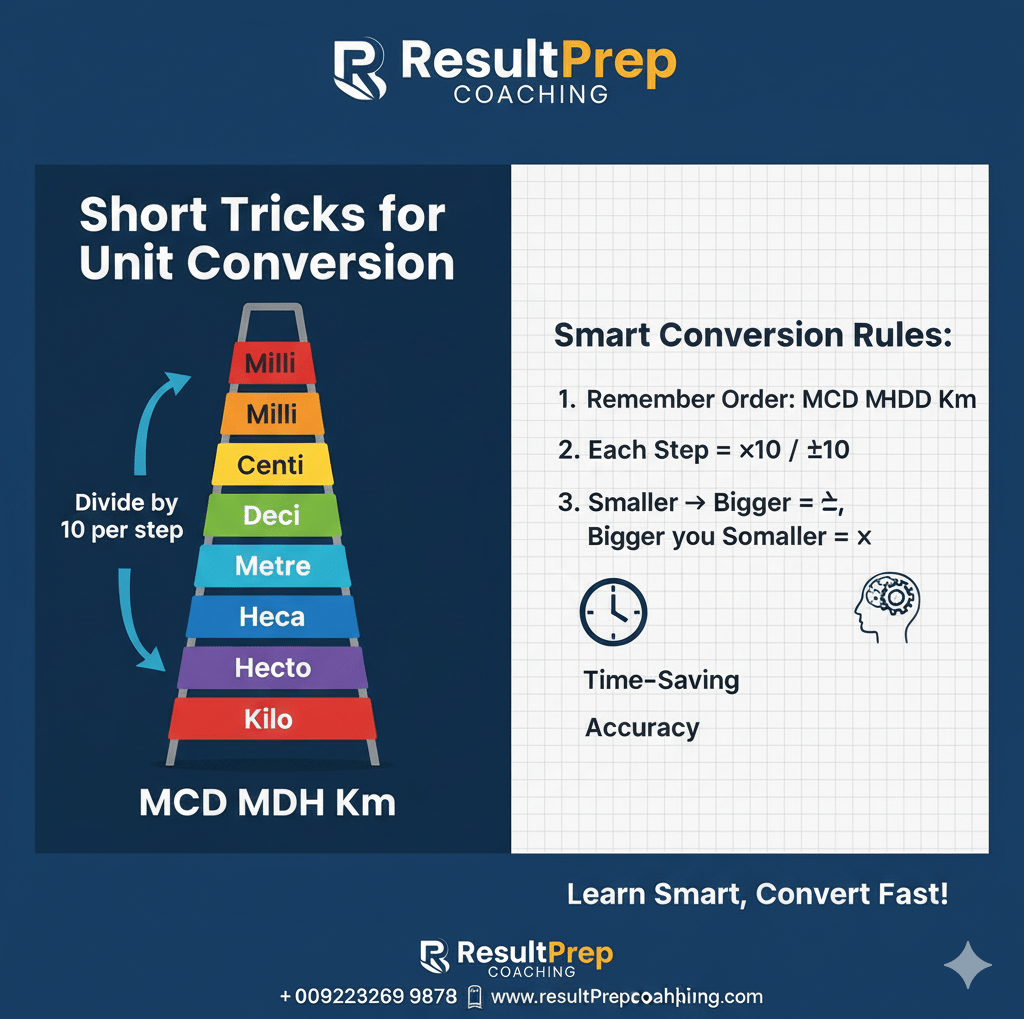
Step 1: Know Your Unit Family — The Secret Code “M C D M D H Km”
Before you even start converting, you must understand the hierarchy of units — from smallest to largest.
Here’s the order you’ll use:
Milli → Centi → Deci → Metre → Deca → Hecto → Kilometre
Sounds long? Don’t worry — there’s a smart mnemonic for that!
Remember:
“MCD (Municipal Corporation of Delhi) + MDH (Masala) + Km (Kilometre)”
So, just say: “MCD MDH Km” — and the entire order is right there in your head!
Unit Order:
Milli - Smallest
Centi - ↓
Deci - ↓
Metre - ↓
Deca - ↓
Hecto - ↓
Kilometre - Largest
Note: The “Milli” prefix works for any measure — millimetre, millilitre, or milligram — depending on what’s being measured.
Once you’ve memorized this order, you’re already halfway to mastering conversions.
Step 2: Learn the Power of 10 — The Mathematical Magic
Every unit in this chain is connected by a power of 10.
That’s right — each step equals ×10 or ÷10, depending on whether you’re moving up or down the chain.
Let’s simplify this:
10 millimetres = 1 centimetre
10 centimetres = 1 decimetre
10 decimetres = 1 metre
10 metres = 1 decametre
10 decametres = 1 hectometre
10 hectometres = 1 kilometre
In other words:
Going upward → divide by 10 each step.
Going downward → multiply by 10 each step.
This rule forms the backbone of all unit conversions — simple, systematic, and logical.
So whenever you’re stuck, remember: each jump in the unit ladder equals one zero!
Step 3: Know When to Multiply and When to Divide
Here’s where most students slip up — direction of conversion.
To make it crystal clear:
Conversion Type:
Smaller → Bigger = Divide (÷)
Bigger → Smaller = Multiply (×)
Logic:
A bigger unit contains many smaller ones, so you divide when going from smaller to bigger.
A smaller unit repeats many times in a bigger one, so you multiply when going from bigger to smaller.
Example 1: Convert Metre to Centimetre
We know the unit chain: Milli → Centi → Deci → Metre → Deca → Hecto → Km
From metre to centimetre, we move two steps down (Metre → Deci → Centi).
So we multiply by 10 × 10 = 100.
1 metre = 100 centimetres
Simple, right? You multiplied because you went from bigger to smaller.
Example 2: Convert Centimetre to Hectometre
From centimetre to hectometre, we move four steps up (Centi → Deci → Metre → Deca → Hecto).
So, we divide by 10 × 10 × 10 × 10 = 10,000.
1 centimetre = 0.0001 hectometre
Here, we divided because we went from smaller to bigger.
Step 4: Visualize It — The Ladder Trick
If numbers confuse you, use this simple unit ladder visual:
Km
↑
Hecto
↑
Deca
↑
Metre
↑
Deci
↑
Centi
↑
Milli
Moving up the ladder (toward Kilometre) → Divide by 10 per step
Moving down the ladder (toward Millimetre) → Multiply by 10 per step
This mental image helps you remember the process — no matter what the question asks.
Step 5: Practice Makes You Perfect — and Fast!
Once you understand the three-step logic — sequence, relation, and direction — the next goal is speed.
Practice converting between random units daily. Start small:
Convert metres to centimetres
Then millilitres to litres
Then challenge yourself with hectometres to millimetres
Soon, you’ll notice something amazing — you won’t even need to write down the steps! Your mind will automatically multiply or divide in the right direction.
That’s the ResultPrep advantage — turning confusion into confidence.
Pro Tip: Apply This Trick Beyond Length!
These unit tricks aren’t limited to measuring length — they also work for:
Area: cm², m², km²
Volume: mL, L, m³
Mass: mg, g, kg
Just remember, when converting squared or cubed units, apply the power of 10 for each dimension.
For example:
1 m² = (100 cm)² = 10,000 cm²
1 m³ = (100 cm)³ = 1,000,000 cm³
Final Step: Make It Stick with Memory Tricks
Here’s a simple summary to fix it in your mind forever:
Step 1: Remember the order — MCD MDH Km
Step 2: Every step = ×10 or ÷10
Step 3: Smaller → Bigger = ÷ | Bigger → Smaller = ×
That’s all you need!
Conclusion: Convert Like a Pro!
Unit conversion doesn’t have to be confusing or time-consuming. With these ResultPrep short tricks, you can handle any question confidently — even under exam pressure.
The next time you see different units in your question and answer options, smile and remember:
“MCD MDH Km”
“Multiply down, divide up.”
With regular practice, you’ll start converting units instinctively, saving valuable exam time and avoiding silly mistakes.
As the saying goes — “Smart work beats hard work.”
So, let’s make learning faster, smarter, and sharper — with ResultPrep!
Prepare for the best results!
Achieve your goals with expert coaching and support from ResultPrep.
Contact us:
© 2025. All rights reserved.
Address:
GSS Complex, 2nd Floor,
16th Cross Rd, HMT Layout, Vidyaranyapura, Bengaluru, Karnataka- 560097