CLAT 2027 Mock Test Analysis: How to Analyse Every Mock and Improve Your Score
Taking mocks is only half the battle. Discover the topper-tested 10-step CLAT mock analysis routine to diagnose errors, manage sectional pacing, eliminate trap options, and break score plateaus.
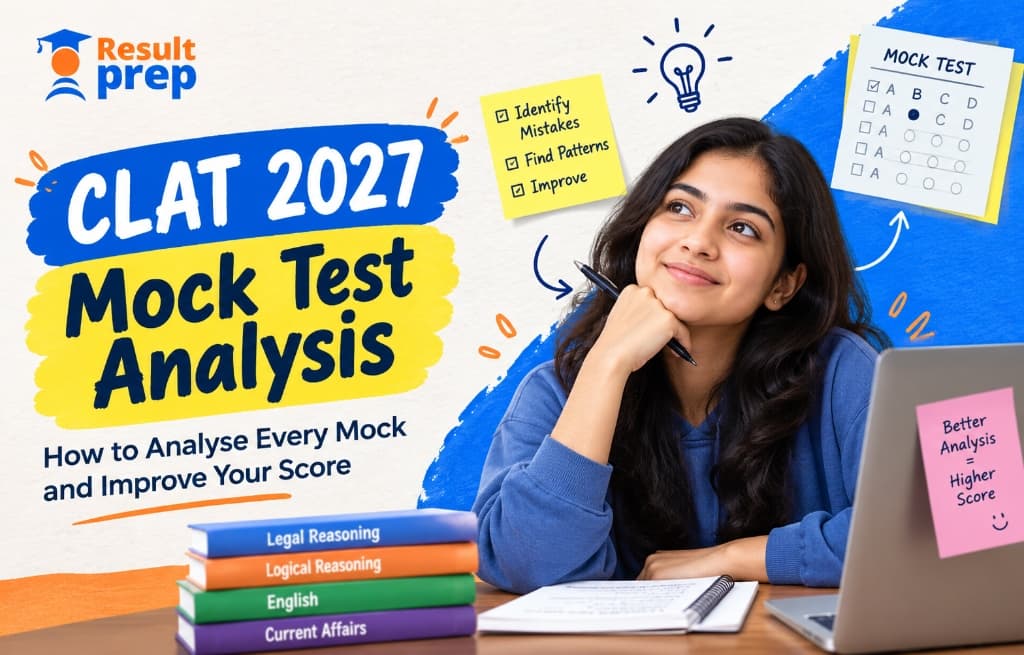
Taking CLAT mock tests regularly is a mandatory pillar of preparation. But simply completing a 2-hour simulation, checking the score, and moving on to the next test will never produce a top NLU rank. A mock test is fundamentally a diagnostic tool, not a vanity scorecard.
Recent interviews with CLAT toppers emphasize that rank improvement happens during the post-test post-mortem. Toppers dissect whether an error arose from a conceptual blind spot, a reading comprehension lapse, poor time management, or a careless bubbling mistake, while methodically tracking questions that drained excessive time.
With CLAT 2027 scheduled for December 6, 2026, adopting a disciplined, reproducible mock analysis routine is the single most powerful leverage you have to increase your score by 15–25 marks.
"Writing a mock test without analyzing it is like running on a treadmill: you expend immense energy, but you go nowhere. Two hours of testing requires at least three hours of ruthless analysis."
Why CLAT Mock Test Analysis Matters
Suppose you score 78 in one mock and 84 in the next. Looking only at the aggregate numbers tells you that you gained six marks—it does not explain how or why. A thorough analysis reveals actionable intelligence:
- Your accuracy improved in Legal Reasoning due to better principle application.
- You spent 11 minutes on a single Logical Reasoning set, starving Quantitative Techniques of time.
- Several Current Affairs marks were lost because of incomplete revision of 3-month-old topics.
- Careless option-marking caused a net loss of 3.75 marks (3 incorrect + penalties).
The 10-Step CLAT Mock Analysis Framework
1. Record Your Baseline Performance Metrics
Immediately after finishing the mock, log your macro statistics into an Excel sheet or analysis journal:
- Total Raw Score and Percentile
- Total Attempted vs. Unattempted Questions
- Net Correct vs. Incorrect Breakdown
- Section-wise Scores and Accuracy Percentages
- Exact Time Spent on Each Section (e.g., Legal: 36 mins, Logic: 28 mins, English: 26 mins, GK: 12 mins, Quant: 18 mins)
2. Categorize Every Wrong Answer (The 5-Error Taxonomy)
Never just look at the answer key and nod along. For every negative mark (-0.25 penalty), classify the underlying error into one of five categories:
| Error Classification | Root Problem | Targeted Prescription |
|---|---|---|
| Conceptual Error | Unfamiliarity with legal principle or math formula | Re-read foundational notes; solve 15 topical drills before next mock |
| Comprehension Error | Misunderstood passage tone, author stance, or question stem | Practice structural reading; underline transitional words (*However, Although*) |
| Application Error | Knew principle but applied external factual assumptions | Strict adherence to provided facts; discard outside general knowledge |
| Careless Error | Misread 'NOT / EXCEPT', sign mistake, or option bubbling slip | Slow down on question stems by 3 seconds; highlight qualifiers |
| Time-Pressure Error | Rushed answering because clock was ticking down in final 10 mins | Enforce strict section cutoff times; never let one section borrow from another |
3. Review Questions You Got Right by 'Lucky Guess'
A correct answer does not always mean strong underlying competency. If you eliminated two options and gambled on an educated guess, dissect why the correct option was right. Lucky guesses mask underlying vulnerabilities on test day.
4. Audit Your Unattempted Questions
Distinguish between a strategic skip (leaving an abnormally long, confusing DI set to save time) and an avoidable skip (running out of time before reaching four easy English questions). If manageable questions were left unread, your pacing strategy is flawed.
5. Conduct a Section-Wise Deep Dive
- English Language: Did errors occur in inference, vocabulary-in-context, or main idea? Was the passage type (literary vs. philosophical) uncomfortable?
- Current Affairs & GK: Were mistakes due to forgotten static facts or recent events? Group them by national, international, legal, and awards.
- Legal Reasoning: Check whether you imported outside legal knowledge instead of relying strictly on the text.
- Logical Reasoning: Review assumption, strengthen/weaken, and syllogism errors. Did you misidentify premises?
- Quantitative Techniques: Track calculation errors vs. formula gaps. Were basic percentage/ratio conversions fast enough?
6. Track Time Spent per Question, Not Just Accuracy
A question solved correctly in 3.5 minutes is actually a net negative because it stole time from two other questions. Flag any question that demanded more than 90 seconds and determine whether an easier shortcut or earlier abandonment was warranted.
7. Maintain an Active Error Logbook
Format every major blunder into this structured row:
8. Identify Multi-Mock Recurring Patterns
One poor score in critical reasoning is an anomaly; four consecutive mocks with sub-60% critical reasoning accuracy is a structural emergency. Look across your last 5 mocks to identify persistent leaks.
9. Translate Analysis into a Concrete Action Plan
Never conclude analysis with vague resolutions like 'I need to read faster'. Formulate precise weekly targets:
- 'Solve 4 timed critical reasoning passages every morning for 6 days.'
- 'Revise last 3 months of GK notes and take 2 topical quizzes before Saturday's mock.'
- 'Strictly limit Legal Reasoning to 35 minutes using a vibrating countdown timer.'
10. Do Not Chase a Higher Score on Every Single Test
Mock difficulty varies widely. Focus on process metrics: Did your unforced careless errors decrease? Did you stick to sectional time budgets? Did you eliminate trap options faster? If yes, your rank trajectory is positive regardless of raw score fluctuations.
A Simple Post-Mock Checklist
- Recorded score, attempts, accuracy, and section times in tracking sheet
- Classified all wrong answers into the 5-Error Taxonomy
- Reviewed lucky guesses and identified the correct elimination logic
- Logged missed easy questions and determined why they were skipped
- Updated the physical Error Logbook with concrete action items
Frequently Asked Questions (FAQs)
How long should I spend analysing a CLAT mock?
For a 2-hour mock test, you should spend between 2.5 to 3.5 hours on analysis. Rushing through the answer key in 30 minutes wastes 80% of the diagnostic value of taking the mock.
How many mock tests should I take before CLAT 2027?
Aspirants should aim for 35 to 50 full-length mocks. However, thoroughly analyzing 30 mocks yields far higher percentile gains than blindly attempting 70 without post-test review.
What should I do if my mock score plateaus?
Score plateaus indicate a recurring behavioral trap—such as stubbornness on difficult math questions, passive reading in English, or superficial GK revision. Review your last 5 error logs to identify the bottleneck.
Should I re-attempt questions I got wrong?
Yes. Solve missed questions without looking at the explanations first. Discovering the correct path through your own reasoning locks in the concept far better than passively reading the solution.
Final Thoughts: Turn Every Mock into a Stepping Stone
Instead of viewing a low mock score as a setback, view it as an early warning system that prevented mark loss on December 6, 2026. Every mistake identified and neutralized during analysis is a point saved on the real exam day.
ResultPrep offers structured CLAT mentoring, classroom coaching, and personalized mock test analysis in Bangalore. Book a free consultation with our faculty to audit your mock performance and accelerate your score.
Discussion (7)
Pooja Rao
This is a very insightful article. The strategies mentioned are incredibly practical.
Amit Das
I've been preparing for a few months now and these tips perfectly align with what my mentors have been saying.
Meghna Reddy
Do you have any offline batches starting soon? I need help with the advanced topics.
Aditya Kapoor
Bookmarked! I will be revisiting this guide before my mock tests next month.
Divya Sharma
The point about consistent daily practice cannot be overstated. Great read.
Rohan Mathur
Thank you for breaking down such a complex topic into actionable steps.
Sneha Gupta
I shared this with my entire study group. We were making half the mistakes listed here.
Related Articles in CLAT Preparation

CLAT 2027 Reading Comprehension: How to Improve Accuracy and Solve RC Passages Faster
Master CLAT 2027 English Reading Comprehension. Learn how to identify the author's argument, eliminate trap options, solve inference & tone questions, and boost solving speed.
CLAT Preparation Strategy for Beginners: A Complete Guide
Starting CLAT preparation from scratch? Here is the ultimate step-by-step roadmap covering subject-wise strategies, daily study routines, 6-month timelines, mock analysis, and common pitfalls.

CLAT 2027 Legal Reasoning: How to Apply Principles to Passage-Based Questions
Stop memorizing law. CLAT Legal Reasoning tests your ability to extract principles from passages and apply them to facts without outside assumptions. Learn the golden rules of accuracy.