CLAT Preparation Strategy for Beginners: A Complete Guide
Starting CLAT preparation from scratch? Here is the ultimate step-by-step roadmap covering subject-wise strategies, daily study routines, 6-month timelines, mock analysis, and common pitfalls.
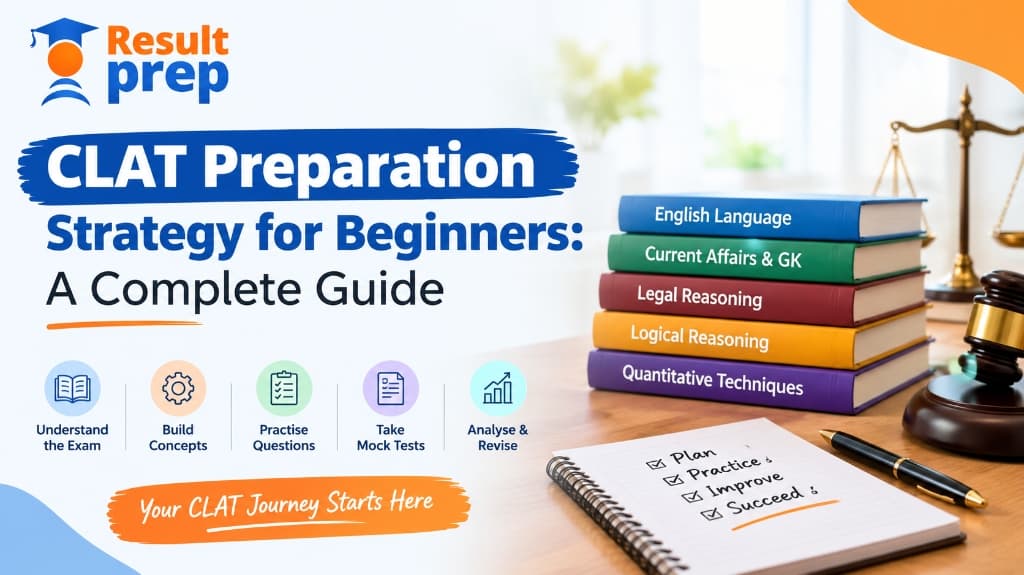
It can be intimidating to begin CLAT preparation for the first time. Aspirants frequently wonder where to begin, what topics to concentrate on, how many hours to study, which resources to trust, and when to start taking mock tests.
Fortunately, beginners do not have to become experts in every subject on their very first day. With an organized preparation plan, students can progressively build their reading stamina, critical reasoning, quantitative computation, and legal aptitude from the ground up.
Preparing for the CLAT involves much more than simply clocking in long study hours. It requires thoroughly comprehending the examination pattern, practicing passage-based question types, boosting accuracy, mastering sectional time management, and routinely maintaining a mistake log.
"CLAT is not a test of rote memory; it is an aptitude exam designed to test reading speed, analytical depth, and objective problem-solving under strict time constraints."
CLAT Preparation Strategy for Beginners: Quick Overview
Effective CLAT preparation can be broadly classified into five progressive stages:
| Stage | Core Objective | Key Activities |
|---|---|---|
| 1. Comprehend the Exam | Understand the CLAT pattern, syllabus, marking scheme, and passage structure. | Review official sample papers & PYQs |
| 2. Develop Concepts | Master core foundational topics across all 5 sections. | Theory notes, editorial reading, grammar & basic math |
| 3. Practice Questions | Transition from standalone questions to passage-based sets. | Sectional drills, RC passages & legal reasoning problem sets |
| 4. Take Mock Exams | Simulate real exam conditions and test sectional time management. | Full-length 2-hour timed mock tests |
| 5. Analyze & Revise | Systematically eliminate recurring mistakes and solidify weak spots. | Mistake log reviews, weekly CA revision & formula sheets |
The current CLAT syllabus comprises five primary sections, each requiring a specialized preparation approach:
- English Language: Reading comprehension, inference extraction, tone, vocabulary in context.
- Current Affairs & General Knowledge: National and international events, legal developments, policies, reports.
- Legal Reasoning: Identifying legal principles in passages and applying them strictly to given facts.
- Logical Reasoning: Evaluating arguments, premises, assumptions, strengthening/weakening claims, conclusions.
- Quantitative Techniques: 10th-standard arithmetic applied to passage-based data sets and caselets.
What Should Beginners Do Before Starting CLAT Preparation?
Before buying several books or enrolling in high-fee coaching programmes, determine your present baseline readiness. Take a recent CLAT previous-year paper or diagnostic mock test without any prior preparation under a strict 2-hour timer.
The goal is not to score high marks. Rather, use this preliminary evaluation to determine:
- Which sections feel intuitive and comfortable?
- Which parts consume an excessive amount of time?
- Where do the majority of unforced errors occur?
- How easily can you comprehend lengthy, opinion-heavy passages?
- How quickly and accurately can you solve basic mathematical data sets?
- What is your baseline knowledge of current events and constitutional topics?
CLAT Preparation Strategy: Subject-Wise Approach
1. English Language Preparation
Reading comprehension forms the core of CLAT English. Rather than simple grammatical recall, the exam tests whether you can deconstruct a 450-word editorial in under 5 minutes and answer nuanced contextual questions.
Crucial Domains in English:
- Reading comprehension and speed
- Identifying the central theme and secondary arguments
- Deducing the author's tone, stance, and bias
- Contextualized vocabulary and idioms
- Logical conclusions and implicit assumptions
Actionable English Strategy:
Integrate rigorous reading into your daily routine. Read long-form editorials from The Hindu or The Indian Express. After reading an article, ask yourself:
- What is the author's central contention?
- What evidence supports the argument?
- What can be logically inferred from the passage without outside assumptions?
Once your reading stamina is established, solve timed 450-word passages daily.
2. Current Affairs & General Knowledge Preparation
Delaying current affairs until the final few months is a catastrophic error made by many novices. The resulting information backlog creates unnecessary panic and poor retention.
Key Topics to Track:
- National news, bills, acts, and major government policies
- International affairs, geopolitical summits, and global conflicts
- Landmark Supreme Court verdicts and constitutional amendments
- Economic indicators, budgets, and environmental treaties
- Science, technology, national awards, and key appointments
- Global indices, reports, and international organizations
How to Prepare for Current Affairs:
Adopt a structured 4-step note-making framework: Event → Context → Crucial Details → Why It Matters. Avoid copying whole newspaper articles word-for-word. Instead, summarize in bullet points and maintain daily, weekly, and monthly revision cycles.
3. Legal Reasoning Preparation
Legal Reasoning often intimidates beginners who have never studied law. However, CLAT does not require legal training before beginning preparation. The section is entirely passage-based; you are given the legal principles in the passage and must apply them dispassionately to hypothetical factual situations.
Essential Skills for Legal Reasoning:
- Careful reading of legal definitions, exceptions, and conditions
- Recognizing relevant facts versus distractor details
- Applying principles strictly without personal moral bias
- Never importing external legal assumptions not stated in the passage
How to Prepare: Start with foundational legal concepts (Constitutional Law, Law of Torts, Indian Penal Code, Contract Law), understand landmark doctrines, and then practice applying these principles to passage-based case studies.
4. Logical Reasoning Preparation
Logical Reasoning evaluates your ability to dissect and evaluate arguments. Beginners should master fundamental critical reasoning concepts before tackling full passages.
Key Topics:
- Premises, arguments, and conclusions
- Strengthening and weakening arguments
- Implicit assumptions and logical flaws
- Cause-and-effect relationships
- Inferences and parallel reasoning
How to Prepare: After solving each passage, dissect all four answer options. Ask: Why is this specific choice correct, and what makes the other three choices incorrect? This develops the elimination skill required on exam day.
5. Quantitative Techniques Preparation
Students who are uncomfortable with mathematics often skip Quantitative Techniques entirely, which is a major mistake. The 10–12 marks in this section often decide whether you land an AIR in the top 300 or drop out of top NLU contention.
Core Mathematical Modules:
- Percentages, Fractions, and Conversions
- Ratios and Proportions
- Averages, Mixtures, and Alligations
- Profit, Loss, and Discount
- Simple and Compound Interest
- Time, Speed, Distance, and Work
- Caselet Data Interpretation and Bar/Pie Chart analysis
How to Prepare: Follow a 5-step progression: Concepts → Basic Questions → Mixed Drills → Caselet Data Sets → Timed Exercises. Master mental calculations and fractional shortcuts to speed up execution.
How Much Time Should Beginners Spend Studying for CLAT?
No specific number of hours guarantees a top rank; consistency and focused quality are far more important than unguided marathon sessions. A balanced daily allocation for beginners:
| Area of Preparation | Primary Focus | Daily Time (Approx.) |
|---|---|---|
| Reading & Editorial | Newspaper editorials, long-form journals, opinion columns. | 45–60 minutes |
| Current Affairs | Daily news compilation, monthly compendiums, notes revision. | 45–60 minutes |
| English & Logical Reasoning | RC passage practice, critical reasoning sets, argument breakdown. | 60–75 minutes |
| Legal Reasoning | Passage-based problem sets, constitutional doctrines, torts/contracts. | 60–75 minutes |
| Quantitative Techniques | Arithmetic caselets, calculation drills, percentage/ratio sets. | 40–50 minutes |
| Mistake Log & Review | Analyzing incorrect answers from the day's practice sets. | 30 minutes |
Strategy for CLAT Preparation: Daily Study Schedule
A practical beginner routine balancing school/college and CLAT prep:
- Morning (7:00 AM – 8:30 AM): Read one comprehensive newspaper editorial (e.g., The Hindu) and review yesterday's current affairs notes.
- Afternoon (2:30 PM – 4:30 PM): Study a core conceptual topic from Legal Reasoning or Quantitative Techniques and solve 15–20 targeted problems.
- Evening (5:30 PM – 7:30 PM): Solve two timed Reading Comprehension passages and two Critical Reasoning passage sets.
- Night (9:30 PM – 10:30 PM): Update your mistake log, record unforced errors, and revise formulas or current affairs.
When Should Beginners Begin Taking Mock Exams for CLAT?
Beginners should first build a 40–50% syllabus foundation before attempting full-length 2-hour mocks. Starting full mocks without basic conceptual clarity often leads to demoralizing scores.
Instead, follow this progression: Topic Tests → Sectional Tests → Half-Length Mocks → Full-Length Timed Mocks. By month 3 of your preparation, take at least one full mock test per week.
How to Evaluate a Mock Test for CLAT
A mock test is only as valuable as the analysis that follows it. Spending 2 hours taking a mock requires at least 2.5 to 3 hours of rigorous post-test analysis. Categorize every error:
| Error Type | Potential Cause | Actionable Solution |
|---|---|---|
| Conceptual Error | Topic was unfamiliar or poorly understood. | Revisit theoretical concepts and redo basic drills. |
| Calculation Error | Careless arithmetic or rushing under pressure. | Practice mental math drills and slow down calculation steps. |
| Reading Error | Misinterpreted passage tone, keywords, or qualifiers ("except", "not"). | Practice active reading; highlight condition words. |
| Time-Related Error | Got bogged down in one difficult question. | Implement a strict 60-second question-skipping rule. |
| Guesswork Error | Guessed without eliminating at least two wrong choices. | Restrain wild guesses to prevent negative marking (-0.25). |
How to Manage Your Time Better in CLAT
Time management must be trained during daily practice, not left for the final examination day. Categorize every question during practice into three buckets:
- Simple (Direct & Familiar): Solve immediately in under 45 seconds.
- Moderate (Passage-Heavy): Read carefully and solve in 60–75 seconds.
- Time-Consuming (Lengthy/Complex): Mark for review, skip, and return only if time permits.
Typical Errors Beginners Make When Preparing for CLAT
- Starting Without Comprehending the Test: Diving into study material without analyzing recent official question patterns.
- Excessive Resource Hoarding: Collecting dozens of PDFs, question banks, and books, leading to paralysis and lack of depth.
- Neglecting Daily Reading Practice: Treating reading as optional when 80%+ of CLAT is reading-dependent.
- Avoiding Quantitative Techniques: Leaving 10–12 free-scoring arithmetic marks on the table out of math phobia.
- Taking Mocks Without In-Depth Analysis: Chasing raw mock counts instead of learning from mistakes.
- Procrastinating on Current Affairs: Trying to memorize 12 months of news in the final 30 days.
- Prioritizing Speed Over Accuracy: Rushing through passages, leading to a cascade of negative marking deductions.
CLAT Preparation Strategy: 6-Month Framework
If you have around six months to prepare, divide your roadmap into three distinct two-month phases:
| Phase | Key Focus Areas | Expected Milestones |
|---|---|---|
| Months 1–2: Foundation | Syllabus clarity, daily reading habit, basic legal principles, critical reasoning foundations, arithmetic concepts. | Complete 100% conceptual syllabus; finish past 3 years' PYQs. |
| Months 3–4: Practice & Sectionals | Passage-based drills, sectional tests, monthly CA compilations, DI caselets, timed sets. | Take 1 mock per week; maintain an active mistake log. |
| Months 5–6: Full Mocks & Revision | 2 full-length mocks per week, intensive error analysis, speed optimization, year-round CA consolidation. | Achieve stable sectional scores; finalize exam-day sequence. |
Final CLAT Preparation Checklist
Before entering your intensive final mock phase, ensure you have accomplished:
- [x] Completely understood the CLAT syllabus, marking scheme, and passage structure
- [x] Established a non-negotiable daily editorial reading habit
- [x] Built an organized current affairs note-taking and revision routine
- [x] Covered foundational principles in Constitutional Law, Torts, Contracts, and IPC
- [x] Solved official previous-year papers under timed conditions
- [x] Reinforced basic 10th-standard arithmetic concepts and fractional shortcuts
- [x] Set up and actively maintained a comprehensive mistake analysis log
- [x] Transitioned from sectional topic tests to regular full-length mock examinations
Discussion (7)
Meghna Joshi
This is a very insightful article. The strategies mentioned are incredibly practical.
Amit Desai
I've been preparing for a few months now and these tips perfectly align with what my mentors have been saying.
Pooja Menon
Do you have any offline batches starting soon? I need help with the advanced topics.
Arjun Kumar
Bookmarked! I will be revisiting this guide before my mock tests next month.
Neha Patil
The point about consistent daily practice cannot be overstated. Great read.
Vikram Iyer
Thank you for breaking down such a complex topic into actionable steps.
Kavya Bose
I shared this with my entire study group. We were making half the mistakes listed here.
Related Articles in CLAT Preparation

CLAT 2027 Mock Test Analysis: How to Analyse Every Mock and Improve Your Score
Taking mocks is only half the battle. Discover the topper-tested 10-step CLAT mock analysis routine to diagnose errors, manage sectional pacing, eliminate trap options, and break score plateaus.

CLAT 2027 Reading Comprehension: How to Improve Accuracy and Solve RC Passages Faster
Master CLAT 2027 English Reading Comprehension. Learn how to identify the author's argument, eliminate trap options, solve inference & tone questions, and boost solving speed.

CLAT 2027 Legal Reasoning: How to Apply Principles to Passage-Based Questions
Stop memorizing law. CLAT Legal Reasoning tests your ability to extract principles from passages and apply them to facts without outside assumptions. Learn the golden rules of accuracy.