"I Don't Know What to Study After Coaching." Here's the CLAT Study Routine That Actually Works.
If you're attending coaching regularly but feel lost once you reach home, don't assume you're falling behind. This guide will help you build a simple, repeatable study system.

"I attend my coaching classes every day. I come home, scroll Instagram, sleep, and then panic at night because I have no idea what to study. My mock scores are around 500, but I know I'm capable of much more."
If this sounds familiar, you're not alone.
Thousands of CLAT aspirants don't struggle because they're lazy. They struggle because they lack clarity.
Most students assume they have a motivation problem.
In reality, they have a decision problem.
Every time they sit down to study, their brain asks:
- Should I solve Legal?
- Should I revise English?
- Should I read Current Affairs?
- Should I attempt a mock?
- Should I analyse yesterday's mock?
- Should I read the newspaper?
- Should I practice Quant?
After spending fifteen minutes deciding, they end up opening Instagram instead.
If you're facing the same issue, this guide will help you build a simple, repeatable study system that removes confusion and keeps your preparation moving every single day.
Why Most CLAT Aspirants Feel "Lost"
Many students believe preparation means completing the syllabus.
But here's the truth.
Unlike board examinations, CLAT is not a syllabus-heavy examination.
You already know English.
You already know basic mathematics.
You already understand reasoning.
The challenge is not learning something entirely new.
The challenge is becoming faster, more accurate, and more consistent than thousands of other students.
That's why after a few months of coaching, students often feel stuck.
They think,
"I've already studied most concepts. What exactly am I supposed to do now?"
The answer is simple.
Stop studying randomly.
Start training systematically.
Your Daily Goal Is Not "Study More"
Instead of asking,
"How many hours should I study today?"
Ask,
"Which skills will I improve today?"
Every CLAT study session should improve one of these:
- Reading speed
- Accuracy
- Logical thinking
- Legal reasoning
- Vocabulary
- Current Affairs retention
- Mock analysis
- Time management
If today's study doesn't improve one of these, you're probably wasting time.
The Biggest Mistake Students Make After Coaching
Many students return home and immediately think,
"I'll start after taking a small break."
That break becomes:
- One YouTube video
- Three Instagram reels
- A two-hour nap
- Dinner
- Then guilt
Instead, create one simple rule.
Never sit on your bed after coaching.
Seriously.
The moment you lie down, your brain decides the day is over.
Instead:
- Drink water.
- Freshen up.
- Eat something light.
- Sit at your study table within 20-30 minutes.
You don't need motivation.
You need momentum.
The "I Don't Know What To Study" Formula
Whenever you sit down, don't think.
Follow a fixed sequence.
Step 1: Read for 30 Minutes
This could be:
- Newspaper
- Editorial
- Magazine article
- Long-form essay
The objective isn't Current Affairs.
It's reading stamina.
CLAT passages reward students who can stay focused for two hours without losing concentration.
Step 2: Practice One Section
Choose only one.
For example:
Monday → English
Tuesday → Legal
Wednesday → Logical
Thursday → Quantitative Techniques
Friday → Mixed practice
Saturday → Weakest subject
Sunday → Mock
Don't jump between four subjects in one sitting.
Deep practice beats shallow practice.
Step 3: Revise Mistakes
This is where most rankers improve.
Don't solve 500 new questions every day.
Solve fewer questions.
Review them carefully.
Ask:
- Why was this answer wrong?
- What assumption did I make?
- Was I rushing?
- Did I misunderstand the passage?
- Was vocabulary the issue?
Every wrong answer teaches more than five correct ones.
Mock Analysis Is More Important Than Mock Tests
Many students proudly say,
"I've attempted 60 mocks."
But ask them,
"How many have you analysed properly?"
Silence.
Attempting mocks without analysing them is like taking medical tests and never reading the reports.
A proper mock analysis should take longer than the mock itself.
Look for:
- Questions you guessed correctly
- Questions you guessed incorrectly
- Time spent on each section
- Reading mistakes
- Silly errors
- Topics repeatedly causing problems
Maintain a notebook called Mock Mistake Journal.
Write only:
- Mistake
- Reason
- Lesson
Revise it every week.
You'll stop repeating the same mistakes.
Current Affairs Doesn't Have To Be Miserable
Let's address the biggest complaint.
"I hate Current Affairs."
You're not alone.
Many students spend hours memorising endless PDFs without remembering anything.
That's because they're trying to memorise facts instead of understanding stories.
Instead, follow this approach.
Daily
- Read one newspaper for 20-30 minutes.
- Focus on understanding events.
Weekly
Read one reliable Current Affairs compilation.
Instead of trying to remember every fact, ask:
- What happened?
- Why did it happen?
- Why is it important?
- Who are the important organisations involved?
Understanding creates memory.
Rote learning disappears within days.
Stop Treating Current Affairs Like UPSC
One common mistake is trying to know everything.
You don't need to know every cabinet reshuffle, every award, every summit, or every committee in extreme detail.
CLAT tests:
- Awareness
- Reading comprehension
- Context
Not encyclopaedic memory.
Quality beats quantity.
Build A Weekly CLAT Routine
Instead of planning every day separately, create one weekly system.
Monday
- Reading
- English practice
- Vocabulary revision
Tuesday
- Reading
- Legal reasoning
- Mock review
Wednesday
- Reading
- Logical reasoning
- Current Affairs revision
Thursday
- Reading
- Quantitative Techniques
- Error notebook
Friday
- Mixed sectional practice
- Newspaper
- Vocabulary
Saturday
- Full revision
- Weak areas
Sunday
- Full mock
- Detailed analysis
Repeat.
Don't redesign your timetable every week.
Consistency beats perfect planning.
Make An Error Notebook
This is one habit almost every serious topper develops.
Divide one notebook into sections.
English
Words you didn't know.
Grammar patterns.
Reading mistakes.
Legal
Principles misunderstood.
Frequently tested concepts.
Incorrect assumptions.
Logical
Question types.
Trap options.
Time-consuming patterns.
Quant
Calculation shortcuts.
Formula revision.
Recurring mistakes.
This notebook becomes your revision goldmine.
The 80-20 Rule Of CLAT Preparation
You don't need ten different books.
You don't need five Current Affairs portals.
You don't need seven Telegram channels.
Choose:
- One coaching material
- One newspaper
- One Current Affairs source
- One mock platform
Then revise them repeatedly.
Depth always beats variety.
Doomscrolling Is A Symptom, Not The Problem
Most students think,
"I waste too much time on my phone."
Actually, phones aren't the root problem.
The real issue is friction.
Your study session begins with uncertainty.
Your phone begins with instant entertainment.
Naturally, your brain chooses the easier option.
Reduce friction.
Before sleeping, write tomorrow's first task.
Example:
5:30 PM Read Editorial on Supreme Court judgment.
6:00 PM Legal Sectional Test (25 Questions)
6:45 PM Analyse Wrong Answers
Now there's no thinking involved.
You simply execute.
What If You're Already Scoring Around 500?
Many students become comfortable after crossing the 500 mark.
That's dangerous.
The difference between an average rank and a top NLU often comes down to:
- Better mock analysis
- Faster reading
- Fewer silly mistakes
- Better time management
Small improvements every week create massive rank improvements over months.
Your Preparation Doesn't Need To Feel Perfect
Some days you'll study six hours.
Some days only two.
That's okay.
What matters is avoiding zero days.
Even on difficult days, complete one small task.
For example:
- Read one editorial.
- Solve one passage.
- Revise one topic.
- Analyse five mistakes.
Momentum matters more than intensity.
A Sample Evening Routine After Coaching
Here's a simple routine that many students can realistically follow.
4:30 PM Reach home and freshen up.
5:00 PM Light snack.
5:15 PM Read newspaper or editorial for 30 minutes.
5:45 PM Sectional practice (45-60 minutes).
6:45 PM Review answers and note mistakes.
7:15 PM Short break.
7:30 PM Current Affairs revision (30 minutes).
8:00 PM Vocabulary or weak subject.
8:30 PM Plan tomorrow's first study session.
Done.
No overthinking.
Remember Why You're Preparing
CLAT isn't won by students who study sixteen hours once a week.
It's won by students who quietly improve every single day.
You don't need a brand-new timetable every Monday.
You don't need another productivity app.
You don't need to wait for motivation.
You simply need to know what comes next every time you sit at your desk.
Once that uncertainty disappears, consistency becomes much easier.
Final Thoughts
If you're attending coaching regularly but feel lost once you reach home, don't assume you're falling behind.
This phase is extremely common.
The solution isn't finding more resources or studying for impossible hours.
The solution is building a system that tells you exactly what to do every day.
Remember these five principles:
- Never end the day without a planned study task.
- Analyse every mock thoroughly.
- Focus on improving one skill at a time.
- Keep an error notebook and revise it often.
- Stay consistent, even on low-energy days.
CLAT rewards discipline far more than bursts of motivation.
Start small.
Stay consistent.
And trust the process.
Discussion (7)
Ishita Chatterjee
This is a very insightful article. The strategies mentioned are incredibly practical.
Karan Patel
I've been preparing for a few months now and these tips perfectly align with what my mentors have been saying.
Anjali Nair
Do you have any offline batches starting soon? I need help with the advanced topics.
Siddharth Mehta
Bookmarked! I will be revisiting this guide before my mock tests next month.
Priya Rao
The point about consistent daily practice cannot be overstated. Great read.
Manish Das
Thank you for breaking down such a complex topic into actionable steps.
Simran Reddy
I shared this with my entire study group. We were making half the mistakes listed here.
Related Articles in CLAT Preparation
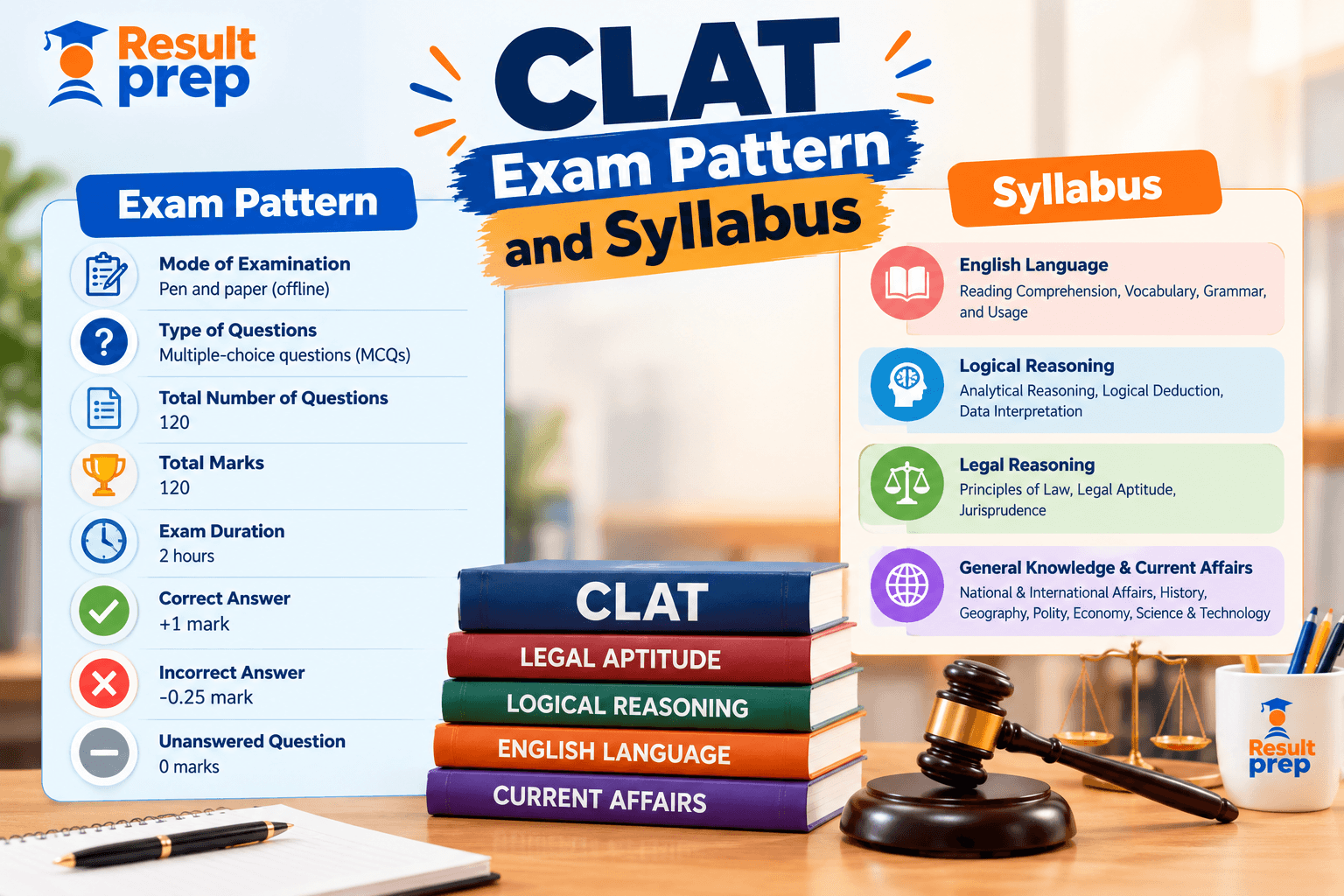
Everything Students Should Know About the CLAT Exam Pattern and Syllabus
The complete guide to the CLAT 2027 exam pattern and syllabus: 120-question passage format, 5 sectional syllabi, marking scheme, offline OMR logistics, and preparation roadmaps.

CLAT - Criteria for Eligibility: Age Range, Criteria, and Prerequisites
A complete guide to CLAT 2027 eligibility: Minimum marks in Class 12, no age limit rules, stream flexibility, reservation categories, and CLAT UG vs. PG comparison.

How to Apply for CLAT: A Step-By-Step Guide For Law Aspirants
A complete walkthrough of the CLAT application process: Step-by-step registration on the Consortium portal, document specifications, fee payment, common pitfalls, and post-submission steps.