How Information Overload Affects Students and How to Make Better Decisions
Learn how to improve your performance in competitive entrance exams with structured strategies and expert guidance.
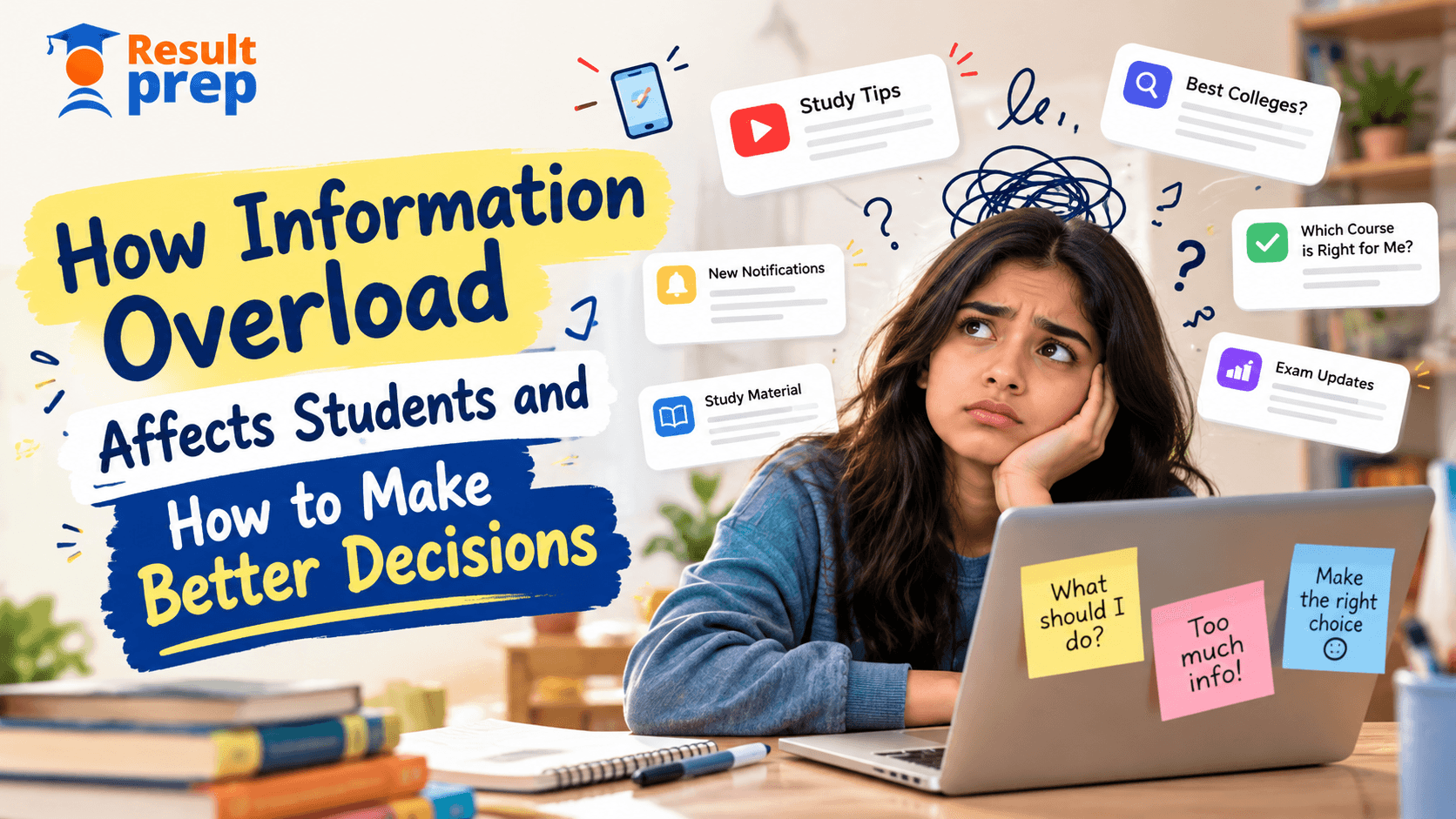
Students today have access to more information than ever before. A quick search can produce hundreds of videos, articles, study resources, college reviews, career opinions and recommendations.
At first, having more information seems helpful. But there is a point at which too many options make decisions harder rather than easier.
A student trying to choose a course may compare dozens of colleges. Someone preparing for an entrance exam may save countless study videos without knowing which ones to follow. Another student may keep researching career options without actually making a decision.
This is known as information overload, and it can affect how students study, choose courses and plan their future.
Recent research involving India-based higher-education applicants found that greater choice complexity and information overload were associated with higher decision fatigue and a greater likelihood of abandoning started applications.
What Is Information Overload?
Information overload happens when you have more information available than you can effectively process and use.
For students, this can happen in many situations.
You might search for:
The best course after Class 12
The best college for a particular degree
Which entrance exam to take
Which book to study from
Which online teacher to follow
How many hours to study
Which career has the best future
Whether to choose one course over another
Instead of finding one clear answer, you discover hundreds of opinions.
One website recommends one approach. A video recommends another. A friend suggests something completely different.
Eventually, the problem is no longer a lack of information.
It is deciding which information actually matters.
How Information Overload Affects Students
It Makes Simple Decisions Feel Complicated
When there are too many choices, even a relatively straightforward decision can start feeling difficult.
For example, a student may initially want to choose between two courses. After hours of research, they may have a list of ten possible options and still feel less confident than when they started.
More information has not necessarily created more clarity.
It Encourages Constant Research
Information gathering can become a substitute for taking action.
A student may keep watching videos about study techniques instead of studying.
They may continue comparing colleges instead of narrowing their choices.
They may keep searching for the perfect timetable instead of following a reasonable one.
Research is useful when it helps you make a decision.
It becomes unproductive when it prevents you from making one.
It Creates Decision Fatigue
Students make dozens of academic decisions every day.
What should I study first?
Which resource should I use?
Should I revise or practise?
Which college should I apply to?
Should I take another test?
Repeated decision-making can become mentally tiring. Research on university students has also linked higher decision fatigue with greater perceived stress.
This does not mean every academic decision causes serious stress. The larger issue is the cumulative effect of constantly having to choose between competing options.
Why Social Media Can Make Information Overload Worse
Students do not only search for information deliberately.
They also encounter it while scrolling.
One video explains a study method. Another discusses a college. Someone else talks about their exam strategy. Another person shares a supposedly must-read book.
The problem is that these recommendations are often presented without the context needed to determine whether they are appropriate for you.
A strategy that worked for one student may not fit another student's examination, preparation level or schedule.
This is why consuming more student content does not necessarily improve decision-making.
How to Tell Whether You Have Too Much Information
Ask yourself a few questions.
Am I still researching the same decision after finding enough information to make a reasonable choice?
Do I have several resources but no clear idea which one to use?
Do I frequently change my study strategy after watching new content?
Do I save more advice than I actually implement?
Am I comparing options that are already good enough rather than identifying what I actually need?
If several of these sound familiar, the problem may not be insufficient information.
You may need a better filtering system.
Start With Your Actual Goal
Before searching for advice, define what you are trying to accomplish.
Suppose you search for:
Best books for entrance exam preparation.
You may find dozens of recommendations.
A better starting question is:
What do I need help with?
Perhaps your problem is vocabulary.
Perhaps you need more practice questions.
Perhaps you do not understand the syllabus.
Perhaps you need previous-year papers.
Once you identify the problem, the amount of relevant information becomes much smaller.
The same principle works for career and college decisions.
Do not start with:
Which is the best college?
Start with:
What factors matter most to me in choosing a college?
That could include the course, location, academic environment, fees, career opportunities or other priorities.
Create a Shortlist Before Comparing Options
You do not need to investigate every possible option.
Start by creating a shortlist based on your basic requirements.
For example, if you are researching colleges, eliminate options that clearly do not meet your eligibility, course or location requirements.
Then compare the remaining choices more carefully.
This is much more manageable than researching every college you encounter online.
The same approach can be used when choosing study resources.
Instead of downloading ten PDFs, watching twenty videos and buying several books, choose a small number of resources that address your actual needs.
Learn to Separate Information From Advice
Not everything you read online has the same value.
There is an important difference between:
Information:
A college has a particular course or an exam has a particular structure.
Opinion:
This is definitely the best college.
Personal experience:
This study method worked for me.
Prediction:
This career will definitely be the most successful in the future.
Understanding this difference helps you evaluate what you are reading.
Personal experiences can be useful, but they should not automatically become rules for everyone.
Check the Source Before Trusting It
When making an important academic decision, look at where the information comes from.
For exam-related facts, official examination sources should take priority.
For college information, check the institution's official information alongside other reliable sources.
For career decisions, look at multiple credible sources rather than relying entirely on a single social-media post.
The objective is not to distrust everything online.
It is to understand which information deserves more weight.
Set a Research Limit
One practical way to prevent information overload is to decide how much research you actually need.
For example:
Step 1: Identify the question.
Step 2: Find a few reliable sources.
Step 3: Write down the key differences.
Step 4: Decide what information is still missing.
Step 5: Make the decision once you have enough evidence.
You do not need to eliminate every uncertainty before making a reasonable choice.
Some decisions will always involve uncertainty.
Avoid Constantly Changing Your Study Strategy
This is especially important for entrance-exam preparation.
You may discover a new study technique every few days.
One person recommends early-morning studying. Another recommends late-night sessions. One video recommends flashcards. Another says to use detailed notes. Someone else says you should solve hundreds of questions.
Trying everything can leave you with no consistent system.
Instead, choose a reasonable method and give it enough time to evaluate whether it works for you.
A strategy should be changed because your experience or results show that it needs improvement - not simply because you encountered another recommendation online.
Use a Good Enough Standard
Students sometimes believe that there must be one perfect answer.
The perfect book.
The perfect college.
The perfect timetable.
The perfect career.
The perfect preparation strategy.
In reality, many decisions have several reasonable options.
The goal is not always to find the theoretically perfect choice.
It is to find an option that fits your requirements and then use it effectively.
A good resource that you actually complete can be more useful than a supposedly perfect resource that you constantly replace.
Make Important Decisions in Stages
Large decisions become easier when you break them into smaller questions.
Instead of asking:
What should I do after Class 12?
start with:
What subjects do I enjoy?
What type of work interests me?
Which courses connect with those interests?
What entrance exams are relevant?
Which colleges offer those courses?
What practical factors matter to me?
You do not have to answer every question in one sitting.
A staged approach can reduce the mental burden of making a major decision.
Keep a Decision Journal
For important choices, write down:
What decision you are making
The options you are considering
Your most important criteria
The information you currently have
What remains uncertain
Why you chose your final option
This does not need to be complicated.
The benefit is that it forces you to turn scattered thoughts into a structured decision.
It can also prevent you from repeatedly revisiting the same question simply because you have forgotten why you made the original choice.
Know When to Ask for Guidance
Some decisions are easier with another person's perspective.
This does not mean someone else should make the decision for you.
A teacher, mentor, counsellor or knowledgeable adult can help you identify questions you may not have considered and separate useful information from unnecessary noise.
This can be particularly helpful when several choices appear reasonable and you are struggling to understand which one fits your goals.
Information Is Useful Only When It Leads to Action
One of the simplest ways to identify information overload is to look at what happens after you research.
Did you:
Choose a resource?
Create a shortlist?
Register for the appropriate exam?
Start studying?
Narrow your college options?
Make a decision?
If the answer is consistently no, you may not need more information.
You may need to stop searching and start acting.
A Simple Framework for Making Better Student Decisions
Whenever you face an important academic decision, use this five-step process.
1. Define
Clearly identify the decision you need to make.
2. Filter
Decide which factors actually matter.
3. Research
Use a limited number of reliable sources.
4. Compare
Focus on the options that genuinely meet your requirements.
5. Decide
Once you have enough information, make a reasonable choice and move forward.
This does not guarantee that every decision will be perfect.
It helps ensure that your decision is deliberate rather than overwhelming.
Final Takeaway
Students do not necessarily need more information.
Often, they need better ways to filter the information they already have.
The internet has made it easier to research courses, colleges, careers, entrance exams and study strategies. But unlimited information can also make students feel uncertain, especially when every source seems to recommend something different.
Start with your goal. Identify what information you actually need. Use reliable sources, narrow your options and give yourself permission to make a reasonable decision without finding a mythical perfect answer.
Good decision-making is not about knowing everything.
It is about knowing what matters, what does not, and when you have enough information to move forward.
If you are trying to make important decisions about entrance exams, courses or your academic path and are unsure where to begin, Book a Free Counselling Session with ResultPrep for guidance tailored to your goals.
7 Comments
Share journey
Discussion (7)
S
Sneha Reddy
This is a very insightful article. The strategies mentioned are incredibly practical.
R
Rohan Das
I've been preparing for a few months now and these tips perfectly align with what my mentors have been saying.
D
Divya Rao
Do you have any offline batches starting soon? I need help with the advanced topics.
A
Aditya Mehta
Bookmarked! I will be revisiting this guide before my mock tests next month.
M
Meghna Nair
The point about consistent daily practice cannot be overstated. Great read.
A
Amit Patel
Thank you for breaking down such a complex topic into actionable steps.
P
Pooja Chatterjee
I shared this with my entire study group. We were making half the mistakes listed here.