How to Choose the Right Study Material for Competitive Exams
Learn how to improve your performance in competitive entrance exams with structured strategies and expert guidance.
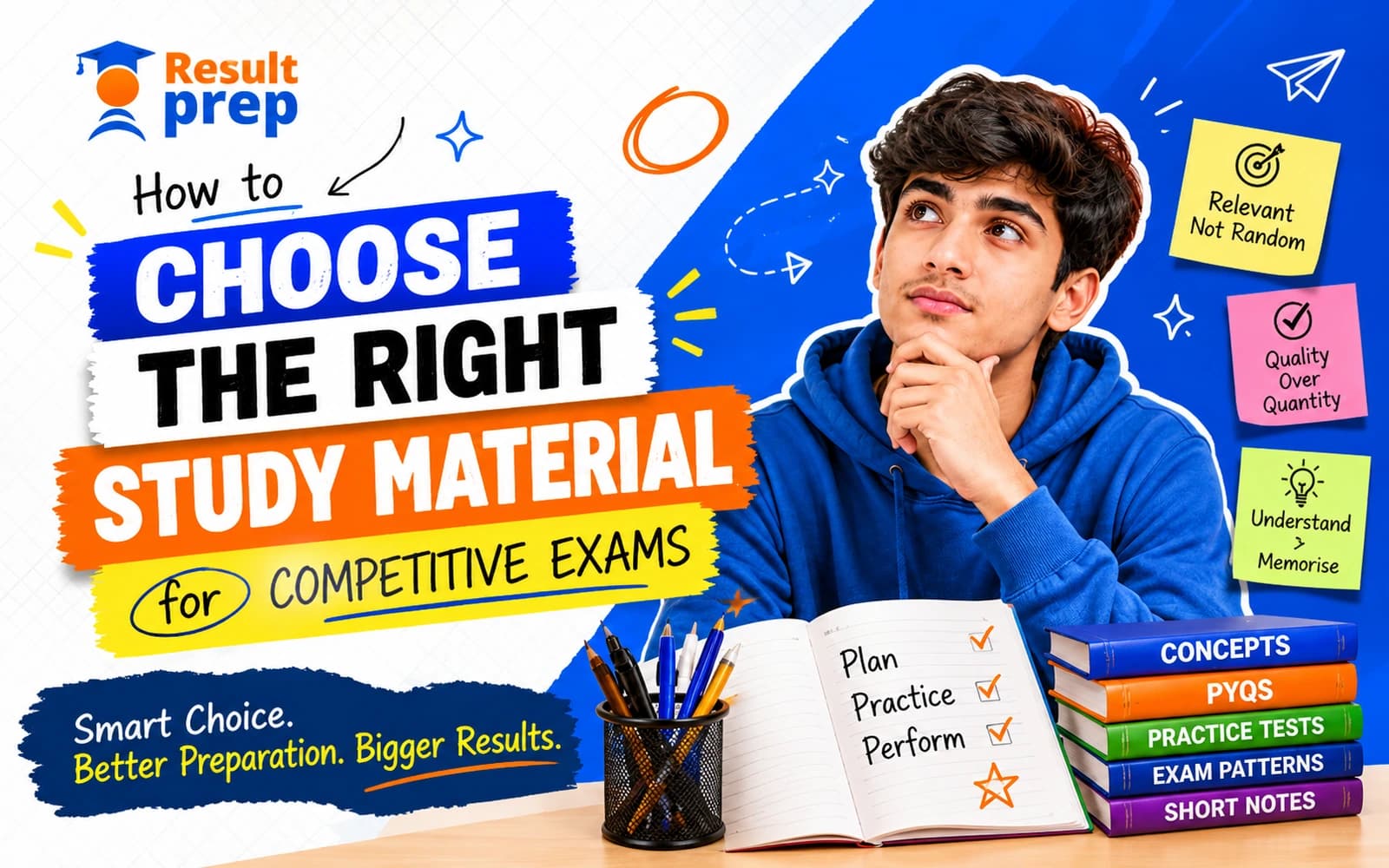
One of the first questions students ask after deciding to prepare for a competitive exam is: Which book should I study from?
The problem is that there are usually too many answers.
Search online and you can find books, PDFs, question banks, video lectures, crash courses, practice websites and multiple recommendations for the same subject. Having more resources may seem helpful, but using too many can create confusion and make preparation less organised. Current discussions among aspirants also reflect this problem of having too many competing resources.
The right study material is not necessarily the material with the largest number of pages or questions. It is the material that matches your exam syllabus, preparation level and learning needs.
Why Choosing the Right Study Material Matters
Competitive-exam preparation involves limited time. If you keep switching between different books and resources, you may repeatedly study the same topic without actually completing your preparation.
One resource may explain a concept clearly, another may provide better practice questions, while a third may contain useful previous-year questions. The challenge is deciding what you actually need.
Good study material should help you do three things:
Understand the concept
Practise applying it
Identify and correct mistakes
If a resource does not contribute meaningfully to any of these, you may not need it.
Start With the Official Exam Syllabus
Before purchasing a book or downloading study material, look at the official syllabus for your target examination.
This is particularly important because CLAT, AILET, IPMAT and CUET do not have identical exam patterns or syllabi.
A book marketed as a general competitive exam guide may contain hundreds of topics that are irrelevant to your particular examination.
Start with the syllabus and use it as a filter.
If a resource covers your required topics clearly and in sufficient depth, it becomes a candidate for your preparation. If a large portion of the material is unrelated to your exam, it may not be the most efficient choice.
Don't Choose a Book Just Because It Is Popular
A book can be widely recommended and still not be the right resource for you.
Consider questions such as:
Does it match the latest syllabus?
Is the difficulty level appropriate?
Does it explain concepts clearly?
Does it contain enough practice?
Are solutions provided?
Is the question style relevant to your exam?
Popularity can be one factor, but it should not be the deciding factor.
Your target exam should determine your resources, not the other way around.
Choose Resources According to Your Preparation Stage
The best study material can change as your preparation develops.
Beginning Your Preparation
At the beginning, you need material that explains concepts clearly and builds fundamentals.
A resource overloaded with extremely difficult questions may not be useful if you are still learning the basics.
Building Your Preparation
Once your fundamentals are stronger, you can introduce more exam-level practice.
At this stage, question banks, topic-wise exercises and previous-year questions become increasingly useful.
Closer to the Exam
Later in preparation, your focus should shift towards exam-specific practice, revision and timed tests.
You may not need another large theory book at this stage. You may benefit more from material that helps you practise and evaluate your existing knowledge.
Don't Use Five Resources for One Topic
One of the easiest ways to create study overload is to collect several resources covering exactly the same material.
For example, you might have:
A coaching module
A reference book
A second reference book
Downloaded PDFs
YouTube notes
An online question bank
If all six explain the same basic concept, moving between them can consume more time than actually studying the concept.
Choose a primary resource and use additional resources only when they solve a specific problem.
Use Different Resources for Different Purposes
There is nothing wrong with using more than one resource.
The important thing is that each resource should have a clear role.
For example:
Primary study material: concept learning
Question bank: additional practice
Previous-year papers: understanding actual exam questions
Mock tests: exam simulation and performance evaluation
Short notes: revision
This is much more effective than using five resources interchangeably.
Check Whether the Material Is Updated
Entrance exams can change their syllabus, question pattern or instructions.
This means old study material may not always reflect the current examination.
Before relying heavily on a resource, check:
Publication or update date
Whether it mentions the latest exam pattern
Whether its syllabus matches the current official syllabus
Whether its practice questions resemble recent papers
Current competitive-exam resources increasingly emphasise updating material according to the latest syllabus and patterns.
For any current exam information, however, the official examination authority should remain your primary reference.
Previous-Year Questions Are a Separate Resource
Previous-year question papers deserve special attention.
They show you what the examination has actually asked rather than what a book assumes it might ask.
Use them to understand:
Question style
Difficulty level
Topic distribution
Wording
Repeated concepts
How concepts are applied
Do not use previous-year papers only as tests. Study them as a source of information about the exam itself.
Free Resources Can Be Useful, But Be Selective
Students do not necessarily need to pay for every resource.
There are free educational websites, digital textbooks, practice resources and online learning materials available to students.
The issue is quality and relevance.
Before adding a free resource to your preparation, ask the same questions you would ask about a paid book:
Is it accurate? Is it relevant? Is it updated? Does it actually help me prepare?
Free does not automatically mean useful.
How to Tell If a Study Resource Is Actually Helping You
After using a resource for some time, evaluate it.
Ask yourself:
Am I understanding concepts better?
Am I able to solve questions after studying?
Are the explanations clear?
Are the questions relevant to my exam?
Are the solutions detailed enough to learn from?
Am I making progress or simply collecting material?
If you repeatedly struggle to understand the explanations or find that most questions are irrelevant to your exam, the resource may not be suitable for your preparation.
Avoid Constantly Searching for the Best Book
There is rarely one universally best book for every student.
A student with strong fundamentals may need more advanced practice. Another student may need clearer explanations and basic exercises.
Similarly, a CLAT aspirant may require resources designed around passage-based preparation, while an IPMAT student may need stronger quantitative practice.
The better question is not:
What is the best book for this exam?
Instead ask:
What resource best solves my current preparation problem?
That shift can make resource selection much easier.
Create a Simple Resource System
You do not need a complicated study-material plan.
For each subject or preparation area, identify:
One primary learning resource
Use this to learn and revise the core concepts.
One main practice resource
Use this to strengthen your ability to apply those concepts.
Previous-year questions
Use these to understand the actual exam.
Mock tests
Use these to practise under exam-like conditions.
This gives your preparation structure without creating unnecessary resource overload.
What If You Already Have Too Many Books?
Don't feel that you have to finish every resource you have collected.
Start by sorting them into three categories:
Essential: directly relevant to your current preparation.
Useful: helpful for specific weak areas.
Redundant: largely repeats material you already have.
Focus on the essential material first.
You can return to the useful resources when you have a specific need. The redundant ones do not need to become part of your daily preparation simply because you already own them.
Study Material Should Support Your Strategy, Not Replace It
A large collection of books does not automatically create a strong preparation strategy.
You still need to know what you are studying, why you are studying it, how you will practise it and how you will identify weaknesses.
The purpose of study material is to support that process.
The resource itself cannot decide what you need to improve.
Final Thoughts
Choosing study material for competitive exams is less about finding the biggest collection of books and more about finding the right resources for your specific exam and preparation stage.
Start with the official syllabus. Choose a reliable primary resource, add targeted practice material and use previous-year questions to understand the actual examination. Avoid constantly switching between resources simply because another book or PDF has been recommended.
A smaller, well-chosen set of resources that you actually complete is often more useful than a large collection that you rarely finish.
Prepare With a Structured Approach
Choosing resources is only one part of entrance-exam preparation. For exams such as CLAT, IPMAT, AILET and CUET, preparation also needs to account for the specific syllabus, question style and requirements of the target examination.
Book a Free Counselling Session with ResultPrep to understand how structured, exam-specific preparation can help you make better use of your study time and resources.
7 Comments
Share journey
Discussion (7)
A
Aditya Kumar
This is a very insightful article. The strategies mentioned are incredibly practical.
D
Divya Menon
I've been preparing for a few months now and these tips perfectly align with what my mentors have been saying.
R
Rohan Desai
Do you have any offline batches starting soon? I need help with the advanced topics.
S
Sneha Joshi
Bookmarked! I will be revisiting this guide before my mock tests next month.
T
Tarun Singh
The point about consistent daily practice cannot be overstated. Great read.
I
Ishita Chatterjee
Thank you for breaking down such a complex topic into actionable steps.
K
Karan Patel
I shared this with my entire study group. We were making half the mistakes listed here.