How to Improve Critical Thinking Skills as a Student
Learn how to improve your performance in competitive entrance exams with structured strategies and expert guidance.
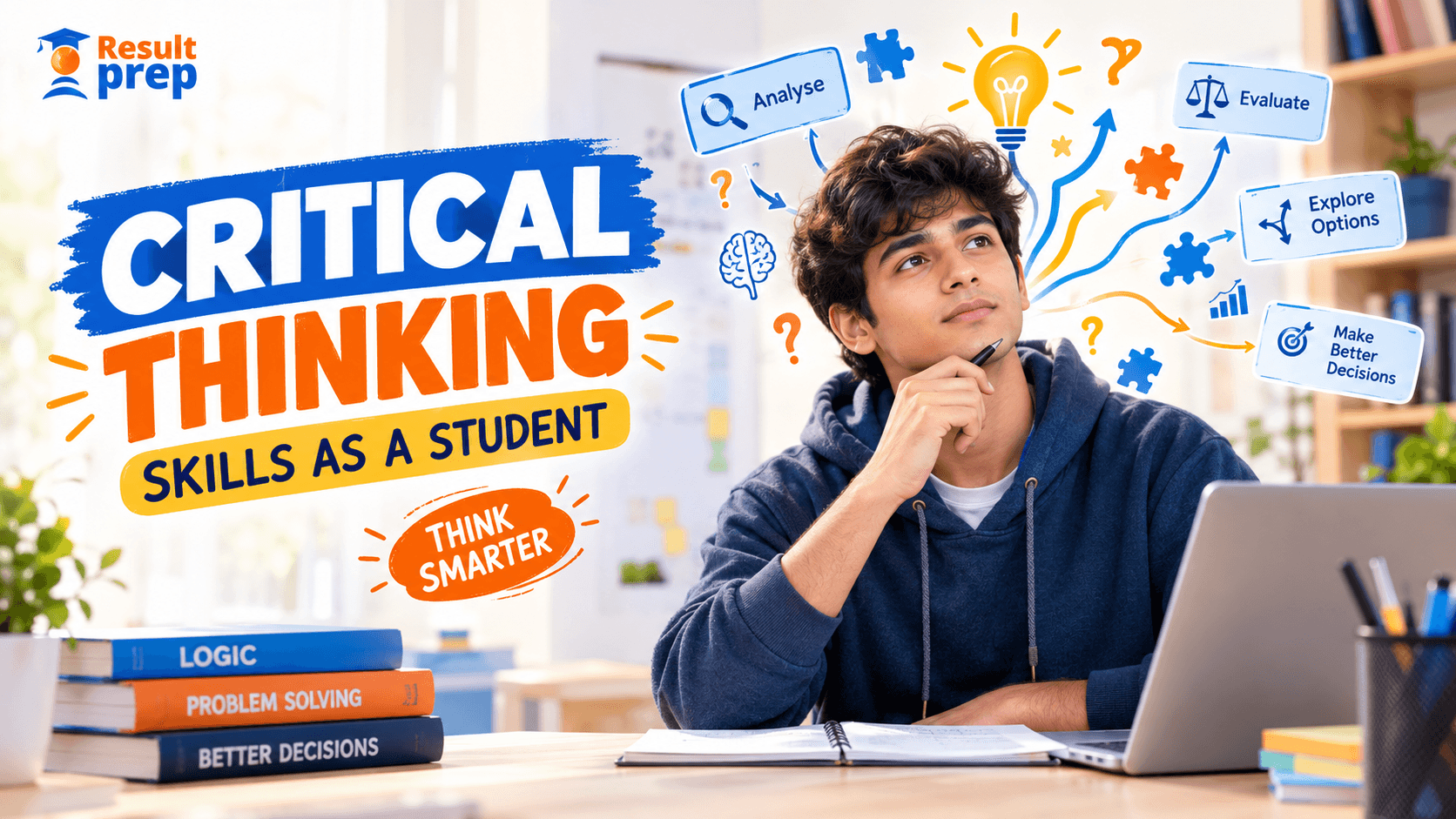
Students are surrounded by information every day. A quick search can produce hundreds of answers, opinions, videos and explanations within seconds. But having access to information does not automatically mean knowing how to judge whether that information is reliable or useful.
This is where critical thinking skills become important.
Critical thinking helps students move beyond simply accepting information. It involves asking questions, examining evidence, considering different perspectives and reaching conclusions based on reasoning. Recent education research continues to highlight critical thinking as an important skill that students need to develop across both academic and everyday situations.
What Is Critical Thinking?
Critical thinking is the ability to examine information carefully before deciding what to believe or do.
It does not mean questioning everything just for the sake of questioning it. Instead, it means learning to ask better questions and make decisions based on evidence and reasoning.
For example, when you come across a statement online, a critical thinker might ask:
Where did this information come from?
What evidence supports it?
Is there another explanation?
Is the source reliable?
Am I accepting this because it sounds convincing or because it is supported by evidence?
These habits can be useful in school, college, online research, discussions and everyday decision-making.
Why Are Critical Thinking Skills Important for Students?
1. They Help You Understand Rather Than Memorise
Memorising information can help you remember facts, but understanding requires you to connect ideas and determine how they relate to one another.
Critical thinking encourages students to ask why something is true and how different concepts connect.
This can make learning more meaningful instead of reducing every subject to a list of facts to remember.
2. They Help You Evaluate Information
Students regularly encounter information from search engines, social media, videos, AI tools, websites and other sources.
Not all information has the same level of reliability.
Learning to compare sources and examine evidence can help students distinguish between a well-supported explanation and an unsupported claim. Research on students' online searching has also examined the connection between information-search abilities, research skills and critical thinking.
3. They Improve Decision-Making
Students make decisions constantly, from choosing subjects and courses to deciding which resources to use for learning.
Instead of making a decision based only on what is popular or what someone else recommends, critical thinking encourages you to consider your own goals, available evidence and possible consequences.
4. They Encourage Independent Thinking
Independent thinking does not mean refusing advice from teachers, parents or others.
It means understanding the reasoning behind a recommendation and being able to form your own informed conclusion.
This becomes particularly useful as students move into higher education, where they are often expected to analyse information and participate more actively in their learning.
How to Develop Critical Thinking Skills
Critical thinking is not something students either have or do not have. It can be developed through regular practice.
Start Asking Better Questions
Instead of stopping at What is the answer?, try asking:
Why is this the answer?
What evidence supports it?
What assumptions are being made?
Could there be another explanation?
What information might be missing?
These questions encourage deeper thinking.
Compare Different Perspectives
When you encounter an important topic, do not immediately rely on the first explanation you find.
Read or listen to different viewpoints and identify where they agree and disagree.
You do not have to treat every viewpoint as equally correct. The purpose is to understand the reasoning behind different positions before reaching your own conclusion.
Check the Evidence
A confident statement is not necessarily a correct statement.
When evaluating information, look at the evidence behind it. Consider whether the source is credible, whether the information is supported by reliable material and whether the conclusion actually follows from the evidence.
Explain Your Reasoning
After reaching a conclusion, try explaining how you arrived at it.
If you cannot explain your reasoning clearly, you may need to examine the information again.
This simple habit can reveal gaps in your understanding and help you develop more structured thinking.
Discuss Ideas Instead of Just Defending Opinions
Good discussions are not about proving that you are always right.
Listen to another person's reasoning and consider whether their argument introduces information you had not considered.
Recent research into dialogue-based learning has found that structured discussion, questioning and consideration of different perspectives can support students' critical and reflective thinking.
Use Everyday Situations as Practice
Critical thinking does not have to happen only during study sessions.
You can practise it when reading an online article, comparing two products, evaluating a social media claim, deciding between different options or discussing an issue with a friend.
The more frequently you practise examining information and reasoning through decisions, the more naturally the process can become.
How AI Can Affect Critical Thinking
AI tools can make it easier to find explanations, generate ideas and understand difficult concepts. However, using an AI-generated answer without examining it can reduce the opportunity to think through a problem independently.
A better approach is to use AI as a starting point rather than automatically treating its response as the final answer.
Ask yourself whether the explanation makes sense, whether the information is supported and whether you can explain the concept without simply repeating the AI's response.
This distinction is becoming increasingly relevant as AI becomes part of students' everyday learning environments. A 2026 study comparing ChatGPT and college students during argumentation activities found that students demonstrated strong critical-thinking development as the discussion progressed, particularly when engaging with arguments and rebuttals.
Simple Critical Thinking Activities for Students
You can build the habit without turning it into another subject to study.
Try taking a claim from an article and identifying the evidence behind it. Pick a topic and write down two different perspectives before forming your own conclusion. When solving a difficult academic problem, explain each step rather than writing only the final answer.
You can also choose a news story or online claim and investigate where the information originated.
The goal is not to spend hours analysing every piece of information. It is to become more deliberate about the information and conclusions that actually matter.
The Difference Between Critical Thinking and Simply Knowing More
Knowing more facts can certainly be useful, but critical thinking is about what you do with those facts.
A student may know a large amount of information but still accept weak arguments without examining them. Another student may know less initially but ask better questions, look for evidence and recognise when more information is needed.
That is why critical thinking should be treated as a skill that works alongside knowledge, rather than as a replacement for learning.
Build Critical Thinking One Habit at a Time
You do not need complicated exercises to improve critical thinking.
Start by questioning assumptions, checking evidence, comparing perspectives and explaining your reasoning. Practise these habits in your academic work and everyday decisions.
Over time, you can become more confident not only in finding information, but also in understanding and evaluating it.
For students preparing for higher education, developing these habits can also make learning more active and independent.
Want guidance on developing stronger academic habits and becoming a more confident learner? Book a Free Counselling Session with ResultPrep.
7 Comments
Share journey
Discussion (7)
R
Rahul Singh
This is a very insightful article. The strategies mentioned are incredibly practical.
K
Kavya Chatterjee
I've been preparing for a few months now and these tips perfectly align with what my mentors have been saying.
V
Vikram Patel
Do you have any offline batches starting soon? I need help with the advanced topics.
N
Neha Nair
Bookmarked! I will be revisiting this guide before my mock tests next month.
A
Arjun Mehta
The point about consistent daily practice cannot be overstated. Great read.
P
Pooja Rao
Thank you for breaking down such a complex topic into actionable steps.
A
Amit Das
I shared this with my entire study group. We were making half the mistakes listed here.