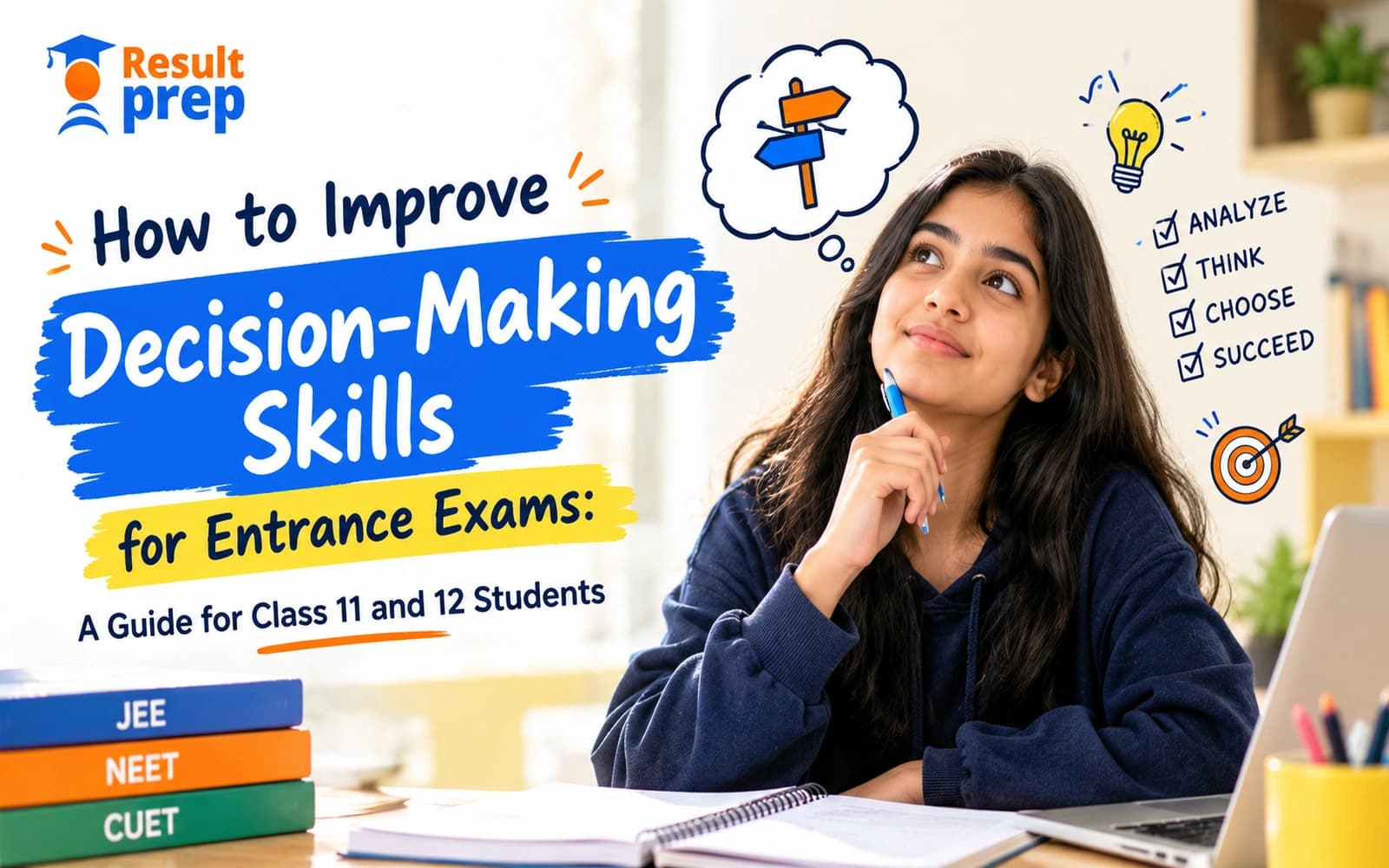
How to Improve Decision-Making Skills for Entrance Exams: A Guide for Class 11 and 12 Students
Make quick, accurate decisions under time pressure. Learn to eliminate unlikely options, manage uncertainty, and approach difficult questions strategically.
Preparing for entrance exams in Class 11 and 12 involves more than learning concepts, memorising facts, or completing practice questions. Students must also make quick, accurate decisions while solving unfamiliar problems, managing limited time, and choosing which questions deserve their attention.
Many students understand a concept but still lose marks because they misinterpret a question, select an answer too quickly, or spend too much time deciding between two options. These challenges are often linked to decision-making skills, which play an important role in aptitude-based entrance examinations.
Developing better decision-making skills can help students evaluate information, eliminate unlikely answers, manage uncertainty, and approach difficult questions more strategically. These abilities are useful across entrance exams that assess logical reasoning, quantitative aptitude, verbal ability, reading comprehension, and general awareness.
Why Decision-Making Skills Matter in Entrance Exams
Entrance examinations often test how effectively students can apply their knowledge rather than simply recall information. A question may present an unfamiliar situation, a lengthy passage, a numerical problem, or several answer options that appear equally plausible at first.
In such situations, students need to identify what the question is asking, evaluate the available information, and select the most appropriate response. Making this decision accurately can be just as important as knowing the underlying concept.
Time pressure adds another challenge. Students cannot spend several minutes analysing every question, especially when the paper contains multiple sections. They need to recognise which questions they can solve confidently, which require additional thought, and which may be better left for later.
Strong decision-making also helps students remain flexible. Instead of continuing with an approach that is not working, they can reassess the question, consider another method, or move forward to protect their overall performance.
1. Understand the Question Before Choosing an Answer
One of the most common reasons students select incorrect answers is that they begin solving a question before fully understanding it. They may notice a familiar keyword, assume they know what is being asked, and select an answer based on that initial impression.
To avoid this, read the question carefully before examining the options. Identify the central requirement and pay attention to words such as not, except, incorrect, most appropriate, and necessarily. These terms can change the meaning of an otherwise familiar question.
For reading comprehension and logical reasoning, distinguish between what the question actually states and what you believe it implies. An answer may sound reasonable in everyday life but still be incorrect if the passage or given information does not support it.
Develop the habit of briefly identifying the task before solving. Ask yourself whether the question requires a calculation, an inference, a comparison, or the identification of an assumption. This small step can prevent avoidable errors and help you choose a suitable approach.
2. Learn to Eliminate Incorrect Options Systematically
Multiple-choice questions do not always require students to identify the correct answer immediately. In many cases, eliminating clearly incorrect options is an effective way to narrow down the possibilities.
Begin by checking each option against the information provided in the question. Remove answers that contradict the passage, violate a stated condition, use an incorrect calculation, or introduce information that has not been established.
For example, a logical reasoning question may present four conclusions based on a short statement. One conclusion might contradict the statement, while another may make an assumption that the statement does not support. Eliminating these options makes the remaining choices easier to evaluate.
However, elimination should be based on evidence rather than guesswork. An option should not be rejected merely because it sounds unfamiliar, and a remaining option should not automatically be treated as correct.
With regular practice, students can become more efficient at recognising common distractors, including extreme statements, partially correct answers, and options that answer a different question from the one asked.
3. Know When to Attempt, Skip or Return to a Question
An important entrance exam skill is deciding how to allocate time across the paper. Spending too long on one difficult question can leave insufficient time for several questions that could have been answered correctly.
When you encounter a question, make an initial assessment of its difficulty. If the method is clear and the solution appears manageable, attempt it. If the question requires lengthy calculations or you cannot identify a reliable approach, consider moving to another question and returning later.
This does not mean avoiding every challenging problem. Some questions appear difficult at first but become straightforward once you identify the right method. The goal is to recognise when continued effort is productive and when it is becoming inefficient.
Your decision should also account for the examination's marking scheme. If incorrect answers attract negative marks, guessing carries a different risk than it does in an exam without negative marking. Always check the official instructions and develop an attempt strategy that reflects the actual rules.
During practice tests, record how much time you spend on difficult questions. Reviewing this information can help you recognise when you tend to persist for too long and make better choices in subsequent tests.
4. Separate Facts from Assumptions
Entrance exams often present questions that test whether students can distinguish supported conclusions from assumptions. This is particularly important in verbal reasoning, reading comprehension, critical reasoning, and data interpretation.
A fact is information directly provided or established by the question. An assumption is something you believe to be true but that has not necessarily been confirmed.
Consider a passage stating that a company introduced flexible working hours and subsequently reported higher employee satisfaction. It would be reasonable to say that satisfaction increased after the change. However, concluding that flexible working hours were the only reason for the improvement would require additional evidence.
The same principle applies to data interpretation. If a graph shows that a company's sales increased in one quarter, it does not automatically establish that its profits increased as well. Sales and profits are different measures, and the graph may not provide enough information to draw that conclusion.
Practise asking yourself three questions: What information is explicitly given? What conclusion follows from it? What additional information would be needed to support a stronger claim?
This habit can help you avoid attractive but unsupported answers.
5. Avoid Making Decisions Based on the First Impression
When students encounter a familiar-looking question, they may select an answer quickly because it resembles a problem they have solved before. Although recognising patterns can save time, relying entirely on the first impression can lead to mistakes.
A question may use familiar language while testing a different concept. Similarly, two reasoning problems may look alike but contain different conditions that change the correct answer.
Before finalising your response, verify that the method you have chosen matches the exact question. In quantitative aptitude, check the units and the quantity being requested. In reading comprehension, confirm that the answer reflects the passage rather than your personal opinion. In logical reasoning, review the conditions that determine the conclusion.
Students should also avoid changing answers without a clear reason. If you reconsider a response, identify the specific evidence or calculation that makes your original choice doubtful. Changing an answer simply because another option suddenly feels more appealing may introduce unnecessary errors.
The objective is not to spend extra time checking every response repeatedly. It is to make decisions based on the information available rather than on impulse.
6. Use Mock Tests to Practise Decision-Making Under Time Pressure
Untimed practice helps students understand concepts, but timed mock tests provide a different kind of learning experience. They require students to make decisions while balancing accuracy, speed, and the pressure of a limited examination window.
During a mock test, pay attention not only to the number of correct answers but also to the decisions that led to your result. Notice whether you spent too much time on one section, attempted questions without sufficient evidence, or skipped questions that you could have solved.
After completing the test, review questions in which your decision-making affected the outcome. A wrong answer may result from a knowledge gap, a misreading of the question, an incorrect assumption, poor time allocation, or an unnecessary change of answer. Each problem requires a different solution.
For instance, if you repeatedly choose an incorrect option because you overlook a condition, you need to improve how you read and interpret questions. If you know the method but cannot complete the calculation within the available time, you may need more targeted practice with that question type.
A mock test becomes far more useful when it helps you understand not just what went wrong, but why you made that decision in the first place.
7. Maintain a Decision-Making Error Log
Keeping a record of recurring mistakes can help students identify patterns that are difficult to notice during ordinary practice.
Instead of recording only the question and the correct answer, note the reason for the mistake. Was the question misunderstood? Did you make an unsupported assumption? Did you choose an inefficient method? Did you spend too much time trying to solve a single problem?
You can organise these observations into categories such as misinterpretation, faulty reasoning, calculation error, poor question selection, and unsupported guessing. Over time, the record may reveal that a large proportion of your mistakes come from one or two recurring habits.
Use this information to set specific improvement goals. For example, if you frequently overlook qualifying words, make careful question reading a priority during your next practice session. If you regularly spend too long on complex questions, practise identifying a sensible point at which to move on.
Revisit your error log periodically to check whether the same mistakes are becoming less frequent. This makes your preparation more focused and helps you measure progress beyond your overall mock test score.
8. Learn to Make Decisions When You Are Unsure
Not every entrance exam question will have an obvious answer. Sometimes you may narrow the choices down to two options without feeling completely confident about either one.
In these situations, avoid treating uncertainty as a reason to panic. Return to the information provided and compare the remaining options carefully. Identify which option is better supported by the question and whether one choice relies on an assumption that the other does not require.
If the question involves a calculation, estimate the expected result or check whether the answer is consistent with the given values. If it involves reasoning, test the options against the stated conditions rather than choosing the one that sounds more convincing.
You should also recognise the limits of your available information. If you cannot establish a reliable answer and the marking scheme penalises incorrect responses, skipping the question may be more sensible than making an unsupported guess.
Good decision-making does not mean being certain all the time. It means evaluating the evidence, understanding the risks, and selecting the most reasonable course of action available.
9. Strengthen Your Ability to Compare Different Approaches
Some entrance exam questions can be solved using more than one method. Choosing an efficient approach can save time and reduce the likelihood of mistakes.
In quantitative aptitude, for example, a problem may be solved through a direct formula, a ratio comparison, or the elimination of answer choices. In logical reasoning, drawing a small diagram may be more effective than repeatedly rereading a complicated set of conditions.
During practice, try to understand why a particular method works rather than memorising only the steps. When you find an alternative solution, compare the two approaches in terms of clarity, time required, and likelihood of error.
However, do not assume that the shortest-looking method is always the best one. An unfamiliar shortcut may increase the risk of mistakes, especially when you are still learning a concept. Choose the approach that you can apply accurately and efficiently.
As your understanding improves, you will become better at recognising which methods suit different question types and adapting your approach when the first method fails.
10. Build Decision-Making Skills Through Everyday Practice
Decision-making can be developed outside formal mock tests as well. Students can practise evaluating evidence, comparing alternatives, and explaining their reasoning during ordinary academic activities.
When reading a news report, distinguish between the reported facts and the writer's interpretation. When solving a difficult problem, compare different approaches and explain why one is more suitable. When discussing an issue in class, consider alternative viewpoints before reaching a conclusion.
These activities encourage students to examine information carefully instead of accepting the first explanation they encounter. They also help develop reasoning habits that can be applied to unfamiliar questions in entrance examinations.
The key is to practise deliberate thinking rather than making every activity unnecessarily complicated. Even a short exercise in identifying evidence, evaluating alternatives, or explaining a conclusion can strengthen the habits needed for better decisions.
Common Decision-Making Mistakes to Avoid During Entrance Exam Preparation
One mistake is confusing speed with efficiency. Answering quickly is useful only when the answer is supported by sound reasoning. Rushing through questions may increase the number of attempts but reduce accuracy.
Another mistake is spending too much time trying to achieve certainty on every question. Entrance exams require students to make practical choices within a fixed time, and not every question deserves equal attention.
Students should also avoid copying another student's attempt strategy without considering their own strengths, weaknesses, and the examination's marking scheme. A strategy that works for one student may not be suitable for another.
Finally, do not judge your decision-making ability based on a single mock test. Performance can vary depending on question difficulty, familiarity with the topics, and test conditions. Look for recurring patterns across multiple practice sessions before deciding what needs improvement.
Final Thoughts
Decision-making is an important part of entrance exam preparation because students must constantly interpret questions, evaluate options, manage uncertainty, and allocate their time. These skills become more reliable when students practise them deliberately and review the reasoning behind their mistakes.
For Class 11 and 12 students, the goal should be to develop a consistent approach to solving problems rather than relying on instinct alone. Careful question reading, evidence-based elimination, sensible time management, and regular mock test analysis can all contribute to better decisions during the examination.
At ResultPrep, an offline coaching centre in Bangalore, students preparing for CLAT, IPMAT, and CUET Commerce can work towards strengthening the reasoning, aptitude, and exam-taking skills relevant to their chosen entrance exams.
Want to prepare more strategically for your entrance exam? Book a free counselling session with ResultPrep to understand the preparation approach that fits your goals.
Discussion (7)
Sneha Reddy
This is a very insightful article. The strategies mentioned are incredibly practical.
Rohan Das
I've been preparing for a few months now and these tips perfectly align with what my mentors have been saying.
Divya Rao
Do you have any offline batches starting soon? I need help with the advanced topics.
Aditya Mehta
Bookmarked! I will be revisiting this guide before my mock tests next month.
Meghna Nair
The point about consistent daily practice cannot be overstated. Great read.
Amit Patel
Thank you for breaking down such a complex topic into actionable steps.
Pooja Chatterjee
I shared this with my entire study group. We were making half the mistakes listed here.