How to Improve General Knowledge for Competitive Entrance Exams: A Practical Guide for Students
Learn how to improve your performance in competitive entrance exams with structured strategies and expert guidance.
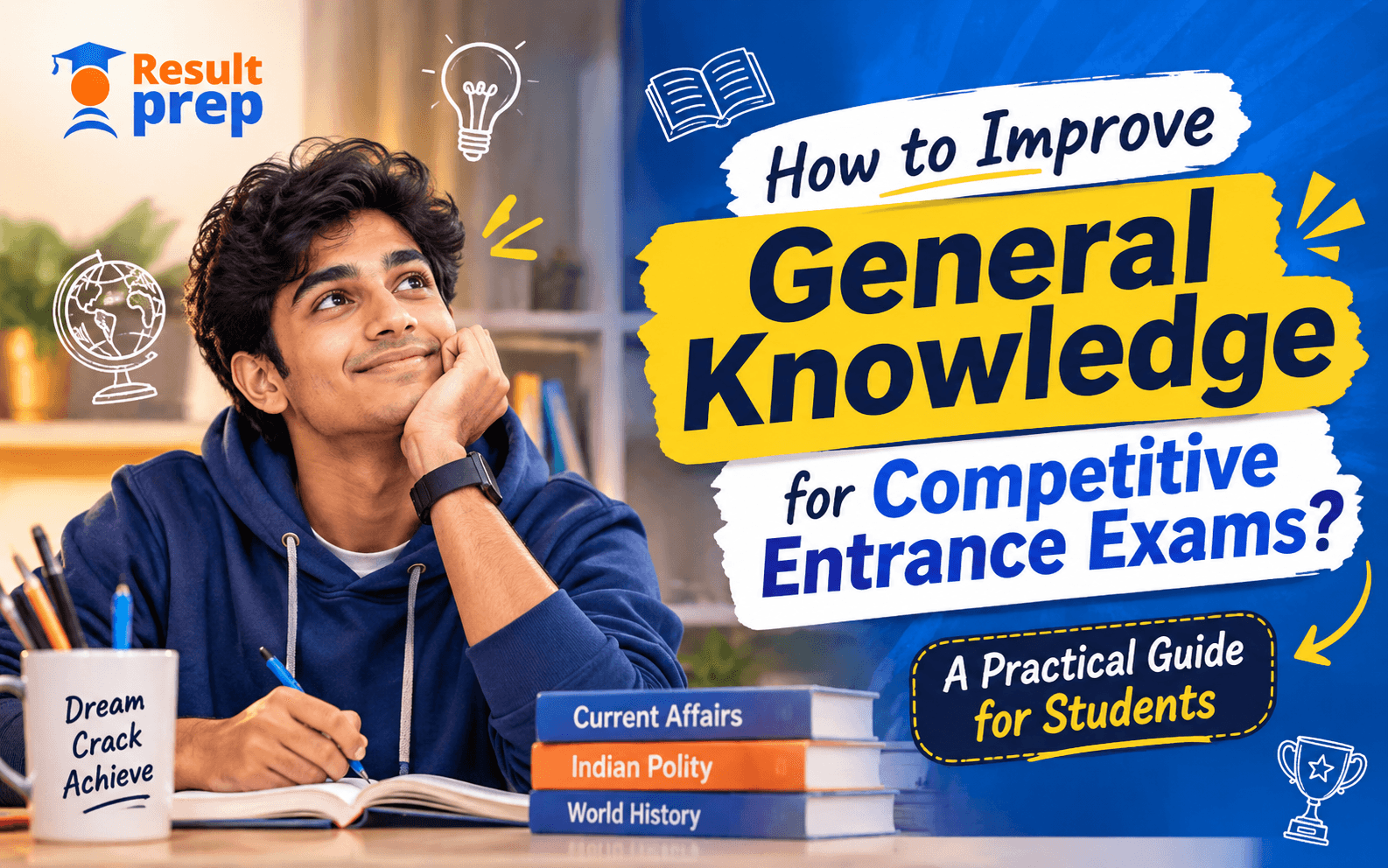
How to Improve General Knowledge for Competitive Entrance Exams: A Practical Guide for Students
General knowledge plays an important role in several competitive entrance examinations. Students are expected to understand important events, recognise significant developments and build awareness of topics beyond their school textbooks. However, preparing for general knowledge can feel confusing when there is an overwhelming amount of information available through newspapers, websites, videos and social media.
Many Class 11 and 12 students search for ways to improve general knowledge, develop awareness of important topics and prepare for general knowledge sections in entrance examinations. The challenge is not simply finding more information. It is learning how to identify relevant topics, understand them and retain useful information.
A structured approach can make general knowledge preparation more manageable while helping students develop broader awareness.
Why Is General Knowledge Important for Competitive Exams?
General knowledge helps students understand the world around them and become familiar with important developments in areas such as politics, economics, science, history, geography and international affairs.
Its importance varies across entrance examinations. For instance, CLAT includes a Current Affairs, including General Knowledge, section that requires students to engage with news and related background information. Other entrance examinations may assess general awareness differently or may not have a dedicated general knowledge section at all.
Students should therefore understand the specific requirements of their target examination before deciding how much time to allocate to this area.
Beyond entrance exams, general knowledge also helps students develop informed opinions, understand public discussions and connect classroom learning with real-world events.
Understand the Difference Between General Knowledge and Current Affairs
General knowledge and current affairs are related, but they are not identical.
General knowledge includes information about subjects such as history, geography, important institutions, scientific developments, culture and the functioning of government. Much of this information remains relevant over long periods.
Current affairs focuses on recent developments and events. These may include government decisions, international developments, economic changes, important appointments, awards, sports events and major scientific discoveries.
Some competitive examinations connect the two. A recent news event may require students to understand its historical, political or economic background.
For this reason, students should avoid treating general knowledge preparation as simply memorising daily headlines. Building background knowledge can help them understand why an event matters and how it connects to a larger issue.
Start With the Official Requirements of Your Entrance Exam
Before selecting study resources, check whether general knowledge is part of your target examination and understand how it is assessed.
For CLAT aspirants, current affairs and general knowledge preparation should focus on significant events, relevant background information and the ability to understand information presented through passages.
IPMAT aspirants should prioritise the sections and skills specified by their chosen institute's examination pattern. General knowledge should not take time away from essential quantitative aptitude and verbal ability preparation unless the relevant examination specifically requires it.
Similarly, CUET Commerce students should follow the official syllabus and requirements for their chosen programmes rather than assuming that general knowledge is a compulsory component of every paper.
A clear understanding of the examination pattern prevents students from spending time on irrelevant information.
Choose Reliable Sources for General Knowledge Preparation
One of the biggest challenges students face is deciding what to read. There is no shortage of online information, but not every source is accurate, useful or suitable for entrance exam preparation.
Choose a small collection of reliable resources instead of following dozens of websites and social media accounts. Newspapers, official government publications, recognised educational resources and established reference materials can help students build a stronger information base.
For important developments, verify details using credible sources. This is particularly important when information involves government policies, statistics, international relations or official appointments.
Avoid relying entirely on short social media posts or forwarded messages. They may omit context or present incomplete information, making it difficult to understand the actual significance of an event.
Focus on Important Topics Instead of Memorising Everything
Students often assume that improving general knowledge requires remembering every event they encounter. This approach can quickly become overwhelming.
Instead, prioritise topics that are relevant to your examination and have wider significance. Major national developments, international relations, important economic decisions, environmental issues, scientific achievements and significant institutional changes may deserve closer attention depending on the exam.
When studying a topic, understand the basic facts first. Identify what happened, who was involved, where it happened and why it matters. Then explore the background and any important consequences.
This approach helps students build connected knowledge rather than memorising isolated facts that are difficult to recall later.
Read Newspapers With a Purpose
Newspaper reading can be useful for developing general awareness, but students should not feel that they need to read every page.
Start with sections relevant to your examination. Pay attention to major national and international developments, economic news, government decisions, science and environmental issues.
When you encounter an important story, try to understand the context rather than simply noting its headline. For example, a government policy announcement may be connected to a larger economic or social issue. Understanding that connection can make the information more meaningful.
Avoid copying entire articles into notebooks. Write concise notes containing the important facts, background and significance of the development.
The purpose of reading is to understand information, not to accumulate pages of notes.
Make General Knowledge Notes That Are Easy to Revise
Students preparing for entrance examinations often collect too much information in their notebooks. Long notes can become difficult to revise, particularly when several months of preparation need to be covered.
Use a simple structure to organise information by topic. For example, separate national affairs, international developments, economy, science, environment, awards and important institutions where these categories are relevant to your examination.
Keep each entry focused on the most useful information. Include important names, dates, places, organisations and the context behind the event.
For topics that develop over time, update your notes when significant new information becomes available. This helps you understand how an issue has evolved rather than treating every development as an unrelated event.
Connect Current Events With Static General Knowledge
An effective general knowledge preparation strategy combines recent developments with the background information needed to understand them.
Suppose you read about an international summit. Instead of memorising only its date and location, learn about the organisation that conducted it, the participating countries and the main purpose of the meeting.
Similarly, if you study an important environmental agreement, understand the issue it addresses and the broader context behind its creation.
This connection makes information easier to understand and can help students approach questions that test background knowledge rather than direct recall alone.
For examinations that use passage-based current affairs questions, understanding the context is particularly valuable.
Use Quizzes and Practice Questions to Test Your Knowledge
Reading and note-making are useful, but students also need to check whether they can recall and apply the information they have studied.
Short quizzes and topic-wise practice questions can help identify gaps in understanding. They also provide an opportunity to revisit information that may have been forgotten.
Use questions from reliable educational resources and previous examination papers where available. Make sure the practice material reflects the actual requirements of your target examination.
Do not treat quiz scores as the only measure of progress. If you answer a question incorrectly, revisit the topic and understand the relevant information rather than memorising only the correct option.
How Much Time Should You Spend on General Knowledge?
The amount of time required depends on the examination, the student's existing knowledge and the overall preparation schedule.
For CLAT aspirants, regular current affairs and general knowledge preparation is important because the section requires familiarity with significant developments and their background. Students should build a consistent reading and revision routine rather than attempting to cover everything shortly before the examination.
For IPMAT and CUET Commerce aspirants, time allocation should be guided by the specific examination pattern and the subjects being assessed. Students should not allow general awareness activities to interfere with preparation for their core examination sections.
A practical approach is to include a manageable reading session, brief note-making and periodic revision in the weekly schedule.
Common General Knowledge Preparation Mistakes to Avoid
One common mistake is collecting information from too many sources. Switching between multiple newspapers, websites and videos can create duplication and make revision difficult.
Another mistake is memorising facts without understanding their context. This may help with straightforward recall questions but can be less useful when an examination requires interpretation or background knowledge.
Students should also avoid postponing revision. Information collected over several months can become difficult to remember if it is never revisited.
Finally, do not prepare general knowledge without considering the target examination. A topic may be interesting and informative but still have limited relevance to the examination you are preparing for.
How to Make General Knowledge Preparation a Long-Term Habit
Developing general knowledge is not a one-day activity. It requires regular exposure to reliable information and an interest in understanding developments beyond the classroom.
Start with a manageable reading routine and gradually expand your understanding of important subjects. Discuss significant events, ask questions about unfamiliar topics and use reliable reference material when you need additional context.
Students should also learn to distinguish between verified information, opinion and speculation. This is an important habit when consuming news and researching unfamiliar subjects.
With consistent effort, general knowledge preparation can become a natural part of your academic routine instead of an overwhelming task.
Prepare for Competitive Entrance Exams With ResultPrep
General knowledge preparation becomes more effective when students understand what their target examination requires and follow a structured approach to learning. Building awareness, connecting current events with background knowledge and revising important information can help students prepare more confidently.
ResultPrep offers offline coaching in Bangalore for CLAT, IPMAT and CUET Commerce aspirants. With structured classes, faculty guidance and examination-focused preparation, students can work towards developing the knowledge and skills required for their chosen entrance examinations.
If you are in Class 11 or 12 and planning to appear for a competitive entrance exam, book a free counselling session with ResultPrep to understand your preparation requirements and plan your next steps.
7 Comments
Share journey
Discussion (7)
M
Meghna Joshi
This is a very insightful article. The strategies mentioned are incredibly practical.
A
Aditya Singh
I've been preparing for a few months now and these tips perfectly align with what my mentors have been saying.
D
Divya Chatterjee
Do you have any offline batches starting soon? I need help with the advanced topics.
R
Rohan Patel
Bookmarked! I will be revisiting this guide before my mock tests next month.
S
Sneha Nair
The point about consistent daily practice cannot be overstated. Great read.
T
Tarun Mehta
Thank you for breaking down such a complex topic into actionable steps.
I
Ishita Rao
I shared this with my entire study group. We were making half the mistakes listed here.