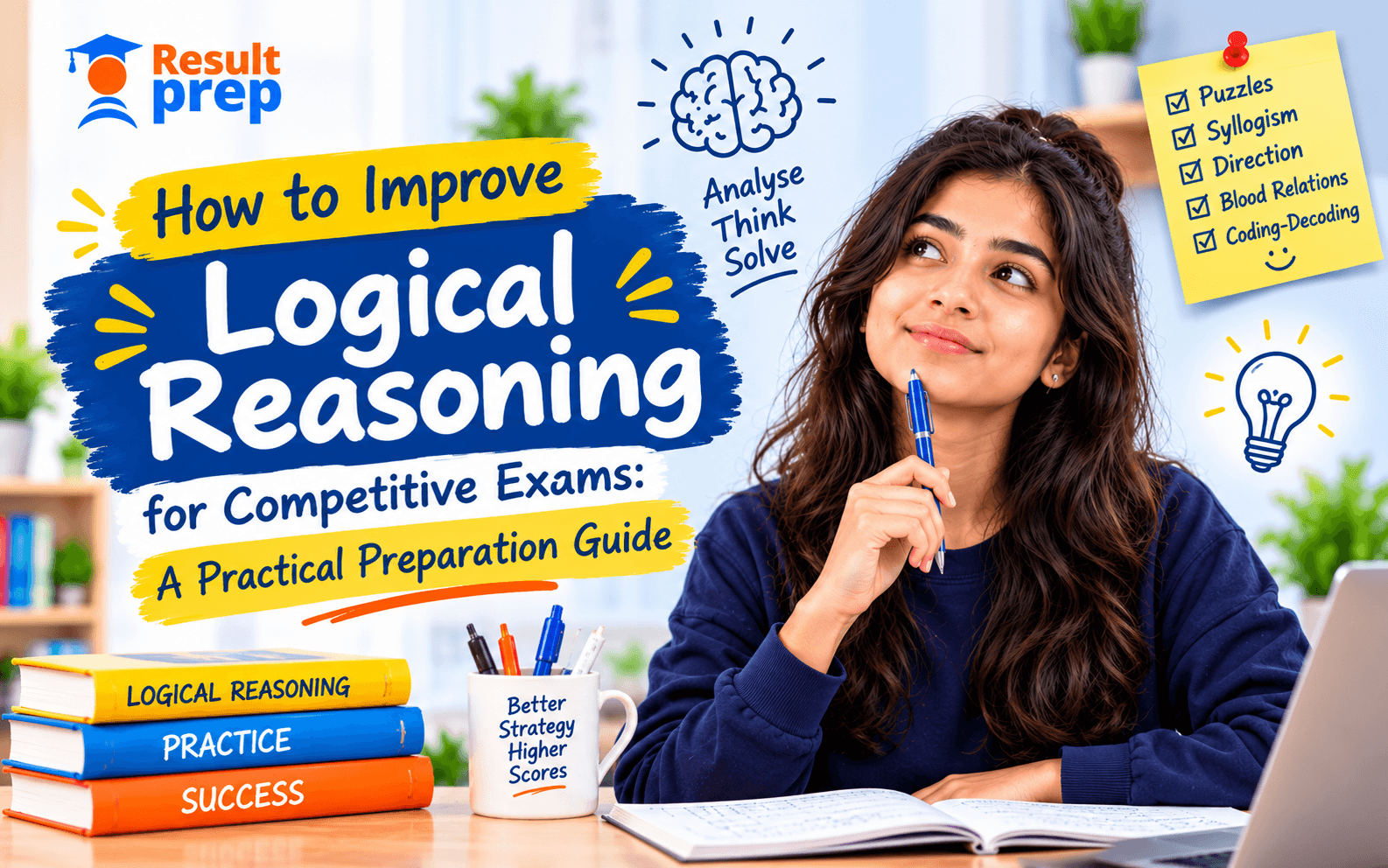
How to Improve Logical Reasoning for Competitive Exams: A Practical Preparation Guide
Learn how to improve your performance in competitive entrance exams with structured strategies and expert guidance.
Logical reasoning is one of the sections where students often discover that memorising concepts is not enough. You may understand the basic rules but still struggle when a question presents unfamiliar information, multiple conditions or a tricky pattern.
That is because logical reasoning tests how well you can analyse information, identify relationships and reach a conclusion. These skills are relevant across several competitive and entrance examinations, although the exact topics and question formats vary by exam.
If you are wondering how to improve logical reasoning for competitive exams, the answer is not simply to solve hundreds of questions randomly. You need to understand the question types, develop a systematic approach and gradually improve both accuracy and speed.
What Is Logical Reasoning in Competitive Exams?
Logical reasoning questions require you to use the information provided in a question to identify a pattern, relationship, conclusion or valid possibility.
Depending on the examination, you may encounter topics such as:
Syllogisms
Coding and decoding
Blood relations
Direction and distance
Series and patterns
Seating arrangements
Puzzles
Statements and conclusions
Assumptions and inferences
Data sufficiency
Critical reasoning
The exact combination differs between exams. For example, logical reasoning is an important component of law entrances such as CLAT and AILET, while other aptitude-based examinations may include a broader range of reasoning problems.
Why Do Students Find Logical Reasoning Difficult?
One reason is that reasoning questions rarely follow one fixed formula.
In mathematics, you may learn a formula and apply it to a familiar type of problem. In logical reasoning, the same topic can be presented in different ways.
A seating arrangement question, for example, may introduce additional conditions that require you to reorganise your approach. Similarly, a critical reasoning question may require you to distinguish between what is directly stated and what can reasonably be inferred.
This is why logical reasoning preparation requires variety of practice, not just repetition of the same question pattern. Preparation guidance for reasoning-heavy entrance exams also emphasises exposure to different question types.
Start by Understanding the Type of Reasoning Question
Before trying to solve difficult questions, become familiar with the major categories that appear in your examination.
Do not try to memorise every possible question format. Instead, understand what each category is testing.
For example, syllogisms test relationships between statements, while direction-based questions require you to track movement and position. Seating arrangements involve organising information according to multiple conditions.
Once you recognise the underlying structure, an unfamiliar question becomes easier to approach.
Learn the Logic Before Learning Shortcuts
Shortcuts can be useful, but they should come after understanding the reasoning behind a question.
If you memorise a trick without understanding why it works, you may struggle when the question changes slightly.
Start by asking:
What information has been given?
What needs to be determined?
What relationship connects the information?
Which possibilities can be eliminated?
This approach helps you build reasoning ability rather than simply memorising patterns.
Practise One Reasoning Topic at a Time
Trying to solve every type of reasoning question from the beginning can make preparation feel unnecessarily difficult.
Instead, begin with one topic.
Learn the basic approach, solve straightforward questions and then gradually move towards more complex problems. Once you are comfortable with that topic, introduce another.
For example, you might begin with simpler areas such as directions, rankings or basic syllogisms before moving towards more complicated arrangements and multi-condition puzzles.
This creates a stronger foundation without making preparation overwhelming.
Focus on Why an Answer Is Correct
Getting an answer right is useful, but understanding why it is right is more important.
After solving a reasoning question, briefly reconstruct the logic:
What information was essential?
Which condition determined the answer?
Which options could be eliminated immediately?
Was there another possible interpretation?
Did you use every relevant piece of information?
This habit is particularly valuable when you encounter unfamiliar questions later.
Learn to Eliminate Impossible Options
Option elimination is one of the most useful skills in multiple-choice reasoning.
You do not always need to construct the complete solution immediately. Sometimes one condition in the question is enough to eliminate several options.
Suppose a question establishes that one person cannot occupy a particular position. Any option placing that person there can immediately be rejected.
The more quickly you identify contradictions, the less time you spend examining options that cannot possibly be correct.
Draw Diagrams When the Question Requires One
Trying to keep a complicated reasoning problem entirely in your head can make it harder than necessary.
Use simple diagrams when appropriate.
For a seating arrangement, sketch the positions.
For directions, draw the movement.
For family relationships, create a basic relationship tree.
For ordering questions, write the sequence.
The purpose is not to create beautiful notes. It is to convert information into a structure that you can analyse more easily.
Practise Different Difficulty Levels
Solving only easy questions can create false confidence.
Once you understand a topic, introduce moderate and difficult questions. This teaches you how the underlying logic changes when additional conditions are introduced.
At the same time, do not abandon basic questions. They help reinforce the fundamentals and improve confidence.
A useful progression is:
Understand - Practise - Increase difficulty - Review
This keeps practice purposeful rather than turning it into random question solving.
How Much Logical Reasoning Should You Practise Every Day?
There is no universal number of questions that every student needs to solve.
Quality matters more than an arbitrary daily target.
A focused practice session could involve learning one concept, solving a set of questions and reviewing the ones you found difficult. As your preparation progresses, you can increase the complexity and introduce timed practice.
The important part is consistency.
Logical reasoning improves through repeated exposure to different ways of presenting information. Current preparation resources similarly emphasise regular practice and familiarity with varied reasoning question types.
Keep a Record of Reasoning Questions You Could Not Solve
When you get a reasoning question wrong, do not immediately move on.
Ask yourself what caused the difficulty.
Perhaps you misunderstood one condition. Maybe you created the wrong arrangement. Perhaps you overlooked an implication or selected an option too quickly.
Write down the underlying reason in a simple error log.
Over time, this can reveal patterns in your preparation. You may discover that your problem is not logical reasoning as a whole but one specific type of question.
Don't Memorise Patterns Without Understanding Them
One common preparation mistake is trying to remember the exact method used for every question encountered during practice.
This can become difficult because competitive exams can change the presentation of a familiar concept.
Instead of remembering one question, understand the principle behind it.
If you understand how to approach the underlying logic, you can adapt when the question looks different.
Improve Your Reasoning Speed Gradually
Speed should come after accuracy.
If you rush through reasoning questions before developing a reliable method, you may simply become faster at making mistakes.
Begin by solving questions carefully. Once your accuracy becomes consistent, introduce time limits.
Eventually, you should be able to recognise familiar structures quickly and decide how to approach them without spending unnecessary time figuring out where to begin.
Use Exam-Specific Practice
Logical reasoning is not identical across every competitive exam.
The topics, difficulty level, question style and importance of the section can vary considerably. Current preparation resources, for instance, describe CLAT logical reasoning as heavily connected to passages and argument analysis, while other exams may emphasise puzzles, arrangements or traditional reasoning formats.
Therefore, once you have built your basic reasoning skills, shift towards questions that reflect your target examination.
This helps you become comfortable with the actual style of questions you are likely to encounter.
Final Thoughts
Improving logical reasoning for competitive exams is less about finding one shortcut and more about learning how to think through unfamiliar information.
Build your fundamentals, practise different question types, use diagrams when necessary and learn to eliminate impossible options. Most importantly, analyse the reasoning behind your answers instead of simply checking whether they are right or wrong.
With consistent practice, questions that initially seem unfamiliar can become much easier to break down into smaller logical steps.
Build Stronger Competitive Exam Preparation
Logical reasoning is only one part of successful entrance-exam preparation. A structured approach can help you combine concept building, question practice and exam-specific preparation more effectively.
Book a Free Counselling Session with ResultPrep to understand how personalised competitive-exam preparation can support your goals.
7 Comments
Share journey
Discussion (7)
S
Siddharth Verma
This is a very insightful article. The strategies mentioned are incredibly practical.
A
Anjali Gupta
I've been preparing for a few months now and these tips perfectly align with what my mentors have been saying.
K
Karan Mathur
Do you have any offline batches starting soon? I need help with the advanced topics.
I
Ishita Sharma
Bookmarked! I will be revisiting this guide before my mock tests next month.
T
Tarun Kapoor
The point about consistent daily practice cannot be overstated. Great read.
S
Sneha Reddy
Thank you for breaking down such a complex topic into actionable steps.
R
Rohan Das
I shared this with my entire study group. We were making half the mistakes listed here.