How to Use AI for Studying Without Becoming Dependent on It
Learn how to use AI as an effective study companion without losing critical thinking skills. Discover strategies for concept breakdown, practice questions, and independent problem-solving.
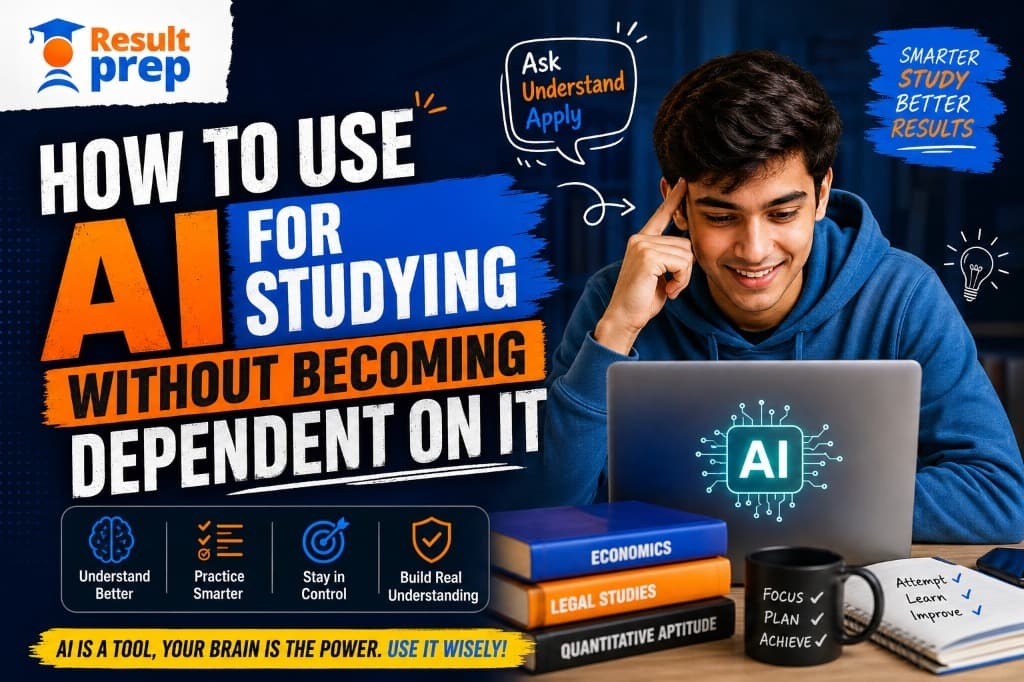
Artificial intelligence has rapidly become an everyday part of how modern students learn. Instead of spending hours scouring different search engines and dense websites for an explanation, students can now prompt an AI tool to simplify a difficult concept, unpack a complex formula, or help organize their study thoughts in seconds.
For students, this immediacy is remarkably powerful. But it also raises an urgent, pivotal question: How should you use AI for studying without allowing it to do all the heavy thinking for you?
The answer is certainly not to ban or avoid AI completely. Rather, it is about understanding precisely where AI can augment your comprehension—and where you must enforce strict boundaries to do the cognitive work yourself.
"AI is a powerful cognitive bicycle, not an autopilot. If the machine pedals for you, your mental muscles will never develop the strength needed to clear high-stakes exams."
How Are Students Using AI for Studying?
From secondary school through competitive entrance preparation, students are leveraging AI for a wide range of learning tasks: breaking down abstract theories, drafting essay outlines, generating custom practice problems, and debugging numerical solutions. Academic reporting on Indian students in 2026 highlights how generative tools have embedded themselves into daily homework routines and test preparation.
For any aspirant, the greatest advantage is frictionless accessibility. If an explanation in your NCERT or coaching material feels obtuse at midnight, an AI tool can reframe that paragraph in plain English instantly. However, that seamless convenience quickly turns counterproductive when students mistake reading an AI summary for actual learning.
Can AI Actually Help You Understand Difficult Topics?
Yes—when used as an interactive tutor rather than an answer vending machine.
Suppose you have read a concept—such as the Keynesian multiplier in Economics, Henri Fayol's Unity of Direction in Business Studies, or conditional probability in Quant—multiple times without clarity. You can instruct an AI tool to:
- "Explain this concept to a 10th-grade student using an intuitive real-world analogy."
- "Provide a step-by-step breakdown of how this formula was derived without skipping intermediate logic."
- "Compare this concept with its most common counter-concept and show where students confuse them."
The Golden Rule: Once you read the AI's explanation, close the browser tab immediately. Take a blank sheet of paper and write out the concept in your own handwriting, using your own words. If you cannot explain it without looking, you haven't mastered it yet.
Use AI to Ask Better Questions, Not Just Broad Demands
A common pitfall is pasting entire chapters or essay prompts with vague commands like "Explain everything about Microeconomics." This passive habit produces bloated, generic responses that require zero cognitive engagement from your brain.
Instead, treat AI like a sparring partner for specific friction points:
High-Yield Study Prompt: "I understand that Kesavananda Bharati established the Basic Structure Doctrine, but I am confused about why Parliament's amending power under Article 368 cannot alter it. Can you explain the constitutional logic in 3 concise points?"
Targeted prompting forces you to identify what you already know and pinpoint the exact intellectual gap causing difficulty.
AI Can Help You Generate Custom Practice Questions
Solving diverse questions is essential for competitive examinations like CLAT, IPMAT, and CUET. AI can instantly produce customized drill sets on topics you have just finished reviewing:
- Ask for 5 caselet-based questions on a specific Business Studies topic.
- Request Reading Comprehension passages containing philosophical or economic arguments followed by inference-based questions.
- Generate Data Interpretation sets testing specific ratio-to-percentage conversions.
Use AI for Feedback, Not Just Final Answers
One of the most damaging habits is querying an AI tool for the final answer before making a genuine independent attempt. Doing so robs your brain of the struggle that builds neural pathways.
Follow this discipline instead:
- Attempt the math problem or legal passage yourself on paper.
- If your answer doesn't match the answer key, paste your written working into the tool and ask: "Where did my reasoning or calculation break down in Step 3?"
- For essay or analytical writing, write your draft first, then ask AI: "Identify the 2 weakest arguments in this draft and highlight where the transition between paragraphs feels abrupt."
This transforms AI from a crutch that replaces your effort into a diagnostic mirror that refines your skills.
Don't Let AI Replace Your Own Notes
While an AI can synthesize a 40-page chapter into a bulleted summary in 3 seconds, receiving that summary creates an illusion of competence. You feel as though you understand the material simply because the text looks clean and coherent.
The act of making your own notes—filtering noise, deciding what is vital, diagramming relationships, and phrasing definitions—is where learning happens. Use AI only after your notes are complete to check if you missed a critical nuance or statutory amendment.
Why Over-Dependence on AI Can Derail Exam Success
Competitive entrance exams (CLAT, IPMAT, CUET, AILET) are closed-book, high-pressure environments. In the examination hall:
- You will not have an AI assistant to parse dense legal principles.
- You will not have an algorithm to calculate time-speed-distance shortcuts.
- You must rely entirely on your own working memory, pattern recognition, and test temperament.
If you have outsourced reading, synthesis, and problem-solving to an AI throughout your preparation year, your cognitive speed and stamina will falter when faced with 120 timed questions in a proctored hall.
The 3-Step Golden Rule: How to Use AI Without Dependency
Step 1: Attempt First
Read the textbook or solve the problem with zero digital aids. Make your brain sweat before reaching for assistance.
Step 2: Use AI Second
Use AI strictly to clarify the specific point of confusion, request an analogy, or diagnose an error in your working.
Step 3: Verify & Retest
Close the AI interface. Re-solve the problem or explain the concept independently, and cross-check against authoritative syllabus material.
AI Cannot Replace Mentorship, Mock Analysis, or Discipline
An AI tool can explain a concept, but it cannot observe your mock test habits. It cannot tell you that you rushed through English in 18 minutes because of anxiety, or that your Quant score dipped because of poor question selection rather than lack of formulas.
True exam readiness requires comprehensive oversight: diagnosing error patterns, mastering pacing under negative marking, and receiving seasoned feedback from educators who understand the competitive benchmark of top NLUs and IIMs.
Need Guidance for Your Entrance Exam Preparation?
AI can help you clarify individual topics, but building a winning strategy for CLAT, IPMAT, or CUET Commerce requires looking at the full picture—personalized study schedules, rigorous proctored mocks, and 1:1 mentorship.
At ResultPrep Bangalore, our classroom and mentoring programs blend structured conceptual training with analytical test strategies to help you get into top NLUs, IIMs, and central universities.
Book a free diagnostic counselling session with ResultPrep today to map out your 2027 preparation blueprint.
Discussion (7)
Anjali Patil
This is a very insightful article. The strategies mentioned are incredibly practical.
Siddharth Kumar
I've been preparing for a few months now and these tips perfectly align with what my mentors have been saying.
Priya Menon
Do you have any offline batches starting soon? I need help with the advanced topics.
Manish Desai
Bookmarked! I will be revisiting this guide before my mock tests next month.
Simran Joshi
The point about consistent daily practice cannot be overstated. Great read.
Rahul Singh
Thank you for breaking down such a complex topic into actionable steps.
Kavya Chatterjee
I shared this with my entire study group. We were making half the mistakes listed here.
Related Articles in Study Skills & Productivity
How to Improve Reading Comprehension for Entrance Exams
Struggling with dense passages, tricky inferences, and time pressure in CLAT, IPMAT, or CUET? Discover paragraph-mapping frameworks, option-elimination tactics, and daily reading habits to master RC.

How to Stop Phone Distractions While Studying: Practical Tips for Students
Losing hours of study time to Instagram Reels, YouTube Shorts, and endless notifications? Learn practical, science-backed strategies to tame digital distractions and reclaim your focus.

How to Deal With Exam Stress: Practical Ways to Stay Calm and Focused
Overwhelmed by exam anxiety, parental pressure, or mock test results? Discover evidence-based mental frameworks, daily routines, and stress management tools to stay composed and perform your best.