IPMAT Preparation: Your Essential Guide to Success in Management Entrance
Aiming for IIM Indore, Rohtak, or Ranchi after Class 12? Discover the essential IPMAT roadmap covering Quant SA & MCQ tactics, Verbal mastery, mock audits, and interview preparation.
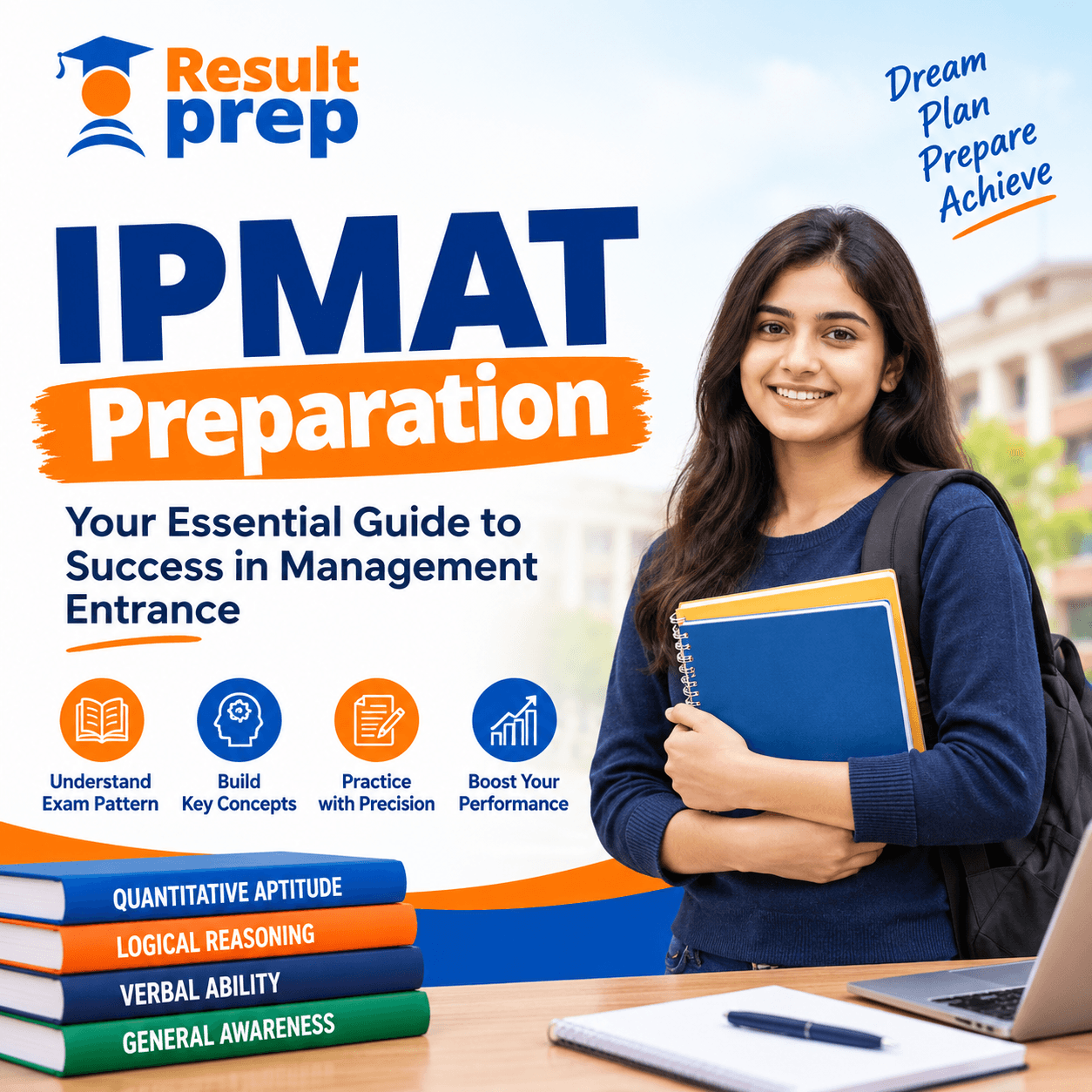
The Integrated Programme in Management Aptitude Test (IPMAT) offers one of the most prestigious academic pathways in India: direct admission into premier Indian Institutes of Management (IIMs) immediately after Class 12. Pioneered by IIM Indore and now adopted in various formats by IIM Rohtak, IIM Ranchi, IIM Bodh Gaya, IIM Jammu, and IIFT, the 5-year integrated BBA+MBA programme transforms ambitious high schoolers into corporate leaders.
With thousands of top-tier commerce, humanities, and science students competing for a limited cohort of seats, cracking IPMAT requires more than basic textbook problem-solving. Success demands an organized, high-precision strategy combining conceptual quantitative mastery, speed-reading instincts, intelligent question selection, and interview poise.
The IPMAT Dual Challenge: Speed vs. Depth
IPMAT Indore uniquely splits its quantitative section into Short Answer (SA) and Multiple Choice (MCQ) formats alongside Verbal Ability (VA). Because Short Answer questions carry zero negative marking, while MCQs enforce a punishing -1 penalty, your tactical approach must shift between aggressive attempts and strict accuracy safeguards.
Understanding the Core Sections of IPMAT
While the testing format varies slightly between IIM Indore (IPMAT Indore), IIM Rohtak (IPMAT Rohtak), and IIM Bodh Gaya/Jammu (JIPMAT), the underlying competencies tested across management entrances remain unified:
| Section | Primary Topics & Focus | High-Yield Testing Skills |
|---|---|---|
| Quantitative Ability (SA - Short Answer) | Pure numerical entry without options; Arithmetic, Algebra, Number Systems | Concept depth and calculation precision. Crucially: No negative marking! |
| Quantitative Ability (MCQ) | Higher Math, Geometry, Modern Math (Permutations, Probability, Matrices), Functions | Speed problem-solving, option substitution, and eliminating impossible distractors. |
| Verbal Ability (VA & RC) | Reading Comprehension, Para Jumbles, Sentence Completion, Idioms, Critical Reasoning | Rapid contextual inference, grammatical precision, and tone analysis. |
Building Non-Negotiable Math Fundamentals
Do not attempt advanced shortcuts until your conceptual foundation is unshakable. Categorize your quantitative preparation into two distinct tiers:
Core Commercial Arithmetic
- Percentages, Profit & Loss, Simple & Compound Interest
- Ratios, Proportions, Mixtures & Alligations
- Time, Speed & Distance (Races, Relative Speed)
- Time & Work, Pipes & Cisterns
Algebra & Modern Higher Math
- Linear, Quadratic equations & Polynomials
- Progressions (AP, GP, HP) & Logarithms
- Permutations, Combinations & Probability
- Coordinate Geometry, Trigonometry & Matrices
Mastering Verbal Ability & Reading Comprehension
Verbal Ability is often the deciding factor that pushes candidates above the sectional cutoffs. Cultivate these daily habits:
- Daily Editorial Immersion: Read one long-form analytical essay daily from publications like The Hindu, Project Syndicate, or Aeon Essays to develop speed without sacrificing retention.
- Para Jumble Logic: Focus on mandatory pairs, pronoun references, and chronological sequencing rather than reading sentences in isolation.
- Contextual Vocabulary: Learn words in structural usage rather than memorizing isolated alphabetical lists. Note connotations and tone markers.
The Pacing Game: Accuracy Before Speed
In competitive aptitude exams, speed is an outcome of conceptual clarity, not a standalone skill. Follow the progressive 3-step execution ladder:
- Stage 1 (Untimed Accuracy): Solve 30 practice problems without a timer until your accuracy exceeds 85%.
- Stage 2 (Time-Capped Sets): Introduce a stopwatch with a target of 90 seconds per quantitative problem and 60 seconds per verbal question.
- Stage 3 (Sectional Simulation): Enforce strict sectional timing (40 minutes per section for IPMAT Indore) to simulate mental fatigue and time pressure.
The Mock Test Feedback Loop
Taking a mock test without deep error analysis is ineffective. After every full-length IPMAT simulation, log every lost mark into your Error Notebook:
| Error Category | What Actually Happened | Strategic Fix |
|---|---|---|
| Concept Blind Spot | Did not know the underlying formula or mathematical theorem | Revisit core concept notes and solve 20 drill problems. |
| Calculation Slip | Correct logic, but algebraic sign or mental arithmetic error | Use structured, clean rough sheets; eliminate mental arithmetic haste. |
| Time Sink Trap | Spent 4+ minutes wrestling with a single ego-trap problem | Enforce a strict 90-second cut-your-losses threshold. |
Preparing Beyond the Written Exam: The Personal Interview (PI)
Clearing the IPMAT written cutoff qualifies you for the second decisive hurdle: the Personal Interview (PI) and Written Ability Test (WAT). IIM interview panels look for authentic intellectual curiosity, academic discipline, current business awareness, and clarity of purpose.
- Master Your High School Academics: Be prepared to explain key Class 11 and 12 concepts from your school subjects (Commerce, Economics, Math, or Science).
- Track Macroeconomic Trends: Read business newspapers like Mint or The Economic Times to discuss GDP, inflation, startup ecosystems, and fiscal policies intelligently.
- Articulate "Why IPM?": Have a clear, non-generic answer regarding why an integrated management program aligns with your long-term vision.
Secure Your IIM IPM Seat With ResultPrep
Aiming for IIM Indore, Rohtak, or Ranchi? At ResultPrep, our specialized IPMAT coaching programs feature quantitative foundation masterclasses, daily verbal drills, computer-based adaptive mock tests, and personal interview mentoring from IIM alumni.
Book a Free IPMAT Counselling SessionDiscussion (7)
Aditya Kumar
This is a very insightful article. The strategies mentioned are incredibly practical.
Divya Menon
I've been preparing for a few months now and these tips perfectly align with what my mentors have been saying.
Rohan Desai
Do you have any offline batches starting soon? I need help with the advanced topics.
Sneha Joshi
Bookmarked! I will be revisiting this guide before my mock tests next month.
Tarun Singh
The point about consistent daily practice cannot be overstated. Great read.
Ishita Chatterjee
Thank you for breaking down such a complex topic into actionable steps.
Karan Patel
I shared this with my entire study group. We were making half the mistakes listed here.
Related Articles in IPMAT Preparation

What to Consider Before Enrolling in an IPMAT Coaching Center
A comprehensive 12-point checklist for aspirants and parents: Evaluate faculty pedigree, batch sizes, mock analytics, fee transparency, commute logistics, and WAT-PI interview coaching.

How to Pick Bangalore's Best IPMAT Coaching Center
A comprehensive 10-point evaluation guide for students and parents: Assess faculty depth, study material rigor, batch sizes, mock analytics, commute logistics, and ResultPrep programs in Bangalore.
How to Select the Best IPMAT Coaching Classes in Bangalore
A practical decision framework for Bangalore IPMAT aspirants: Evaluating faculty expertise, batch sizes, mock test analytics, personalized mentorship, and why ResultPrep Vidyaranyapura stands out.