IPMAT Preparation: Smart Strategies to Crack the Exam and Get into Your Dream IIM
Learn how to improve your performance in competitive entrance exams with structured strategies and expert guidance.
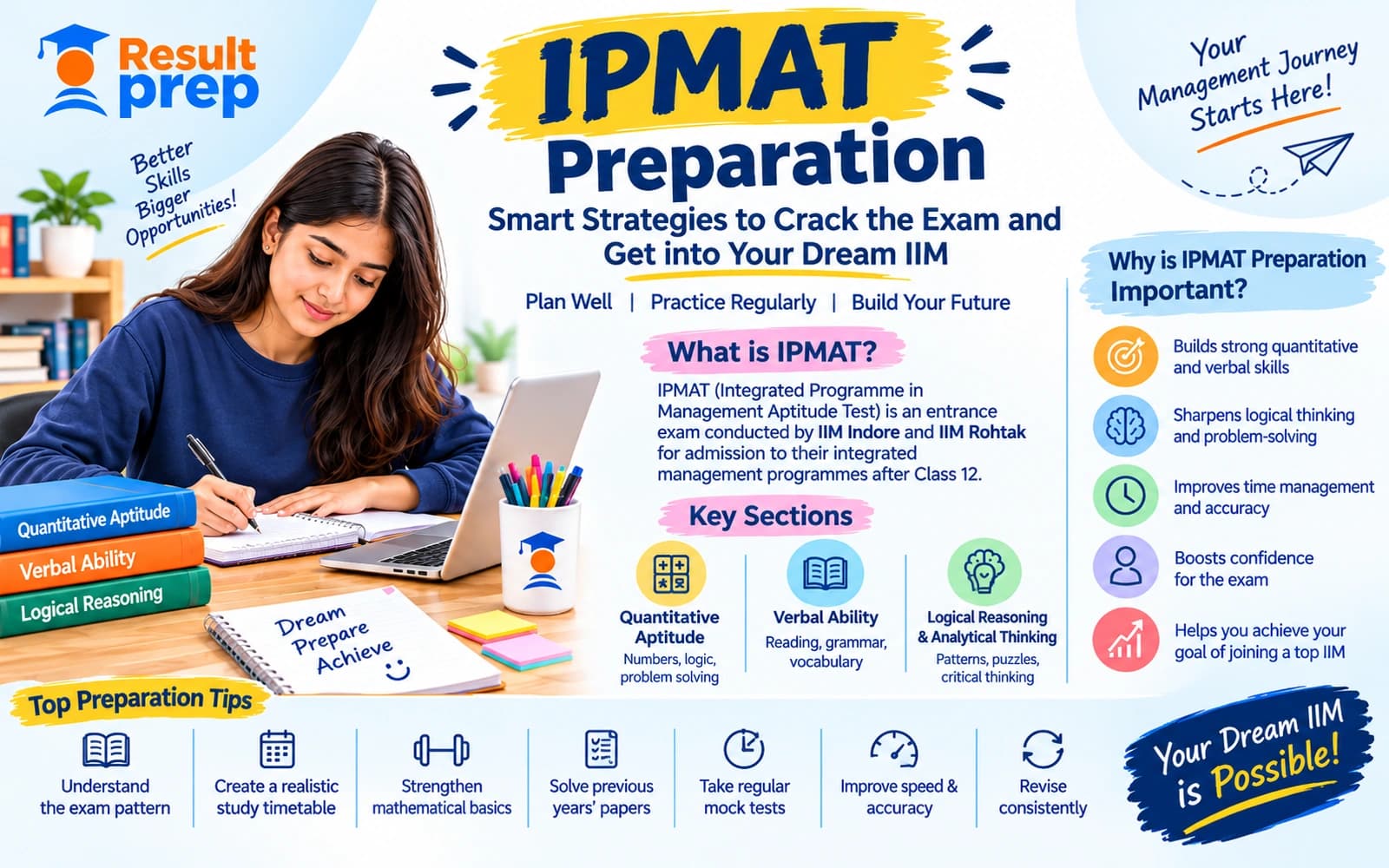
Are you dreaming of building a successful management career straight after Class 12? The Integrated Programme in Management Aptitude Test (IPMAT) can help you take the first step towards that goal. With the right preparation strategy, consistent practice, and a clear understanding of the examination, you can strengthen your skills and improve your chances of securing admission to a prestigious management program.
IPMAT preparation requires more than memorising formulas or solving questions quickly. You need to develop logical thinking, sharpen your quantitative aptitude, improve your verbal ability, and learn to manage time effectively. A structured study plan can help you approach the examination with greater confidence.
What Is IPMAT?
The Integrated Programme in Management Aptitude Test (IPMAT) is an entrance examination used by participating institutions for admission to integrated management programmes after Class 12.
The Indian Institutes of Management (IIMs), including IIM Indore and IIM Rohtak, conduct their respective IPMAT examinations. Other institutions may have separate admission tests or selection procedures for their integrated management programmes.
These programmes generally combine undergraduate and postgraduate management education, allowing students to begin their management journey immediately after school.
Before preparing, check the latest official notification for your target institution because the exam pattern, eligibility criteria, syllabus, and selection process can differ.
Why Is IPMAT Preparation Important?
A strong preparation strategy helps you build the skills required to handle competitive entrance examinations.
Here are some important benefits of systematic IPMAT preparation:
Stronger quantitative aptitude: Improve your understanding of arithmetic, algebra, geometry, and other relevant mathematical concepts.
Better verbal ability: Develop reading comprehension, vocabulary, grammar, and language skills.
Sharper logical thinking: Learn to identify patterns, evaluate information, and solve problems efficiently.
Improved time management: Practise answering questions within the allotted time.
Greater examination confidence: Familiarity with question formats and mock tests helps you prepare more effectively.
Important Sections in IPMAT Preparation
1. Quantitative Aptitude
Quantitative aptitude is an important part of IPMAT preparation. Students need to understand mathematical concepts and apply them accurately under time pressure.
Focus on topics such as:
Percentages, profit and loss
Ratio and proportion
Averages and mixtures
Time, speed, and distance
Time and work
Number systems
Algebra and equations
Geometry and mensuration
Permutations, combinations, and probability
The exact syllabus and question distribution depend on the examination you choose.
Preparation tip: Understand the logic behind each formula before memorising it. Practise different question types and gradually increase the difficulty level.
2. Verbal Ability
Verbal ability tests your command of English and your ability to understand written information. Regular reading and vocabulary practice can help you strengthen this section.
Concentrate on:
Reading comprehension
Vocabulary and word usage
Synonyms and antonyms
Grammar and sentence correction
Para jumbles
Sentence completion
Verbal reasoning
Read editorials, quality newspapers, essays, and informative articles regularly. After reading, summarise the main argument in your own words to improve comprehension.
Preparation tip: Learn new words in context and revise them regularly instead of memorising long vocabulary lists without examples.
3. Logical Reasoning and Analytical Thinking
Some IPMAT-related entrance examinations include logical reasoning or analytical thinking components, while others follow different section structures.
Practise the topics included in your target examination, such as:
Number and letter series
Arrangements and puzzles
Coding and decoding
Blood relations
Directions
Logical deductions
Data interpretation
Solve questions carefully and identify the reasoning pattern behind each answer.
7 Effective Tips for IPMAT Preparation
1. Understand the Exam Pattern
Begin by reviewing the official examination notification for your target institution. Understand the sections, question formats, marking scheme, time limits, and eligibility requirements.
Do not assume that every IPMAT examination follows the same structure. Build your preparation plan around the specific test you intend to take.
2. Create a Realistic Study Timetable
A well-organised timetable helps you balance quantitative aptitude, verbal ability, and other required sections.
Here is an example of a daily study schedule:
Study activity
Suggested time
Quantitative aptitude
90 minutes
Verbal ability and reading
60 minutes
Logical reasoning or additional topics, if applicable
30 minutes
Practice questions and revision
60 minutes
Adjust these timings according to your current preparation level and school commitments. Spend additional time on topics that need improvement.
3. Build Strong Mathematical Fundamentals
Do not rush into advanced questions before mastering the basics. Revise essential mathematical concepts and practise straightforward problems before moving to more challenging exercises.
Maintain a formula notebook and record useful shortcuts alongside the conditions in which they work. Review your notes frequently and solve mixed-topic questions to strengthen your application skills.
4. Practise Previous Years' Question Papers
Previous years' question papers help you understand question styles, assess difficulty levels, and identify topics that require additional practice.
Attempt papers under timed conditions whenever possible. After each attempt, review your incorrect answers and identify whether the problem arose from a conceptual gap, a calculation error, or poor time management.
Use previous papers to understand the examination, not to predict questions with certainty.
5. Take Regular Mock Tests
Mock tests help you evaluate your preparation and develop an effective examination strategy.
After every test, analyse your performance by asking:
Which questions did I answer incorrectly?
Which topics consumed too much time?
Did I make avoidable calculation errors?
Which questions should I have skipped and revisited later?
Which topics need more revision?
Maintain a record of your scores and mistakes. Focus on improving accuracy and decision-making instead of chasing a high score without understanding your weaknesses.
6. Improve Speed Without Sacrificing Accuracy
Competitive examinations reward efficient problem-solving. However, solving questions quickly does not help if you make frequent mistakes.
Learn calculation techniques, practise mental mathematics, and compare different approaches to the same problem. During mock tests, avoid spending too much time on a single difficult question.
Develop the habit of identifying manageable questions first and returning to challenging ones when time permits.
7. Revise Consistently
Regular revision helps you retain formulas, vocabulary, mathematical concepts, and problem-solving techniques.
Create short notes for important formulas, common question patterns, grammar rules, and frequently misunderstood concepts. Review these notes every week and revisit difficult topics until you can solve related questions confidently.
Consistent revision also prevents you from forgetting earlier topics while learning new ones.
Common IPMAT Preparation Mistakes to Avoid
Even dedicated students can lose valuable preparation time through avoidable mistakes.
Ignoring basic concepts: Advanced shortcuts cannot replace a strong foundation.
Practising without analysis: Repeating mistakes without reviewing them slows progress.
Neglecting verbal ability: Focusing only on mathematics can leave other sections underprepared.
Avoiding mock tests: Students need timed practice to develop an effective test-taking strategy.
Collecting too many resources: Switching between multiple books and courses can disrupt consistency.
Ignoring the official exam pattern: Preparing for the wrong sections wastes valuable time.
Studying without a revision plan: New concepts become harder to retain when students neglect regular review.
A 60-Day IPMAT Preparation Plan
If you have approximately two months to prepare, use this plan to organise your learning and practice.
Preparation period
Main focus
Days 1-10
Understand the exam pattern, assess your current level, and revise fundamentals.
Days 11-25
Strengthen quantitative aptitude and verbal ability through topic-wise practice.
Days 26-40
Solve mixed-topic questions, practise previous years' papers, and improve speed.
Days 41-50
Take regular mock tests and analyse your mistakes.
Days 51-56
Revise weak topics, formulas, vocabulary, and important concepts.
Days 57-60
Complete selected practice tests, review notes, and maintain a healthy routine.
Adapt this schedule to your preparation level and examination date. If you have more time, devote additional weeks to learning difficult concepts before increasing the frequency of full-length mock tests.
How Can IPMAT Coaching Help Students?
IPMAT coaching can provide structure and guidance for students who need additional support. A suitable coaching programme may help students understand difficult concepts, follow a study schedule, practise examination-level questions, and receive feedback on their performance.
Before selecting an institute, evaluate these factors:
Experienced faculty with relevant subject knowledge.
A study plan aligned with your target examination.
Regular mock tests and detailed performance analysis.
Quality practice materials and revision resources.
Doubt-clearing sessions and individual guidance.
Suitable batch timings, fees, and learning support.
Choose a coaching programme that matches your learning needs and helps you develop independent problem-solving skills.
Frequently Asked Questions About IPMAT Preparation
1. When should I start preparing for IPMAT?
Starting in Class 11 or early in Class 12 can give you enough time to strengthen fundamentals and practise regularly. However, students can adjust their preparation timelines according to their existing knowledge and the examination date.
2. Can I crack IPMAT without coaching?
Yes. Self-study can work well when you follow the official syllabus, use reliable study materials, practise questions regularly, take mock tests, and analyse your mistakes. Coaching may offer additional structure and guidance, but it is not compulsory for every student.
3. How many hours should I study daily for IPMAT?
Your daily study time depends on your preparation level and school schedule. Focus on consistent, distraction-free study sessions that include concept learning, question practice, and revision rather than simply counting hours.
4. Is mathematics compulsory for IPMAT preparation?
Your academic eligibility and the examination requirements depend on the institution and programme. Quantitative aptitude features prominently in IPMAT examinations, so mathematical preparation is important. Check the latest eligibility criteria for your target institution.
5. Are mock tests important for IPMAT?
Yes. Mock tests help you practise under timed conditions, identify weak areas, improve question selection, and track your progress. Always analyse your performance after completing a test.
6. Which books should I use for IPMAT preparation?
Choose mathematics and English resources that match your current level and the syllabus of your target examination. Supplement them with official sample papers, previous years' questions where available, and reliable mock tests. Avoid using too many resources simultaneously.
7. Can I prepare for IPMAT while studying for board exams?
Yes. Create a balanced timetable that covers board examination subjects and IPMAT preparation. Strengthening relevant mathematical and English fundamentals can support both goals, but you should allocate dedicated time to the different requirements of each examination.
Conclusion
IPMAT preparation becomes more manageable when you combine strong fundamentals, regular practice, consistent revision, and effective time management. Understand your target examination, strengthen quantitative aptitude and verbal ability, practise relevant question papers, and use mock tests to measure your progress.
Remember that success comes from steady improvement rather than last-minute preparation. Identify your weaknesses, learn from every mistake, and maintain a disciplined study routine.
Start your IPMAT preparation today, sharpen your aptitude skills, and take a confident step towards your dream management career!
Category: IPMAT Preparation
7 Comments
Share journey
Discussion (7)
A
Aditya Kumar
This is a very insightful article. The strategies mentioned are incredibly practical.
M
Meghna Patil
I've been preparing for a few months now and these tips perfectly align with what my mentors have been saying.
A
Amit Iyer
Do you have any offline batches starting soon? I need help with the advanced topics.
P
Pooja Bose
Bookmarked! I will be revisiting this guide before my mock tests next month.
A
Arjun Verma
The point about consistent daily practice cannot be overstated. Great read.
N
Neha Gupta
Thank you for breaking down such a complex topic into actionable steps.
V
Vikram Mathur
I shared this with my entire study group. We were making half the mistakes listed here.