CLAT 2027 Logical Reasoning: Important Topics, Question Types & Preparation Strategy
Master CLAT 2027 Logical Reasoning. Comprehensive guide covering critical reasoning passage types, assumption identification, strengthen-weaken logic, and high-accuracy strategy.
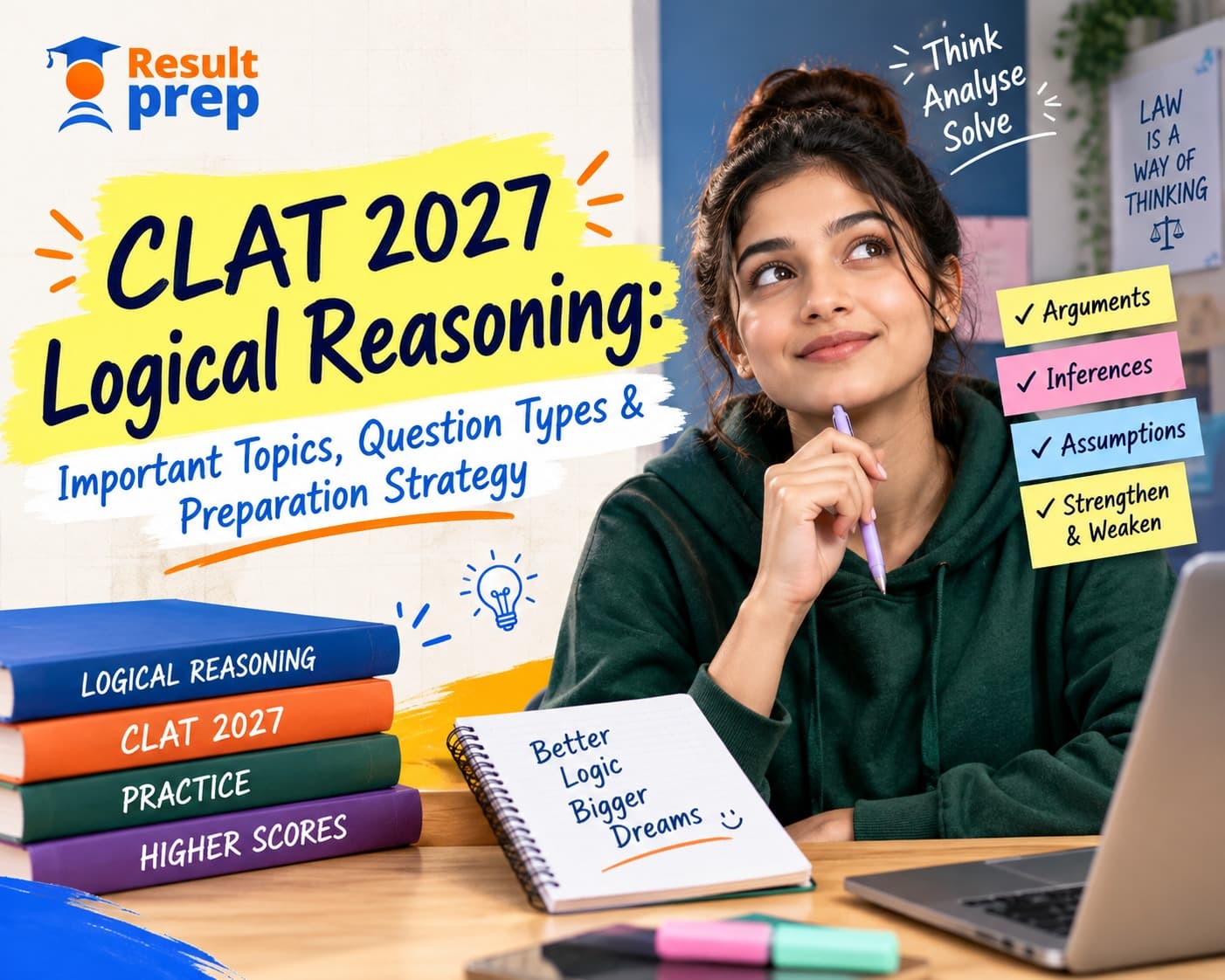
Logical Reasoning is one of the five core pillars of the CLAT 2027 examination, accounting for approximately 22 to 26 questions (roughly 20% of the total paper weightage). Unlike traditional entrance exams that test analytical puzzles, blood relations grids, or arrangement seating, the Consortium of NLUs designs the CLAT Logical Reasoning section around passage-based Critical Reasoning.
For many CLAT aspirants, this section initially feels disorienting. There are no formulas to memorize or algebraic rules to mechanically apply. Success depends on dissecting dense 450-word editorial passages, evaluating argument structures, pinpointing unstated assumptions, and distinguishing valid inferences from attractive answer traps.
Core CLAT LR Mindset: Arguments Over Puzzles
CLAT Logical Reasoning does not assess how fast you can solve number series or clock puzzles. It tests your legal acumen: can you read a contemporary opinion piece, identify the author's primary claim, spot logical fallacies in their evidence, and anticipate counter-arguments?
Official CLAT 2027 Logical Reasoning Syllabus Overview
According to the official Consortium guidelines, each set of questions is derived from passages of approximately 450 words. Candidates are evaluated on their ability to:
- Recognize arguments, their supporting premises, and ultimate conclusions.
- Evaluate patterns of reasoning and determine how conclusions depend on evidence.
- Gauge how introducing new premises can strengthen or weaken the author's argument.
- Draw logical inferences and apply those principles to fresh factual scenarios.
- Identify structural analogies, logical contradictions, and equivalent claims.
8 High-Yield Question Types in CLAT Logical Reasoning
While you must be prepared for diverse argument structures, these eight question types constitute the overwhelming majority of marks in the section:
| Question Type | The Mental Question to Ask | Key Solving Strategy |
|---|---|---|
| 1. Main Conclusion | "What is the author ultimately trying to prove?" | Distinguish evidence (facts) from the claim. Look for pivot words like "Therefore", "Thus", "Hence". |
| 2. Unstated Assumption | "What MUST be true for this argument to stand?" | Apply the Negation Test: if negating the option destroys the conclusion, it is the assumption. |
| 3. Valid Inference | "What is an inescapable fact based strictly on the text?" | Zero outside knowledge allowed. Reject options that generalize or introduce new factual claims. |
| 4. Strengthen the Argument | "Which new fact bridges the premise-conclusion gap?" | Validates the author's assumption or eliminates an alternative explanation for the observed outcome. |
| 5. Weaken the Argument | "Which new fact casts doubt on the causal connection?" | Attacks the reasoning link, introduces an overlooked confounding variable, or shows counter-evidence. |
| 6. Cause and Effect | "Did Event A genuinely cause Event B, or is it correlation?" | Watch for common post-hoc fallacies (assuming chronology implies causation). |
| 7. Parallel Reasoning / Analogy | "Which option mirrors the exact logical blueprint?" | Strip out context and map the logic symbolically (e.g., "If All A are B, and X is A, then X is B"). |
| 8. Paradox / Contradiction | "How can two seemingly contradictory facts coexist?" | Pick the option that introduces an unexpected factor explaining both opposing realities. |
Logical Reasoning vs. Legal Reasoning: Key Differences
A common source of confusion among beginners is treating Legal Reasoning and Logical Reasoning as interchangeable. While both require sharp analytical reading, their operative rules diverge fundamentally:
Legal Reasoning
- Passage establishes legal principles, statutes, or doctrines.
- Questions test mechanical application of principles to hypothetical factual scenarios.
- You must strictly enforce the legal rule as given, even if morally counter-intuitive.
Logical Reasoning
- Passage presents journalistic arguments, sociological theories, or policy debates.
- Questions test structural critique: assumptions, inferences, flaws, and rebuttals.
- Focuses on the internal validity of the reasoning chain connecting premises to conclusions.
The 5-Step Passage Deconstruction Protocol
When confronted with dense, difficult passages during a timed mock test, follow this systematic 5-step checklist:
- Step 1: Identify the Passage Domain: Quickly determine if the context is economics, political governance, environmental policy, or technological ethics.
- Step 2: Isolate the Central Claim: Find the author's primary thesis statement. What is their non-negotiable assertion?
- Step 3: Separate Premises from Context: Highlight factual evidence, statistics, and citations that serve as the premises supporting that assertion.
- Step 4: Scrutinize the Question Stem: Pinpoint the exact cognitive task (e.g., "most directly weakens" vs. "provides an unstated assumption").
- Step 5: Aggressive Option Elimination: Strike out options that rely on extreme qualifiers ("only", "never", "completely"), introduce extraneous outside facts, or address irrelevant secondary details.
Common Traps and Pitfalls to Avoid
Consortium test designers excel at creating tempting distractor options that punish common reading bad habits:
- The Prior Knowledge Trap: If a passage discusses climate change, never select an option based on your knowledge from high school geography if the author did not mention or imply it.
- Confusing an Assumption with a Conclusion: A conclusion is the final claim on display; an assumption is the silent, unstated bridge that makes the claim plausible.
- The Extreme Language Trap: Broad claims containing words like "invariably", "unconditionally", or "no alternative" are almost always incorrect in inference questions.
- Sunk Cost Fallacy on Tricky Passages: If an argument feels hopelessly convoluted after 90 seconds, flag it and move on. Every question in CLAT carries exactly 1 mark—do not sacrifice 4 easy marks elsewhere.
A Proven 3-Stage Practice Routine for CLAT 2027
Build your mastery systematically over the two-year preparation runway:
- Stage 1 (Conceptual Mastery): Practice 50+ standalone questions per question type (assumptions, strengthen/weaken, inferences) without time pressure until accuracy exceeds 85%.
- Stage 2 (Passage Sets): Solve 4-passage sectional drills from previous years' CLAT papers and quality mock tests, focusing on author argument mapping.
- Stage 3 (Timed Full-Mock Execution): Enforce strict 22–24 minute sectional caps for Logical Reasoning during full 2-hour mocks, maintaining a meticulous error log for every lost mark.
Master CLAT 2027 Logical Reasoning With ResultPrep
Achieving a top rank in CLAT requires pinpoint accuracy in Critical Reasoning. At ResultPrep, our CLAT 2027 program offers rigorous passage-based drills, argument-mapping masterclasses, and 1-on-1 mentorship from NLU alumni to transform your logical instincts.
Book a Free Counselling SessionDiscussion (7)
Tarun Mehta
This is a very insightful article. The strategies mentioned are incredibly practical.
Ishita Rao
I've been preparing for a few months now and these tips perfectly align with what my mentors have been saying.
Karan Das
Do you have any offline batches starting soon? I need help with the advanced topics.
Anjali Reddy
Bookmarked! I will be revisiting this guide before my mock tests next month.
Siddharth Kapoor
The point about consistent daily practice cannot be overstated. Great read.
Priya Sharma
Thank you for breaking down such a complex topic into actionable steps.
Manish Mathur
I shared this with my entire study group. We were making half the mistakes listed here.
Related Articles in CLAT Preparation
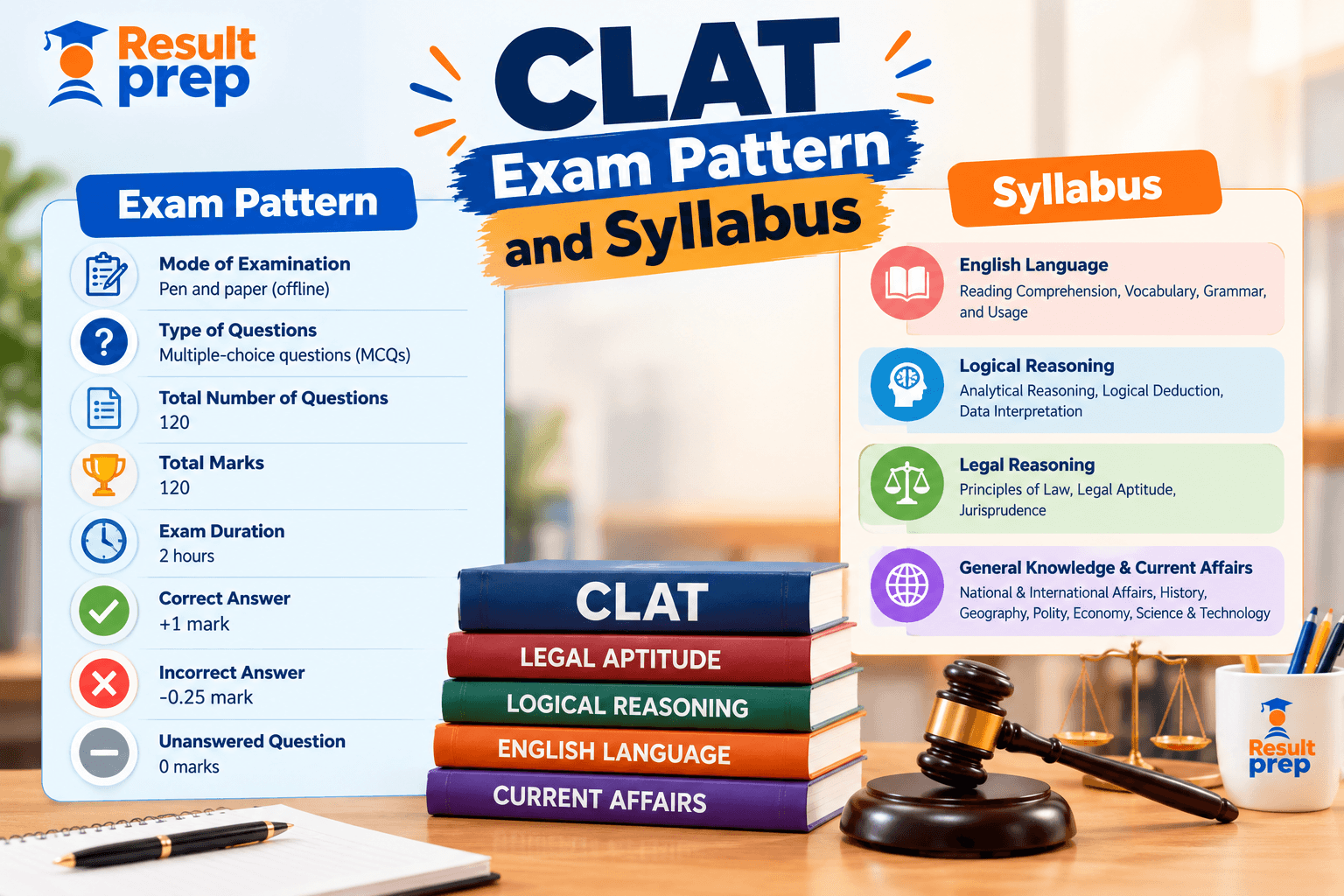
Everything Students Should Know About the CLAT Exam Pattern and Syllabus
The complete guide to the CLAT 2027 exam pattern and syllabus: 120-question passage format, 5 sectional syllabi, marking scheme, offline OMR logistics, and preparation roadmaps.

CLAT - Criteria for Eligibility: Age Range, Criteria, and Prerequisites
A complete guide to CLAT 2027 eligibility: Minimum marks in Class 12, no age limit rules, stream flexibility, reservation categories, and CLAT UG vs. PG comparison.

How to Apply for CLAT: A Step-By-Step Guide For Law Aspirants
A complete walkthrough of the CLAT application process: Step-by-step registration on the Consortium portal, document specifications, fee payment, common pitfalls, and post-submission steps.