CLAT - Criteria for Eligibility: Age Range, Criteria, and Prerequisites
A complete guide to CLAT 2027 eligibility: Minimum marks in Class 12, no age limit rules, stream flexibility, reservation categories, and CLAT UG vs. PG comparison.
If you intend to pursue a premier legal career after Class 12, understanding the CLAT (Common Law Admission Test) eligibility criteria is the foundational first step. Administered by the Consortium of National Law Universities (NLUs), CLAT is India's premier centralized entrance examination for admission into 5-year integrated undergraduate law programs (such as BA LL.B. and BBA LL.B.) and one-year postgraduate LL.M. degrees across 24 participating National Law Universities.
Before beginning your preparation, candidates must verify the exact age rules, minimum marks thresholds, educational board recognitions, stream flexibility, and documentation guidelines. This comprehensive guide outlines the complete CLAT 2027 eligibility requirements for both undergraduate (UG) and postgraduate (PG) law aspirants.
What Is the CLAT Exam?
The Common Law Admission Test is conducted annually for two levels of legal education:
- CLAT UG: For students completing Class 12 seeking admission into 5-year integrated double degrees: B.A. LL.B. (Hons.), B.B.A. LL.B. (Hons.), B.Com. LL.B. (Hons.), and B.Sc. LL.B. (Hons.).
- CLAT PG: For law graduates holding an LL.B. degree seeking admission into specialized 1-year Master of Laws (LL.M.) programs.
CLAT UG 2027 Eligibility Criteria (Bachelor Programs)
Candidates applying for 5-year integrated law programs must satisfy the following core conditions:
1. Educational Qualifications & Qualifying Boards
Applicants must have completed Class 12 (10+2 system) or an equivalent examination from a recognized national or state education board (such as CBSE, CISCE/ISC, State Boards, or NIOS). Students appearing for their Class 12 board examinations in March/April 2027 are fully eligible to apply provisionally. However, they must submit proof of passing the qualifying examination with the requisite percentage during final NLU admissions counseling.
2. Minimum Marks Requirements in Class 12
| Candidate Category | Minimum Percentage Required |
|---|---|
| General / OBC / PwD / NRI / PIO / OCI Categories | At least 45% aggregate marks |
| Scheduled Caste (SC) / Scheduled Tribe (ST) Categories | At least 40% aggregate marks |
3. Age Limit: Zero Upper Threshold
In accordance with landmark Supreme Court directives, there is no upper age limit for candidates appearing for CLAT UG. Whether you are 17, 22, or older, you can register and compete for admissions, provided your academic qualifications satisfy the minimum marks criteria.
4. Stream Flexibility
There are no mandatory subject combinations. Students from Commerce (with or without math), Science (PCM or PCB), Humanities/Arts, or vocational streams are completely equal before the exam.
CLAT PG 2027 Eligibility Criteria (Postgraduate LL.M.)
Candidates aspiring to pursue an LL.M. degree must fulfill the following standards:
- Qualifying Degree: An LL.B. degree (either a 3-year graduate LL.B. or a 5-year integrated law degree) from a recognized university. Appearing final-year LL.B. students can also apply.
- Minimum Marks: At least 50% marks for General, OBC, and PwD categories; at least 45% marks for SC and ST candidates.
- Age Limit: No upper age limit applies to CLAT PG.
Comparative Summary: CLAT UG vs. CLAT PG Eligibility
| Eligibility Parameter | CLAT UG 2027 (Undergraduate) | CLAT PG 2027 (Postgraduate) |
|---|---|---|
| Minimum Qualification | Class 12 (10+2) or equivalent | 3-Year or 5-Year LL.B. Degree |
| General / OBC Min Marks | 45% aggregate in 12th | 50% aggregate in LL.B. |
| SC / ST Min Marks | 40% aggregate in 12th | 45% aggregate in LL.B. |
| Upper Age Limit | No upper age limit | No upper age limit |
| Target Degrees | BA LL.B., BBA LL.B., B.Com LL.B., B.Sc LL.B. | 1-Year Master of Laws (LL.M.) |
Required Documents for CLAT Registration
Ensure digital copies of these credentials are ready in the prescribed format before starting registration:
✓ Passport Photograph: Clear, recent photograph with a light background.
✓ Scanned Signature: Running signature on white paper with black/blue ink.
✓ Class 10 Certificate: For Date of Birth and parentage verification.
✓ Class 12 Marksheet: For passed candidates (or admit card for appearing candidates).
✓ Category / Caste Certificate: Valid SC/ST/OBC (Non-Creamy Layer)/EWS certificate issued by competent revenue authority.
✓ PwD Certificate: If applying under physical disability reservations.
How to Verify Your Eligibility & Apply Step-by-Step
- Step 1: Confirm whether you are targeting CLAT UG or CLAT PG.
- Step 2: Check that your Class 12 or LL.B. score meets the 45%/40% or 50%/45% threshold.
- Step 3: Gather all reservation and identity documentation.
- Step 4: Read the official Consortium notification to confirm registration deadlines.
- Step 5: Complete your application on the official portal and download the submission confirmation.
Preparing for CLAT with ResultPrep
Meeting eligibility rules allows you to register, but clearing the exam requires mastering passage-based reading, legal reasoning principles, and time management. ResultPrep provides specialized CLAT coaching with experienced legal faculty, small classroom batches, computer-based mock testing, and diagnostic error analysis. Visit ResultPrep.com to start your law entrance journey.
Conclusion
Understanding the CLAT eligibility requirements ensures a seamless registration process without last-minute document surprises. Verify your qualifying scores, confirm your category documents, start your preparation early with consistent reading and mock testing, and pursue your dream of studying at India's premier National Law Universities.
Discussion (7)
Aditya Kumar
This is a very insightful article. The strategies mentioned are incredibly practical.
Divya Menon
I've been preparing for a few months now and these tips perfectly align with what my mentors have been saying.
Rohan Desai
Do you have any offline batches starting soon? I need help with the advanced topics.
Sneha Joshi
Bookmarked! I will be revisiting this guide before my mock tests next month.
Tarun Singh
The point about consistent daily practice cannot be overstated. Great read.
Ishita Chatterjee
Thank you for breaking down such a complex topic into actionable steps.
Karan Patel
I shared this with my entire study group. We were making half the mistakes listed here.
Related Articles in CLAT Preparation
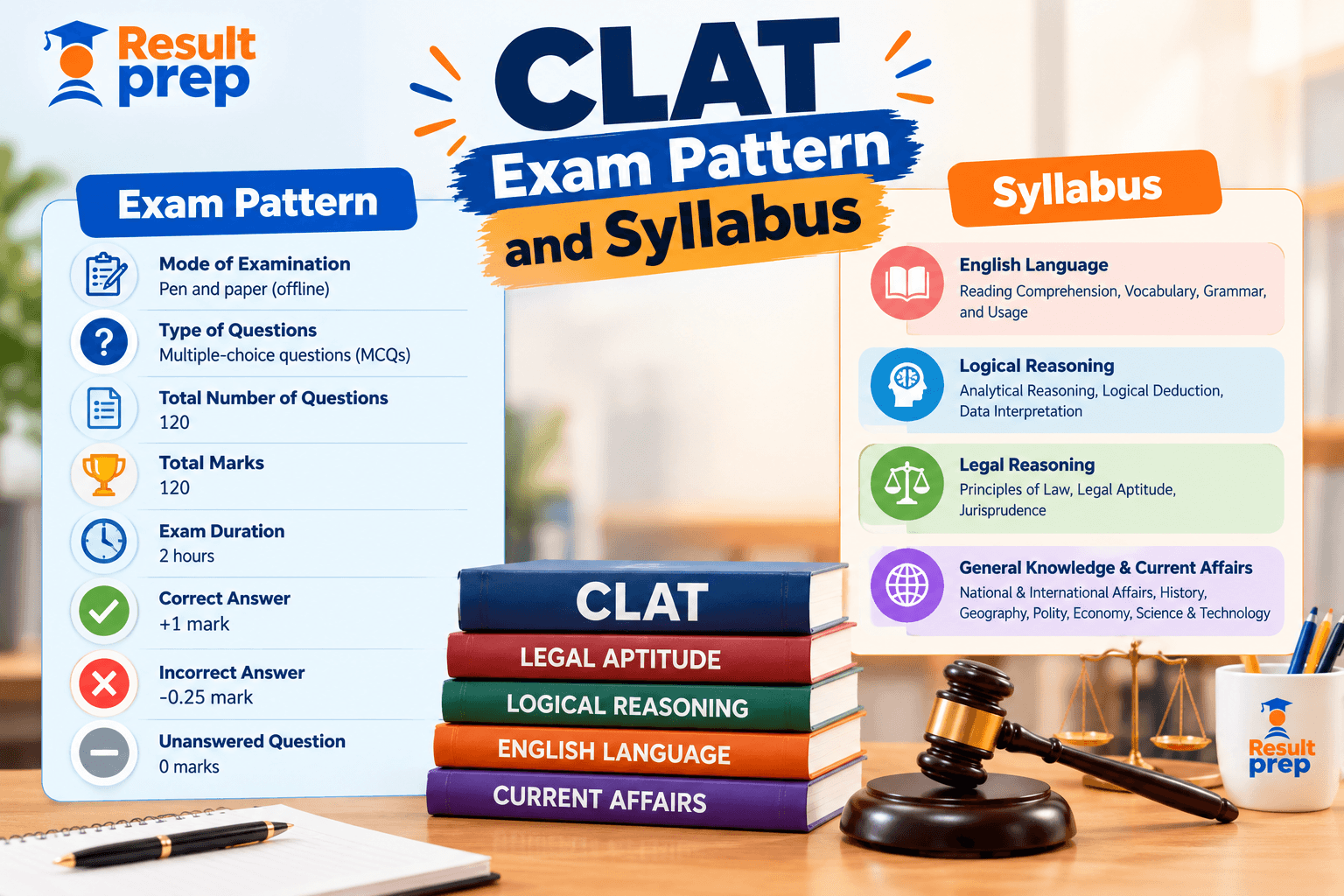
Everything Students Should Know About the CLAT Exam Pattern and Syllabus
The complete guide to the CLAT 2027 exam pattern and syllabus: 120-question passage format, 5 sectional syllabi, marking scheme, offline OMR logistics, and preparation roadmaps.

How to Apply for CLAT: A Step-By-Step Guide For Law Aspirants
A complete walkthrough of the CLAT application process: Step-by-step registration on the Consortium portal, document specifications, fee payment, common pitfalls, and post-submission steps.
Preparing for the CLAT: A How-To Guide to Begin Your Journey into Law School
A comprehensive beginner's roadmap to kickstart CLAT preparation: Master all 5 passage-based sections, establish daily reading habits, build an error-free revision routine, and avoid common prep pitfalls.