Preparing for the CLAT: A How-To Guide to Begin Your Journey into Law School
A comprehensive beginner's roadmap to kickstart CLAT preparation: Master all 5 passage-based sections, establish daily reading habits, build an error-free revision routine, and avoid common prep pitfalls.

The Common Law Admission Test (CLAT) is India's most prestigious and widely recognized national-level law entrance examination, serving as the gateway to the 24+ National Law Universities (NLUs) including NLSIU Bengaluru, NALSAR Hyderabad, and WBNUJS Kolkata. While securing an admission into a premier law school is fiercely competitive, succeeding on the CLAT does not require innate genius—it requires a clear plan, consistent study habits, disciplined reading stamina, and sharp analytical application.
Unlike traditional school board exams that test factual recall and descriptive answers, the CLAT is a 100% passage-based aptitude test consisting of 120 questions to be solved within 120 minutes with a 0.25 negative marking penalty. This beginner-friendly how-to guide covers everything you need to embark on your law school journey: understanding the five core syllabus areas, establishing a daily routine, mastering passage comprehension, and auditing mock test performance.
1. Know What Is on the CLAT Exam
Before buying stacks of guidebooks, understand the five core sections tested in the CLAT Undergraduate examination. Each section features comprehension passages of 350 to 450 words followed by 4 to 6 multiple-choice questions:
| Section | Approx. Questions / Weightage | Core Skills Evaluated |
|---|---|---|
| English Language | 22–26 Questions (~20%) | Comprehension, central theme, author's perspective, vocabulary in context, tone. |
| Current Affairs & General Knowledge | 28–32 Questions (~25%) | National and international affairs, constitutional history, legal milestones, treaties. |
| Legal Reasoning | 28–32 Questions (~25%) | Strict application of legal rules/principles to factual scenarios without external bias. |
| Logical Reasoning | 22–26 Questions (~20%) | Critical reasoning: identifying assumptions, arguments, conclusions, inferences. |
| Quantitative Techniques | 10–14 Questions (~10%) | Data interpretation caselets, percentages, ratios, averages, commercial arithmetic. |
2. Make a Realistic Routine and Stick to It
Do not study for 12 hours on Sunday and zero hours on Monday. True competitive advantage comes from daily consistency. Build a daily schedule that balances active reading, conceptual drills, question solving, and revision:
Reading & GK
45 mins of editorials & current affairs note-taking.
Reasoning Drills
45 mins of Legal or Critical Reasoning passage sets.
Quant & English
30 mins of arithmetic caselets & RC passages.
Daily Review
20 mins reviewing the Mistake Notebook & flashcards.
3. Develop Strong Reading & Comprehension Habits
Reading is the primary vehicle of the entire CLAT exam. Reading approximately 15,000 to 20,000 words within 120 minutes requires continuous stamina. Adopt these active reading habits:
- Read Quality Editorials Daily: Spend 30 to 45 minutes reading opinion columns from The Hindu, The Indian Express, or essays on Aeon.
- Track the Central Thesis: Immediately ask yourself after reading: "What is the single core claim the author is defending?"
- Identify Transition Markers: Watch for pivot words like however, nevertheless, consequently, despite which signal shifts in perspective.
- Contextual Vocabulary: Note unfamiliar words and infer their meanings from context rather than memorizing isolated alphabetical lists.
4. Section-by-Section Tactical Strategies
Current Affairs & General Knowledge
Consistent daily tracking beats frantic last-minute cramming:
- Follow major national events, international summits, constitutional debates, new bills, judicial appointments, awards, and economic policies.
- Synthesize events into brief bullet notes and review them weekly to maintain high recall.
Legal Reasoning (The Deciding Factor)
The Golden Law School Rule: Principle is Sovereign
In CLAT Legal Reasoning, the principle provided in the passage is absolute truth. Even if the stated principle contradicts real-world statutes or your personal moral convictions, apply it literally to the factual situation. Never make outside assumptions that are not directly supported by the passage.
Logical Reasoning (Critical Logic)
Critical reasoning requires deconstructing arguments into their logical anatomy:
- Break down passages into: Premise (stated facts) + Assumption (unstated bridge) = Conclusion (claim).
- Practice strengthening and weakening arguments, identifying logical fallacies, and detecting valid inferences.
Quantitative Techniques
Do not abandon math—10 to 14 marks often separate an NLU Bengaluru rank from missing out entirely:
- Master fundamental arithmetic: percentages, ratios & proportions, averages, profit & loss, and simple interest.
- Translate paragraph-based caselets into structured tables before attempting questions.
- Practice untimed first to ensure complete accuracy, then introduce stopwatch timers.
5. Take Regular Mock Tests & Audit Your Errors
Taking a mock test without analyzing it provides zero improvement. After completing every 120-minute mock exam, audit:
• Which questions did I get wrong, and why? (Conceptual error vs. misread stem vs. guess)
• Which passages took too long? (Exceeded the 8-to-9-minute per passage ceiling)
• Did I miss easy sitters due to carelessness?
• Were there stubborn questions I should have skipped earlier?
6. Avoid Common Preparation Pitfalls
Ignoring Current Affairs: Postponing GK until the final month creates overwhelming stress and memory confusion.
Focusing Only on Favorite Subjects: Neglecting Quant or Critical Reasoning caps your total score.
Rushing Without Checking Accuracy: Uncalculated attempts trigger negative marking penalties (-0.25) that destroy your percentile.
CLAT Preparation Support in Bangalore
If you are looking for structured guidance, experienced legal faculty, and interactive mock test performance reviews in Bengaluru, consider exploring specialized coaching centers such as ResultPrep in Vidyaranyapura, Bengaluru. A dedicated classroom environment with personalized mentorship can help you stay disciplined, clear doubts quickly, and master the competitive skills needed for top NLU admissions.
Conclusion
Cracking the CLAT is a journey built upon steady reading, sharp reasoning, deliberate practice, and regular revision. Rather than waiting for the final weeks, create a daily schedule that incrementally expands your knowledge base and tracks your progress. Stay consistent, maintain an Error Notebook, respect the negative marking boundaries, and march into the examination center with confidence.
Discussion (7)
Amit Patel
This is a very insightful article. The strategies mentioned are incredibly practical.
Meghna Nair
I've been preparing for a few months now and these tips perfectly align with what my mentors have been saying.
Aditya Mehta
Do you have any offline batches starting soon? I need help with the advanced topics.
Divya Rao
Bookmarked! I will be revisiting this guide before my mock tests next month.
Rohan Das
The point about consistent daily practice cannot be overstated. Great read.
Sneha Reddy
Thank you for breaking down such a complex topic into actionable steps.
Tarun Kapoor
I shared this with my entire study group. We were making half the mistakes listed here.
Related Articles in CLAT Preparation
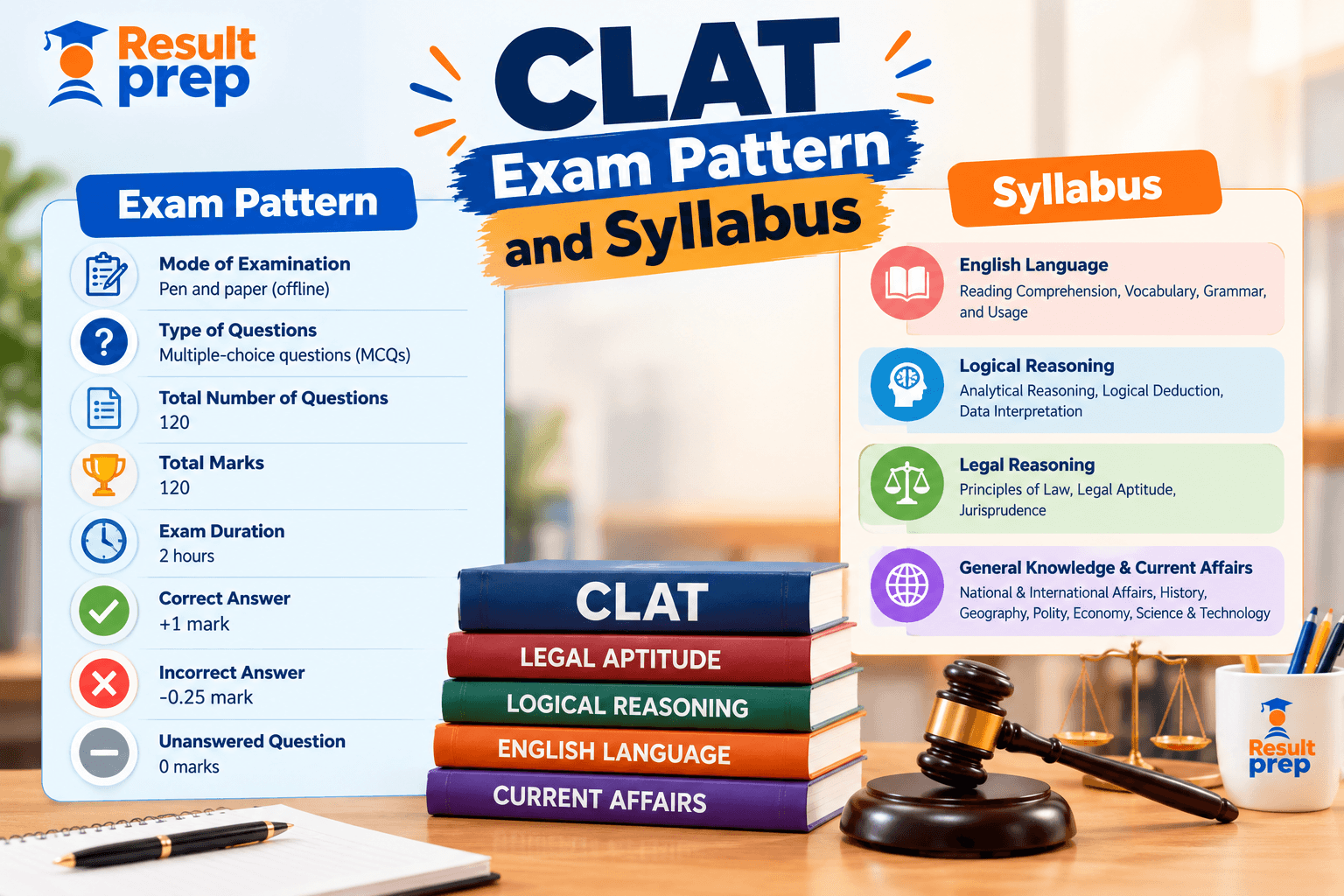
Everything Students Should Know About the CLAT Exam Pattern and Syllabus
The complete guide to the CLAT 2027 exam pattern and syllabus: 120-question passage format, 5 sectional syllabi, marking scheme, offline OMR logistics, and preparation roadmaps.

CLAT - Criteria for Eligibility: Age Range, Criteria, and Prerequisites
A complete guide to CLAT 2027 eligibility: Minimum marks in Class 12, no age limit rules, stream flexibility, reservation categories, and CLAT UG vs. PG comparison.

How to Apply for CLAT: A Step-By-Step Guide For Law Aspirants
A complete walkthrough of the CLAT application process: Step-by-step registration on the Consortium portal, document specifications, fee payment, common pitfalls, and post-submission steps.