CLAT Preparation: An All-Inclusive Guide to Planning & Preparing For Your Exam
Targeting top National Law Universities? Discover the all-inclusive CLAT preparation guide covering section-wise strategies, reading habits, 3-phase roadmaps, and mock test error analysis.

Cracking the Common Law Admission Test (CLAT) is not simply about studying long hours or memorizing vast volumes of legal textbooks. CLAT is fundamentally an aptitude evaluation designed to test how rapidly you comprehend complex language, evaluate logical arguments, interpret contemporary affairs, deduce legal liabilities from stated principles, and analyze quantitative data.
Whether you are starting your preparation in Class 11, balancing your Class 12 board exams, or taking a dedicated drop year, constructing an organized, strategic study plan is what separates top NLU rankers from the rest of the applicant pool. A well-structured preparation roadmap gives you clarity, manages your time effectively, and builds unshakeable confidence across every section of the paper.
The Reading & Reasoning Paradigm
The undergraduate CLAT is a 100% passage-based examination. You are presented with approximately 28 to 32 dense 450-word passages across 120 questions in 120 minutes. You do not need prior knowledge of law; rather, you must master the art of extracting facts, recognizing author perspectives, and executing swift, objective reasoning.
Understanding the 5 Core Sections of CLAT
Before launching intensive study sessions, understand what each section demands and how marks are distributed:
| Section | Approx. Questions (Weightage) | Testing Focus & Competencies |
|---|---|---|
| English Language | 22–26 questions (~20%) | Comprehension, contextual vocabulary, tone analysis, central arguments, and inferences. |
| Current Affairs & General Knowledge | 28–32 questions (~25%) | Contemporary national & international events, constitutional developments, historical backdrops. |
| Legal Reasoning | 28–32 questions (~25%) | Application of legal principles and statutes to hypothetical factual situations without moral bias. |
| Logical Reasoning | 22–26 questions (~20%) | Critical reasoning: assumptions, premises, conclusions, paradoxes, strengthen/weaken logic. |
| Quantitative Techniques | 10–14 questions (~10%) | Data interpretation sets: percentages, ratios, averages, profit & loss, tables, and caselets. |
1. Cultivate High-Stamina Reading Habits
Reading speed and comprehension form the foundation of CLAT performance. Candidates must comfortably process roughly 15,000 words within 120 minutes while maintaining keen mental alertness.
Diversify your reading diet beyond standard textbooks. Engage daily with:
- National newspaper editorials (The Hindu, The Indian Express)
- Analytical socio-legal commentary and policy essays
- International affairs portals and constitutional opinion columns
After finishing every editorial, execute a quick mental audit: What is the author's primary thesis? What empirical evidence is offered? What unstated assumptions are implied? What would most directly weaken this claim?
2. Mastering Legal Reasoning: Principle Over Opinion
The cardinal rule of CLAT Legal Reasoning is absolute fidelity to the provided text:
The Golden Legal Rule
Always apply the legal principle exactly as written in the passage, even if it contradicts real-world statutes or personal moral intuitions. Never introduce outside legal knowledge. Your job is not to be a judge passing moral verdicts; your job is to be a logical evaluator applying Rule A to Fact B.
3. Daily Quantitative Techniques Practice
Many law aspirants make the fatal mistake of abandoning math entirely. However, Quantitative Techniques represents 10 to 14 marks—frequently the exact margin separating a top-3 NLU (NLSIU, NALSAR, WBNUJS) from lower-ranked institutes.
- Focus on 10th-grade arithmetic: Percentages, Ratios & Proportions, Profit & Loss, Averages, Simple & Compound Interest.
- Practice translating text-heavy paragraph caselets into clean mathematical equations.
- Prioritize calculation accuracy first; speed naturally follows conceptual clarity.
The 3-Step Practice Protocol: Learn → Practice → Analyze
Structure every preparation cycle around this high-yield loop:
- Step 1 (Learn the Concept): Understand the underlying mechanism (e.g., how the Negation Test works on assumptions, or the mechanics of strict liability in torts).
- Step 2 (Targeted Practice): Solve 25–30 passage-based questions untimed to verify your conceptual comprehension.
- Step 3 (Diagnostic Analysis): Scrutinize every missed question. Why did you fall for the distractor? What made the correct option legally or logically sounder?
A Realistic Daily Study Routine
Consistency beats irregular marathon study sessions every time. Adapt this practical framework to your personal schedule:
Reading & Current Affairs
Read 2 newspaper editorials and compile monthly current affairs notes.
Legal & Logical Drills
Solve 4 passage sets in Legal Reasoning and Critical Reasoning.
Quantitative Techniques
Solve 2 complete Data Interpretation caselets under a 15-minute timer.
Error Log Review
Review missed questions from the day's drills and update formula cards.
The 3-Phase Long-Term Preparation Roadmap
- Phase 1: Foundations (Months 1–3): Understand exam blueprints, build reading stamina, master argument anatomy, and establish daily current affairs logs.
- Phase 2: Practice & Sectionals (Months 4–6): Increase practice volume, target weaker subject areas, and take regular timed 30-minute sectional tests.
- Phase 3: Simulation & Revision (Final 60 Days): Take 2 full-length timed mocks weekly (strictly 2 PM to 4 PM), conduct 3-hour error log reviews, and refine your section-switching sequence.
Common Preparation Errors to Avoid
- Resource Hoarding: Collecting 20 different prep books, telegram channels, and PDF drives instead of thoroughly mastering 2 reliable sources.
- Ignoring the Mock Error Log: Taking dozens of mock tests without analyzing why marks were lost.
- Neglecting Weak Areas: Continuously practicing familiar English passages while avoiding quantitative techniques.
- Last-Minute GK Cramming: Trying to memorize 12 months of current events in the final two weeks before the exam.
Begin Your CLAT Journey With ResultPrep Mentorship
Securing a top rank in CLAT requires precision, expert test series, and personalized feedback. At ResultPrep, our law entrance programs feature passage-mapping workshops, full-length CBT mock simulations, and 1-on-1 strategy sessions with NLU alumni.
Book a Free CLAT Counselling SessionDiscussion (7)
Anjali Patil
This is a very insightful article. The strategies mentioned are incredibly practical.
Siddharth Kumar
I've been preparing for a few months now and these tips perfectly align with what my mentors have been saying.
Priya Menon
Do you have any offline batches starting soon? I need help with the advanced topics.
Manish Desai
Bookmarked! I will be revisiting this guide before my mock tests next month.
Simran Joshi
The point about consistent daily practice cannot be overstated. Great read.
Rahul Singh
Thank you for breaking down such a complex topic into actionable steps.
Kavya Chatterjee
I shared this with my entire study group. We were making half the mistakes listed here.
Related Articles in CLAT Preparation
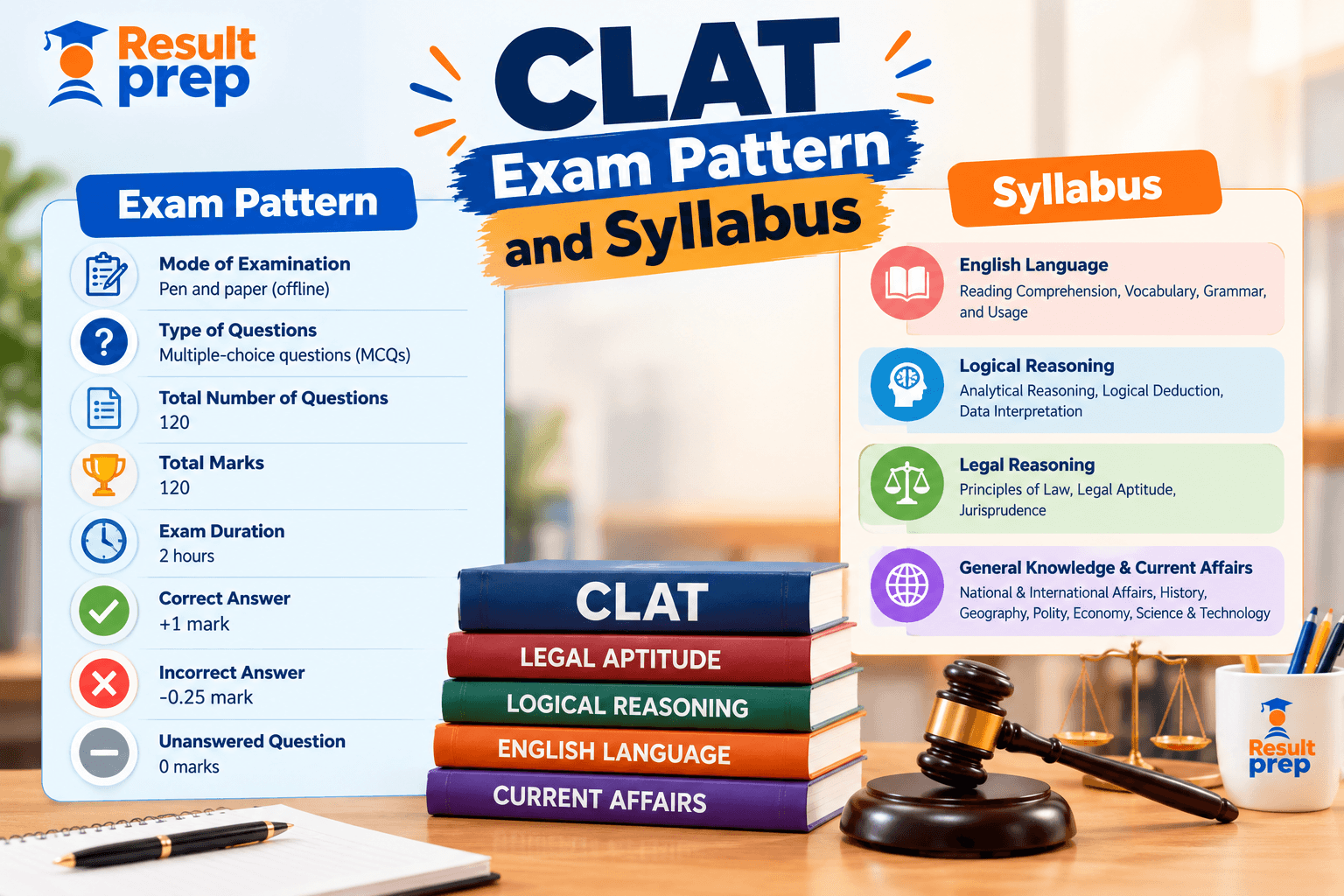
Everything Students Should Know About the CLAT Exam Pattern and Syllabus
The complete guide to the CLAT 2027 exam pattern and syllabus: 120-question passage format, 5 sectional syllabi, marking scheme, offline OMR logistics, and preparation roadmaps.

CLAT - Criteria for Eligibility: Age Range, Criteria, and Prerequisites
A complete guide to CLAT 2027 eligibility: Minimum marks in Class 12, no age limit rules, stream flexibility, reservation categories, and CLAT UG vs. PG comparison.

How to Apply for CLAT: A Step-By-Step Guide For Law Aspirants
A complete walkthrough of the CLAT application process: Step-by-step registration on the Consortium portal, document specifications, fee payment, common pitfalls, and post-submission steps.