CLAT Preparation: An All-Inclusive Guide to Creating Your Study Plan
Master CLAT with a structured study plan: Learn how to balance all 5 sections, analyze diagnostic mocks, build an error notebook, and follow a 5-stage roadmap for NLU success.

The Common Law Admission Test (CLAT) is the premier national-level law entrance examination conducted by the Consortium of National Law Universities (NLUs) for admission to undergraduate five-year integrated LL.B. programmes across 24+ top law schools in India. Excelling on the CLAT requires far more than passive textbook reading or memorizing legal definitions; it demands rapid reading comprehension, sharp critical and analytical reasoning, functional quantitative aptitude, and disciplined composure under strict time constraints.
Without a coherent, structured study plan, aspirants frequently fall into the trap of over-investing time into comfortable subjects while neglecting weaker areas. This comprehensive guide provides an end-to-end framework to design a customized, goal-driven CLAT preparation blueprint—from baseline diagnostics and sectional mastery to a 5-phase preparation roadmap, error notebook architecture, and emergency sprint schedules.
What Is the CLAT Exam Architecture?
The undergraduate CLAT is a passage-driven objective test consisting of 120 multiple-choice questions evaluated within a continuous 120-minute testing window. Every question is anchored to comprehension passages of approximately 350 to 450 words across five distinct domains:
| Subject Section | Approx. Questions / Weightage | Format & Core Skill Evaluated |
|---|---|---|
| English Language | 22–26 Questions (~20%) | Passage comprehension, central theme identification, vocabulary in context, author's tone and arguments. |
| Current Affairs & General Knowledge | 28–32 Questions (~25%) | Passage-based static and contemporary events, international affairs, constitutional law history, governance. |
| Legal Reasoning | 28–32 Questions (~25%) | Application of stated legal principles, rules, and doctrines strictly to passage facts without external legal bias. |
| Logical Reasoning | 22–26 Questions (~20%) | Critical reasoning passages: identifying premises, unstated assumptions, strengthening/weakening claims, inferences. |
| Quantitative Techniques | 10–14 Questions (~10%) | Caselets, textual data interpretation, graphical charts, ratios, percentages, arithmetic problem-solving. |
Why a Structured CLAT Study Plan Is Essential
Because every section is passage-dense, CLAT demands a high reading volume (reading 15,000+ words within 2 hours while calculating and answering questions). A defined strategy enables you to:
- Prevent Asymmetric Preparation: Avoid spending 70% of your time on favorite subjects while neglecting Quantitative Techniques or Critical Reasoning.
- Cultivate Sustained Reading Stamina: Incrementally build the focus needed to read 40+ dense passages without mental burnout.
- Protect Scores from Negative Marking: Every wrong answer penalizes you by -0.25 marks; a structured strategy trains you when to attempt and when to leave questions blank.
- Pinpoint Recurrent Error Patterns: Identify whether mistakes stem from conceptual misunderstanding, time pressure panic, or assumption leakage.
How to Kickstart Your CLAT Preparation
Step 1: Thoroughly Master the Exam Format
Before buying stacks of guidebooks, understand the exact sectional weightages, the +1 / -0.25 scoring dynamic, and official specimen papers released by the Consortium.
Step 2: Take a Diagnostic Baseline Mock Test
Take an official previous year question paper (PYQ) under a strict 120-minute timer before starting formal preparation. Audit:
• Net Score & Percentile Baseline
• Accuracy Ratio per Section (Target: 80%+)
• Unattempted Questions due to Time Out
• Carelessness Errors vs. Complete Knowledge Gaps
Step 3: Construct a Balanced Weekly Study Plan
Design a sustainable schedule that alternates verbal and analytical subjects rather than dedicating entire days to a single domain:
| Day | Primary Section Focus | Secondary Focus & Practice Drills |
|---|---|---|
| Monday | English Language Passages | Daily Current Affairs & Editorial Analysis (30-45 min) |
| Tuesday | Logical Reasoning (Critical Logic) | Quantitative Techniques (Percentages & Ratios Drills) |
| Wednesday | Legal Reasoning (Constitutional Law / Torts) | English RC Passages & Vocabulary in Context |
| Thursday | Current Affairs & GK Deep-Dive | Logical Reasoning (Strengthen/Weaken Argument sets) |
| Friday | Quantitative Techniques (Data Interpretation Caselets) | Legal Reasoning (Contracts & Criminal Law Scenarios) |
| Saturday | Timed Mixed Sectional Drills | Consolidated Weekly Current Affairs Revision & Flashcards |
| Sunday | Full-Length Timed Mock Exam | 2-Hour Comprehensive Mock Audit & Error Notebook Logging |
Section-by-Section Tactical Mastery
1. English Language
CLAT tests contextual comprehension rather than isolated grammar trivia:
- Daily Editorial Immersion: Read opinion columns from The Hindu, The Indian Express, or essays on Aeon for 30 minutes daily.
- Authorial Anatomy: Track the author's primary argument, underlying presuppositions, tone (sarcastic, critical, analytical, descriptive), and concluding stance.
- Contextual Lexicon: Instead of memorizing flashcards of isolated words, deduce meanings of unfamiliar words from their textual context.
2. Current Affairs & General Knowledge
Cramming months of trivia right before the exam leads to low retention and high negative marking:
- High-Yield Domains: National policy rollouts, landmark Supreme Court rulings, constitutional debates, international treaties, economic reforms, and science/technology breakthroughs.
- The Short-Notes Method: Synthesize topics into 4–5 bullet points highlighting the background, key dates, associated institutions, and constitutional provisions.
3. Legal Reasoning
You do not need formal law school knowledge to score 30+ marks in Legal Reasoning:
The Golden Rule of CLAT Legal Reasoning
Strictly adhere to the principle stated in the passage. Even if a stated principle contradicts real-world Indian law or your personal moral beliefs, accept the passage's principle as absolute truth and apply it mathematically to the factual scenario. Never import outside assumptions.
4. Logical Reasoning
The Logical Reasoning section is almost exclusively Critical Reasoning:
- Argument Deconstruction: Break down every passage into Premise + Unstated Assumption = Conclusion.
- Strengthen & Weaken Questions: Find the option that validates or attacks the unstated link between premise and conclusion.
- Process of Elimination: Cross out extreme choices containing words like always, never, only unless explicitly justified by the text.
5. Quantitative Techniques
Representing 10–14 marks, Quantitative Techniques is often the deciding differentiator between an NLU Bangalore/Hyderabad rank and missing out:
- Focus on High-Yield Arithmetic: Percentages, ratios & proportions, averages, profit & loss, simple & compound interest, and speed-time-distance.
- Caselet Translation: Practice converting descriptive paragraphs containing numerical figures into structured tables before attempting questions.
- Mental Arithmetic Drills: Spend 10 minutes daily practicing fast fractional conversions (e.g., 1/7 = 14.28%) and rapid additions.
Maintaining a High-ROI CLAT Error Notebook
An Error Notebook turns mistakes into permanent competitive advantages. After every mock or practice set, log errors in this 4-step format:
• Question Context: Legal Reasoning — Tortious Liability / Vicarious Liability
• My Selected Choice vs. Correct Choice: Chose Option B; Option C was correct.
• Root Cause: Imported personal knowledge of real-world law instead of strictly adhering to Principle 2.
• Actionable Takeaway: "In Legal Reasoning, if the principle says an employer is NOT liable during employee unauthorized deviation, accept it literally."
The 5-Stage Roadmap for CLAT Aspirants
Stage 1: Conceptual Foundation (Months 1–3)
Establish daily editorial reading habits, master core critical reasoning mechanics, learn basic arithmetic formulas, and build daily current affairs notes.
Stage 2: Topic-Wise Passage Practice (Months 4–6)
Solve untimed passage bundles per topic to hone accuracy. Focus on eliminating attractive trap choices and verifying understanding.
Stage 3: Timed Sectional Tests (Months 7–9)
Introduce strict time limits. Solve 25-question legal or logical bundles within 28–30 minutes to develop rapid decision-making.
Stage 4: Full-Length Mock Simulations (Months 10–11)
Take 2 to 3 full mocks per week at 2:00 PM to 4:00 PM (actual exam hours). Replicate real exam conditions and log detailed audits.
Stage 5: Final Revision & Consolidation (Final Month)
Review Error Notebook entries, revise monthly current affairs digests, rehearse question-skipping strategy, and protect mental confidence.
Goal-Driven vs. Hour-Counting Study
Rather than aimlessly sitting at a desk for 8 hours, define crisp daily measurable milestones:
❌ Inefficient Hour-Counting
"I will study CLAT from 10:00 AM to 6:00 PM today without specific output targets."
✓ High-Yield Goal-Driven
"Today I will solve 4 English RC passages, complete 20 Quant percentage problems, review 3 days of GK, and log all errors."
Common CLAT Preparation Pitfalls to Avoid
Material Hoarding: Collecting 20 different coaching booklets causes distraction. Pick 1–2 authentic sources and practice them thoroughly.
Taking Mocks Without Auditing: Simply checking a score gives no strategic feedback. Spend twice as much time analyzing mistakes as taking the test.
Rushing for Speed Over Accuracy: A reckless 115-question attempt with 35 negatives yields a much lower score than an accurate 95-question attempt with 5 negatives.
Conclusion
Cracking CLAT and securing an admission into a top National Law University is not a matter of luck or last-minute cramming. It is the natural culmination of daily editorial reading, disciplined passage-based reasoning practice, systematic error auditing, and tactical time budgeting. Treat every practice mock as a stepping stone, maintain your Error Notebook faithfully, and execute your study plan with consistency.
Discussion (7)
Priya Sharma
This is a very insightful article. The strategies mentioned are incredibly practical.
Siddharth Kapoor
I've been preparing for a few months now and these tips perfectly align with what my mentors have been saying.
Anjali Reddy
Do you have any offline batches starting soon? I need help with the advanced topics.
Karan Das
Bookmarked! I will be revisiting this guide before my mock tests next month.
Ishita Rao
The point about consistent daily practice cannot be overstated. Great read.
Tarun Mehta
Thank you for breaking down such a complex topic into actionable steps.
Sneha Nair
I shared this with my entire study group. We were making half the mistakes listed here.
Related Articles in CLAT Preparation
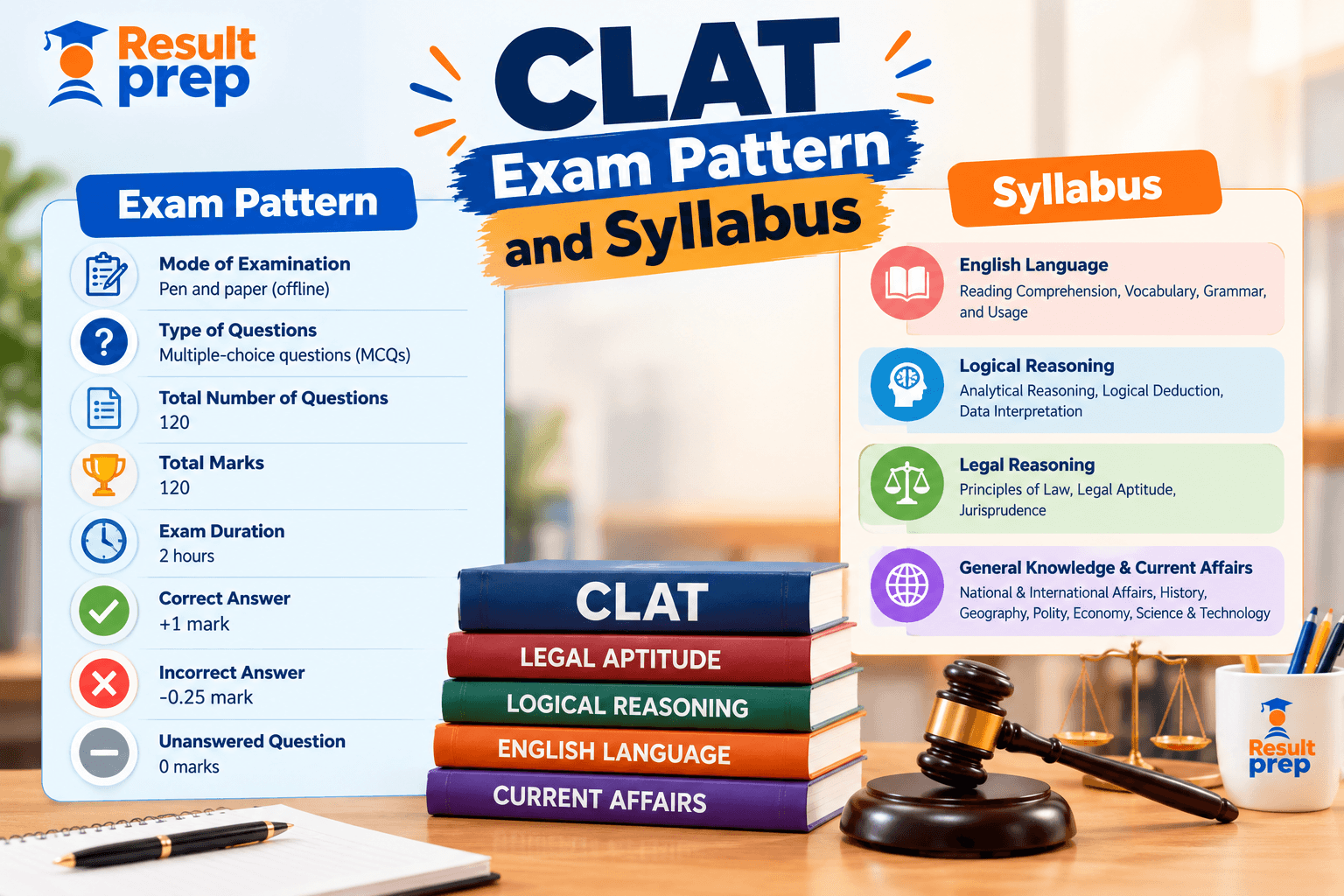
Everything Students Should Know About the CLAT Exam Pattern and Syllabus
The complete guide to the CLAT 2027 exam pattern and syllabus: 120-question passage format, 5 sectional syllabi, marking scheme, offline OMR logistics, and preparation roadmaps.

CLAT - Criteria for Eligibility: Age Range, Criteria, and Prerequisites
A complete guide to CLAT 2027 eligibility: Minimum marks in Class 12, no age limit rules, stream flexibility, reservation categories, and CLAT UG vs. PG comparison.

How to Apply for CLAT: A Step-By-Step Guide For Law Aspirants
A complete walkthrough of the CLAT application process: Step-by-step registration on the Consortium portal, document specifications, fee payment, common pitfalls, and post-submission steps.